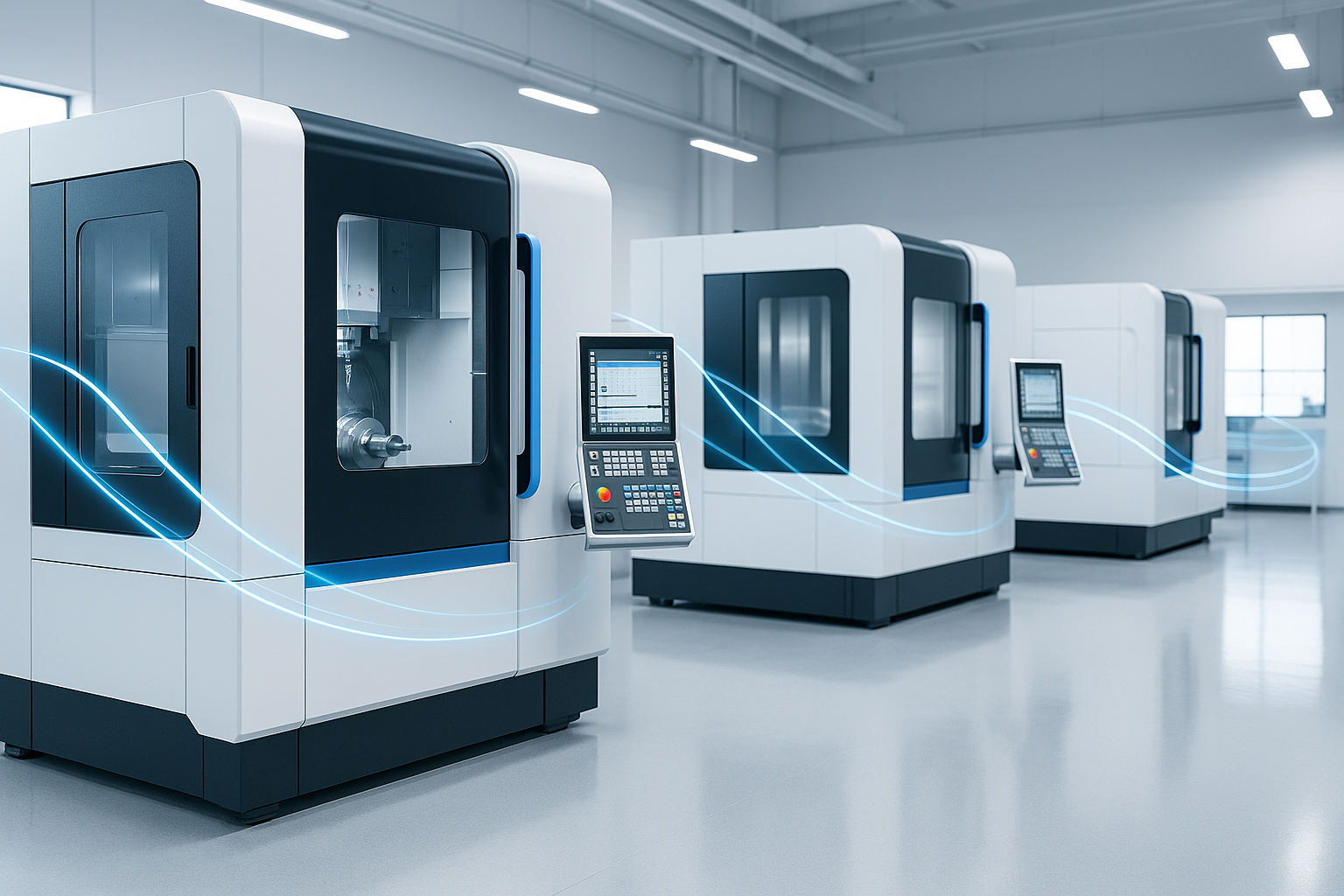
Europe smart factory shift 2026 is accelerating faster than expected and will reshape CNC machining, sheet metal, welding, logistics and inspection. The Europe smart factory shift 2026 movement is driven by skills shortages, rising energy costs, customer pressure for shorter lead times and the rapid arrival of reliable industrial AI. Factories want measurable improvements, not long digital transformation programs, and 2026 is the first year where these AI systems become practical for daily use. The forces driving this shift are clear:
- skilled labour shortages
- rising energy costs
- higher customer pressure for fast delivery
- demand for traceability
- the arrival of reliable industrial AI
Factories are no longer asking whether AI should be used. They are asking which AI systems deliver measurable financial outcomes and how quickly they can be deployed without full digital transformation projects.
This article explains the core AI systems that European factories are expected to adopt in 2026, why these systems matter, and which companies are currently leading.
Predictive maintenance becomes the default intelligence layer
Predictive maintenance is no longer a premium feature. In 2026 it becomes the foundation of smart factory operations. Instead of waiting for failures or relying on scheduled checks, systems will predict:
- spindle wear
- energy anomalies
- laser drift
- thermal variation
- lubrication issues
- part tolerance drift
Leading suppliers include:
- Siemens with Industrial Edge and its Industrial Copilot
- DMG MORI with vibration and torque based modelling
- Renishaw with in process probing intelligence
This shift will reduce unplanned downtime significantly, especially in shops with mixed fleets.
Autonomous material handling becomes a critical bottleneck solver
By 2026, more European factories will discover that their main bottleneck is not cutting speed or machine throughput. The real bottleneck is material movement.
AI supported handling solves:
- part sorting
- sheet loading
- unloading
- pallet movement
- kit building
- job sequencing
- buffer optimisation
Companies such as Bystronic, TRUMPF, AMADA, and KUKA are building AI models that map the most efficient path for every part.
The value
Autonomous handling eliminates silent time losses between operations.
This is one of the biggest ROI areas for 2026.
Read more on this topic in these articles – https://www.bystronic.com/aut/en/la/laser-automation and https://machinetoolnews.ai/vision-assisted-cnc-loading-cells-2025/
Real time optimisation AI becomes part of daily machining
Real time optimisation allows machines to analyse live cutting conditions and adjust parameters during the job. Instead of fixed feeds and speeds, the machine adapts continuously to:
- material hardness
- heat build up
- tool wear
- chip load
- vibration patterns
This improves:
- surface quality
- tool life
- cycle times
- consistency
Leaders include:
- Hexagon
- Mazak
- DMG MORI
- Siemens (through adaptive setpoint control)
AI driven scheduling and production planning arrive mainstream
Production planning is one of the costliest inefficiencies in European manufacturing. Schedulers often rely on spreadsheets, tribal knowledge, and manual adjustments. In 2026, AI will:
- predict delivery bottlenecks
- assign optimal machine routing
- adjust job order based on tool availability
- match operators to job complexity
- recalculate schedules after disruptions
This improves lead times and stabilises customer delivery performance.
Read more what is happening in Dutch factories here.
Computer vision and automated inspection become essential
Automated inspection is becoming central to Europe’s smart factory movement. Vision systems powered by AI will detect:
- burrs
- surface marks
- weld defects
- dimensional drift
- tool marks
- material inconsistencies
Companies leading this shift:
- Cognex
- Sick
- DeepInspect
- Renishaw (in process metrology)
The biggest benefit is that inspections move from final checks to continuous in process validation, reducing scrap and eliminating rework.
Tool wear prediction becomes standard across CNC operations
Tool wear is one of the highest hidden costs. In 2026, factories will adopt AI systems that predict tool breakage before it occurs.
This improves:
- tool life consistency
- part accuracy
- setup planning
- scrap reduction
- operator confidence
Leaders include Siemens, Sandvik Coromant, DMG MORI and Renishaw.
Why Europe smart factory shift 2026 matters
A. It improves resilience
Factories can handle more variation, workforce shortages, and sudden changes.
B. It lowers operating costs
Energy, tooling, scrap and labour hours all become more predictable.
C. It improves customer trust
More stable lead times and higher quality drive stronger contracts.
D. It aligns with the next exhibition cycle
EMO 2027 and EuroBLECH 2026 will showcase the first large scale AI native machines.
Key takeaways from Europe smart factory shift 2026
- AI driven predictive maintenance becomes a foundation
- Autonomous material handling removes bottlenecks
- Real time machining optimisation becomes standard
- AI scheduling tools gain mainstream adoption
- Automated inspection reduces scrap and rework
- Tool wear prediction brings measurable ROI
- 2026 begins the transition to fully intelligent factory ecosystems