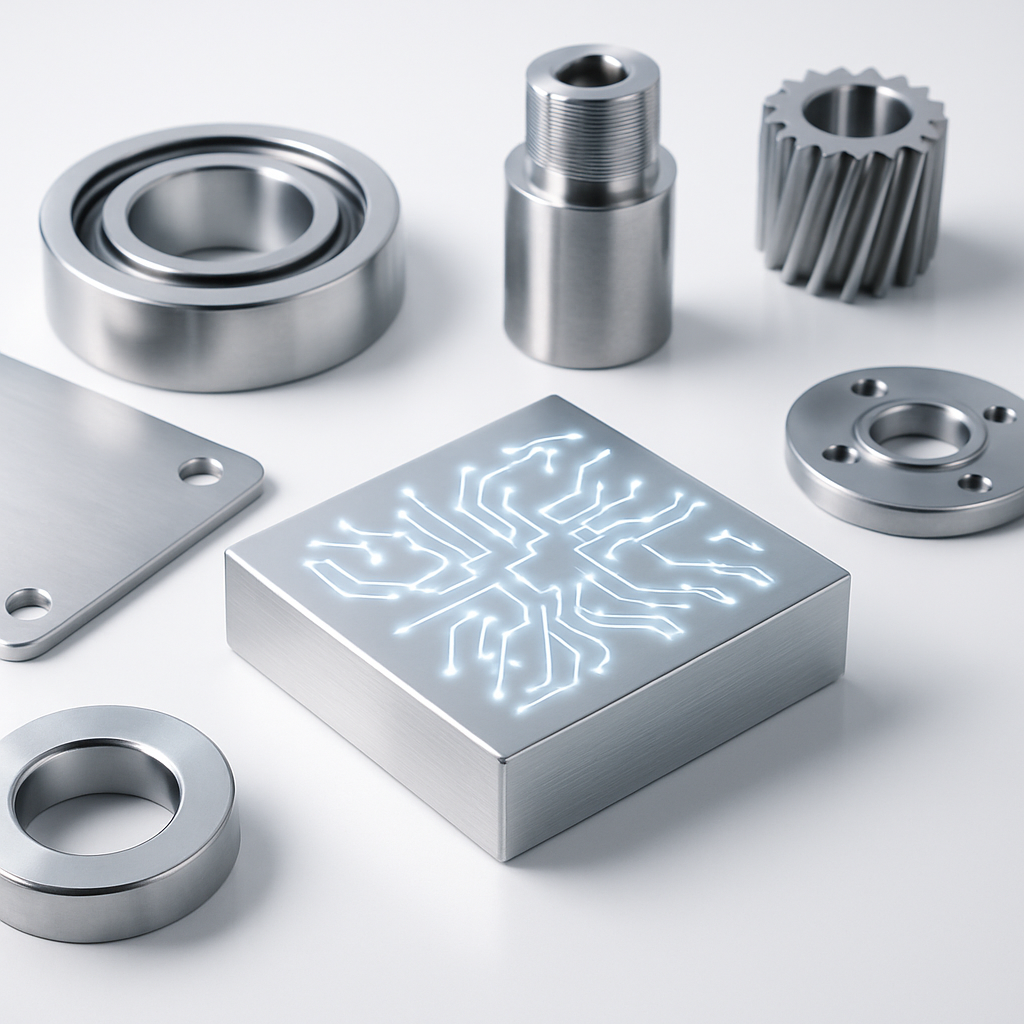
AI in metal manufacturing continued to accelerate this week, with major moves across steelmaking, sheet metal production, robotics, and global industrial policy. Manufacturers across CNC, sheet metal, and fabrication sectors can track these developments within our categories for AI in CNC, AI in Sheet Metal, and Robotics. AI in metal manufacturing continued to expand across sustainability, automation, and robotics, setting a strong pace for the industry moving into 2026.
How AI in Metal Manufacturing Cut Emissions at a UK Steel Plan
A key story came from the UK, where Deep.Meta confirmed that its physics-informed AI system helped Spartan UK’s steel plant reduce emissions by nearly ten percent. The company detailed the results in an interview with AZoM, where they explained how machine learning stabilised furnace performance and reduced resource waste.
These developments show how AI in metal manufacturing is evolving from pilot projects into standard practice for modern factories.
RMFG Raises 4.5 Million Dollars for AI-Driven Sheet Metal Factories
On 3 December, AI-powered manufacturer RMFG secured a 4.5 million dollar pre-seed round to expand its autonomous sheet metal production system. Business Insider published the pitch deck, showing how the company uses AI agents to automate quoting, design adjustments, production workflows, and in-line quality control.
RMFG reports lead times dropping from months to weeks, with AI-enabled QA reducing rework rates. This model is highly relevant for companies operating in areas like robotics and custom machinery, which we frequently explore in our coverage of AI in Sheet Metal.
China Pushes AI+ Industrial Modernisation for Heavy Manufacturing
A major policy shift emerged on 1 December, when Chinese officials announced a strengthening of the national AI+ industrial transformation initiative. The update, which appeared on Metal.com, confirmed that the government plans to scale AI technologies across traditional sectors including metals, machining, and heavy engineering.
This shift will influence global competitive pressure, especially for European and US machine tool builders advancing their own AI strategies. Readers can follow our ongoing coverage within the AI in CNC hub.
Factories Report Real Productivity Gains from Robotics and Digital Twins
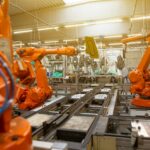
New reporting from Assembly Magazine highlighted that a Tennessee manufacturing plant achieved a seventeen percent rise in productivity and a thirty percent improvement in energy efficiency after deploying AI-powered robotics and digital twin simulations.
Supporting research from ResearchGate shows the same trend, with AI-enhanced robotics delivering better accuracy, faster cycle times, and predictive maintenance gains.
These results strengthen the case for real-world AI adoption across machining, fabrication, welding, and sheet metal – the core sectors we analyse across MTN.
What This Means for Metal Manufacturers
Sustainability becomes a measurable KPI
With Deep.Meta demonstrating a tangible emissions reduction, AI gives manufacturers a route to both cost improvements and environmental compliance.
AI-driven fabrication changes the supply chain
RMFG’s model allows robotics startups, machinery builders, and smaller OEMs to bypass traditional subcontracting with faster, AI-coordinated production.
Global policy will accelerate AI adoption
Government pressure, financial incentives, and industrial modernisation programs will push AI deeper into production lines worldwide.
Factories with robotics and digital twins are outperforming rivals
The Tennessee benchmarks show that manufacturers adopting integrated AI systems achieve better throughput, uptime, and energy savings.
For manufacturers evaluating investment decisions, AI in metal manufacturing now offers measurable gains across energy, throughput, and product quality.
The developments reported this week show that AI in metal manufacturing is moving into a stage where practical action delivers measurable results. Companies that want to prepare for 2026 can start by identifying one process where AI can add immediate value. This could be energy monitoring, automated quality inspection, digital twin simulation, or machine performance prediction. Each of these areas already has examples of proven gains. When teams begin with a focused scope and a clear operational target, they see faster adoption and stronger internal support. These steps allow manufacturers to build a reliable foundation for wider AI transformation.