Edge AI vs Cloud AI for machine tools is becoming a decisive technology question for manufacturers in 2025. Many factories are trying to understand whether real time control at the edge or powerful analytics in the cloud delivers the better result for CNC machines, robotic welding cells, and sheet metal lines. The answer increasingly depends on latency, network reliability, data strategy, and how much predictive intelligence is needed across multiple machines or sites.
Many factory leaders now see Edge AI vs Cloud AI for machine tools as a key decision that shapes both real time control and long term optimisation.
Why Edge AI vs Cloud AI for machine tools matters in 2025?
- Edge AI means running AI inference (data processing, analytics, decision logic) right on-or near-the machine: on embedded controllers, industrial PCs, edge gateways or local servers. Read more here.
- Cloud AI means sending data from machines or sensors over the internet or private network to remote data centers, where powerful servers run analytics, store large datasets, run models, then send back insights or commands. Read more here.
In many cases today, factories don’t choose strictly one or the other: hybrid models – where edge handles real-time tasks, and cloud handles heavy analytics or long-term insights – are increasingly common.
Why Edge AI often wins for real-time machine tool control
Millisecond-level latency matters
For CNC machines, robotic welding, laser cutting, or quality-control cameras on a production line, decisions often must occur in real time. Even tiny delays can disrupt cycle times, cause defects, or lead to scrap. Edge AI processes data right where it is generated, eliminating the network round-trip. This enables shutdowns, adjustments or alerts within milliseconds.
In many CNC environments Edge AI vs Cloud AI for machine tools determines whether adjustments happen at the machine or through remote analytics.
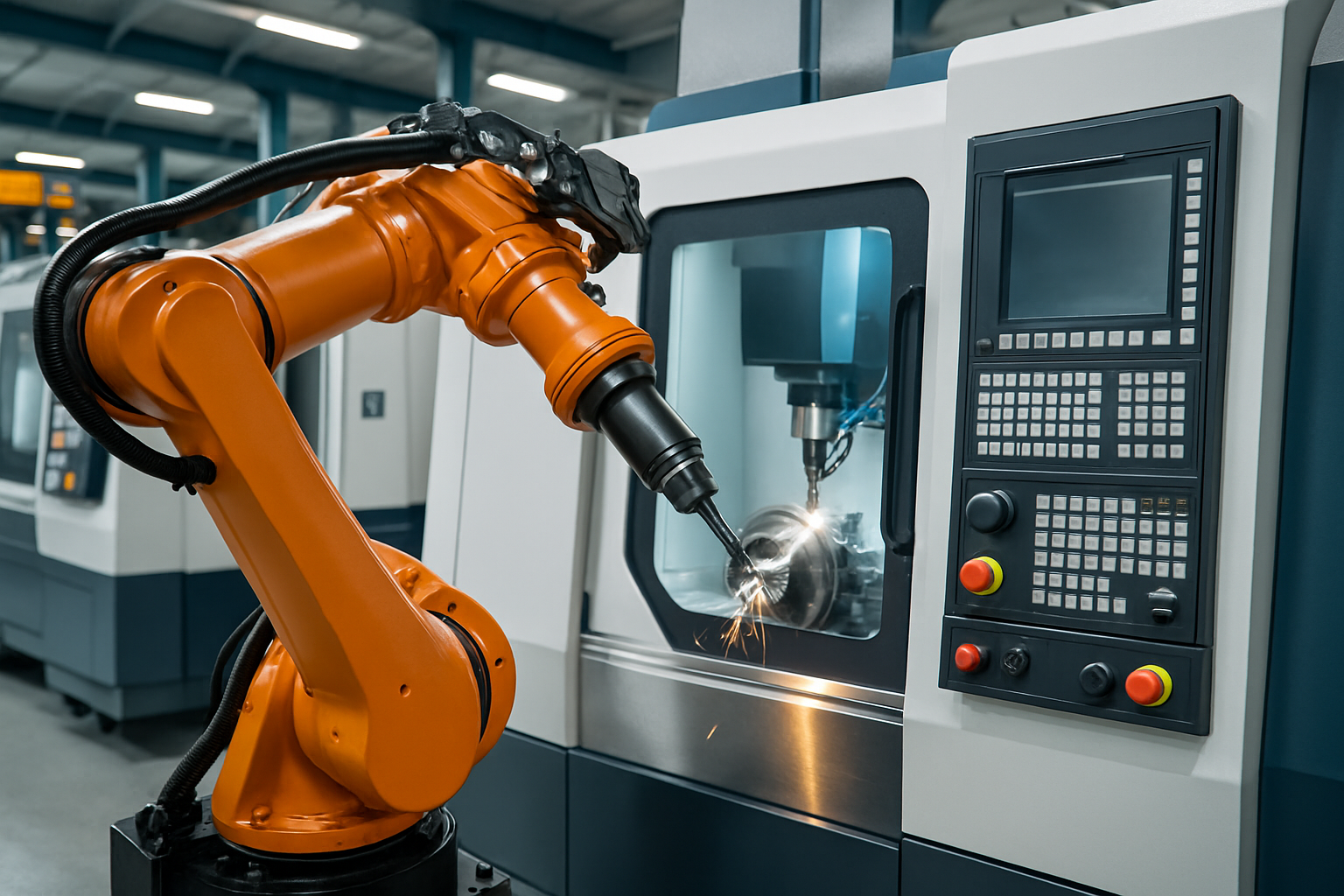
For example: integrating external sensors or vision systems into a CNC machine tool – with edge computing – allows the machine to react instantly to anomalies, vibrations, or tool wear without sending data off-site first.
Lower bandwidth and more reliable operation under limited connectivity
Industrial environments often produce large volumes of sensor data (vibrations, temperatures, images, throughput metrics). Constantly sending all raw data to the cloud would strain network bandwidth. Edge AI can pre-process or filter data locally, sending only aggregated or important data to the cloud. This reduces bandwidth usage and cost.
Edge solutions also give resilience when network connectivity is weak or intermittent – especially relevant for remote or older facilities.
Better privacy and data security for sensitive operations
Keeping data on-site helps companies avoid transmitting potentially sensitive production data over networks. That can reduce cyber-attack surface, and help meet regulatory or IP-protection requirements – especially relevant where processes are proprietary or need confidentiality.
Faster ROI for reactive use cases
For use cases like in-cycle anomaly detection, immediate tool corrections, or reactive quality inspection, edge AI can deliver savings from the first shift. The immediate return on reduced scrap, fewer stops, and better yield often outweighs the cost of upgrading controllers or edge hardware – especially in medium to large factories.
Why Cloud AI remains strong, especially for analytics, optimization and scaling
Scalability and computational power
Cloud infrastructures provide high-level computing power and virtually unlimited storage. This allows for large-scale data aggregation, training heavy AI/ML models, long-term historical analytics, cross-machine comparisons, predictive maintenance over many machines, and trend detection over months or years.
For a network of factories, cloud AI becomes indispensable when you need to compare performance across sites, do fleet-level analytics, or handle big data from many machine tools operating simultaneously.
Lower upfront hardware investment
Using cloud AI often means less local hardware investment: fewer industrial PCs, edge gateways or sensor controllers. For factories that want to avoid capital expenditure or prefer operational expenditure (subscription-based cloud services), it’s more flexible.
Easier updates, model version control and centralised management
With cloud AI, model training, updates, monitoring, logging, and security patches can be managed centrally. This simplifies maintenance, ensures version control, and supports distributed teams – especially in organisations with multiple plants or remote operations.
Ideal for long-term analytics, quality trends, predictive maintenance and cross-machine learning
For tasks that benefit from aggregated data – such as predictive maintenance, lifetime analysis, trend forecasting, supply-demand alignment, energy usage optimization – cloud AI offers the scope and power to deliver real value. It can use data from many machines over long periods, spot patterns that single-machine edge systems cannot.
The winning strategy in 2025: Hybrid – choose per use case
In 2025, many experts and industry adopters no longer see Edge AI and Cloud AI as rivals but as complementary tools.
For modern machine-tool environments, the hybrid approach is often the best:
- Edge AI: handle real-time control, machine-level safety, on-the-spot quality checks, vibration/wear detection, emergency stop triggers, and other latency-sensitive tasks.
- Cloud AI: manage model training, historical data analysis, fleet-wide predictive maintenance, energy and resource optimization, cross-site benchmarking, and long-term process improvements.
Many industrial solutions now ship pre-trained models to edge controllers, with cloud back-end for retraining and analytics. This “train in cloud – run on edge” pattern maximizes responsiveness and scalability.
What it means for machine tool producers and users in 2025
- If your shop floor requires millisecond-precision, minimal downtime, and real-time reaction (CNC with variable load, robotic welding, in-cycle inspection), prioritise Edge AI.
- If you manage multiple machines, want to analyze performance over time, predictive maintenance or fleet-level analytics, or expect to scale rapidly – invest in Cloud AI with strong data infrastructure.
- For most factories, a hybrid architecture will deliver the best ROI and future-proofing. Edge for fast decisions; cloud for long-term intelligence and continuous improvement.
- Legacy machine tools or older factories can retrofit sensors + local edge gateways – which is often more cost-effective than a full cloud-centric transformation, while still reaping benefits in reliability and downtime reduction. This path supports incremental upgrading rather than risky full renovation.
Risks and challenges
- Edge AI requires deploying capable hardware on-site (edge servers/ gateways, GPUs or accelerators), which adds capital expenditure. Managing updates across many edge devices can be burdensome.
- Cloud AI depends on stable network connectivity. In areas with unreliable internet, latency or downtime can undermine benefits.
- Data governance, security, and compliance: sending data to cloud may raise concerns about IP, compliance or privacy. Edge helps but requires onsite cybersecurity management.
- Hybrid complexity: combining edge and cloud increases architectural complexity. Proper design, IT/OT integration, and maintenance discipline are required.
Conclusion: No clear “winner” – it depends on your factory
In 2025, there is no universal winner between Edge AI and Cloud AI for machine tools. The real “win” comes from choosing the right tool for the right task.
Latent tasks requiring lightning-fast response and minimal latency? Edge AI wins. Strategic analytics across sites over months and years? Cloud AI wins. For most modern factories aiming at long term competitiveness, a hybrid approach combining both offers the ideal balance.
Looking ahead to 2025, the most effective approach to Edge AI vs Cloud AI for machine tools is likely to be a practical hybrid that uses edge for speed and cloud for intelligence.
The wider industrial landscape shows that this topic is part of a much bigger transformation happening across AI in metal manufacturing as factories rethink automation strategies for 2025 and 2026.
If you plan carefully – mapping use-cases, evaluating latency, connectivity, hardware cost, and long-term data strategy – hybrid Edge-Cloud AI can unlock better uptime, higher precision, predictive maintenance, and real-time quality control, without massive risk.
FAQ
Why is Edge AI vs Cloud AI for machine tools important for 2025
It influences both real time control and long term analytics across CNC and metal manufacturing.
Which tasks does Edge AI vs Cloud AI for machine tools handle best
Edge is best for real time control, anomaly detection, and fast reaction. Cloud is best for large scale analytics, predictive maintenance, and long term optimisation.
Can Edge AI vs Cloud AI for machine tools work together
Yes. Most factories in 2025 prefer a hybrid setup where edge handles immediate actions and cloud manages deeper analytics and model training.
What benefit does Edge AI vs Cloud AI for machine tools offer small and mid size manufacturers
It lets them modernise operations without replacing every machine. Edge retrofits support immediate performance gains while cloud scales gradually.