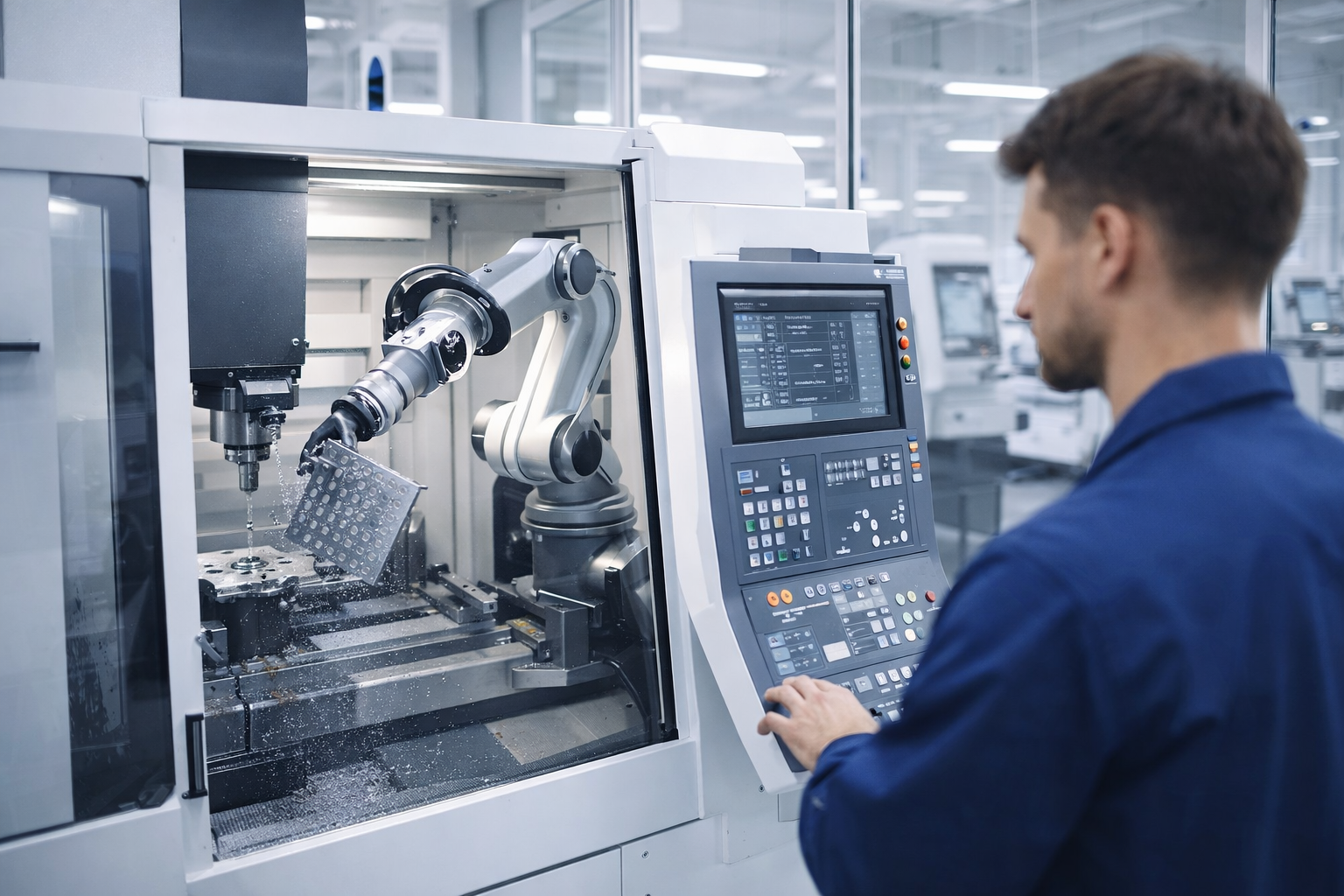
AI in Dutch manufacturing is advancing faster than in many other European countries, not because Dutch factories have access to better technology, but because they approach execution differently. The Netherlands does not have the largest industrial base in Europe, yet Dutch manufacturers consistently move more quickly from AI pilots to real production use than many of their peers.
This mirrors a broader pattern we have highlighted across Europe in AI adoption in machine tools, where speed of execution matters far more than ambition or budget size.
AI in Dutch manufacturing benefits from a pragmatic mindset
Dutch manufacturers tend to frame AI as a productivity tool rather than a long-term transformation programme. Projects are scoped narrowly, deployed quickly, and judged on measurable results.
Instead of multi-year roadmaps, factories focus on practical improvements such as cycle-time reduction, scrap reduction, and programming efficiency. This pragmatism reduces internal friction and allows AI to reach the shop floor faster.
A similar execution-first mindset can be seen in factories leading adoption in AI in German manufacturing, where AI is already separating leaders from laggards.
SME structure enables faster AI decision making
One of the strongest accelerators of AI in Dutch manufacturing is the structure of the manufacturing sector itself. The Netherlands has a high concentration of small and mid-sized manufacturers with flat management hierarchies.
Decision makers are often close to production, allowing AI investments to be approved and deployed without lengthy internal alignment. This avoids the delays common in larger organisations where AI projects must pass through multiple layers of approval.
As a result, Dutch SMEs frequently deploy AI in focused areas such as CNC programming support, quality inspection, and production scheduling rather than attempting large-scale transformation.
Digital readiness accelerates AI in Dutch manufacturing
Dutch manufacturers invested early in digital connectivity. Machine data collection, MES integration, and production monitoring are already in place in many factories. This significantly reduces the integration barriers that slow AI projects elsewhere.
Research from organisations such as Plattform Industrie 4.0 consistently shows that data interoperability is one of the biggest blockers to scalable industrial AI. Dutch factories that addressed this earlier now move faster.
Clean, accessible data allows AI to be applied directly to real production problems rather than spending months preparing infrastructure.
Workforce mindset supports AI adoption
Another reason AI in Dutch manufacturing advances faster is how it is positioned to the workforce. AI is generally introduced as a support tool, not a replacement technology.
Common applications include AI-assisted CAM programming, operator guidance systems, and vision-based quality inspection. These tools reduce cognitive load and repetitive work rather than increasing complexity.
This approach closely aligns with what we are seeing in AI in CNC machining, where AI improves productivity without requiring entirely new skill sets.
According to applied research from institutions such as the Fraunhofer Institute, workforce acceptance plays a decisive role in whether AI scales beyond pilot projects.
ROI discipline speeds up AI deployment
Dutch manufacturers typically expect AI projects to demonstrate value quickly. If a use case does not deliver measurable improvement within a defined timeframe, it is adjusted or stopped.
This discipline forces better project selection. AI is applied where it can clearly improve throughput, quality, or planning accuracy. Long-term strategy exists, but it is built on short-term operational wins.
This explains why AI deployments often scale faster after the first successful project, especially in areas such as AI in sheet metal automation where integration complexity is lower and payback is faster.
Why Dutch manufacturers are pulling ahead
The Dutch approach shows that faster AI adoption does not require radical restructuring or massive budgets. It requires:
- Clear ownership of AI projects
- Strong data foundations
- Workforce inclusion from the start
- Tight focus on ROI
- Willingness to start small and scale
Market analysis from firms such as McKinsey suggests that early AI adopters in manufacturing are already compounding productivity advantages over time.
Manufacturers that continue to treat AI as a strategic concept rather than an operational tool will struggle to keep pace.
Key takeaway
AI in Dutch manufacturing is advancing faster than in much of Europe because factories prioritise execution over ambition. They deploy AI where it solves real problems, involve the workforce early, and demand measurable outcomes.
As AI becomes a competitive necessity rather than an experiment, the Dutch model offers a realistic blueprint for how industrial AI can be scaled across Europe.
FAQ: AI in Dutch Manufacturing
Why is AI in Dutch manufacturing advancing faster than in Europe?
AI in Dutch manufacturing is advancing faster because factories prioritise execution, focus on small scalable projects, and deploy AI where it delivers quick operational value.
Is AI in Dutch manufacturing driven mainly by SMEs?
Yes. SMEs play a major role in AI in Dutch manufacturing, as flatter structures and faster decision making allow quicker deployment and iteration.
Which AI applications are most common in Dutch factories?
Common applications of AI in Dutch manufacturing include CAM programming support, quality inspection, scheduling optimisation, and energy monitoring.
Does AI in Dutch manufacturing face the same skills challenges as elsewhere in Europe?
Skills challenges exist, but AI in Dutch manufacturing is often designed to support existing operators and engineers rather than require entirely new roles.
Will other European manufacturers follow the Dutch model?
As AI adoption accelerates, many European manufacturers are likely to adopt elements of the Dutch approach focused on pragmatism and ROI.