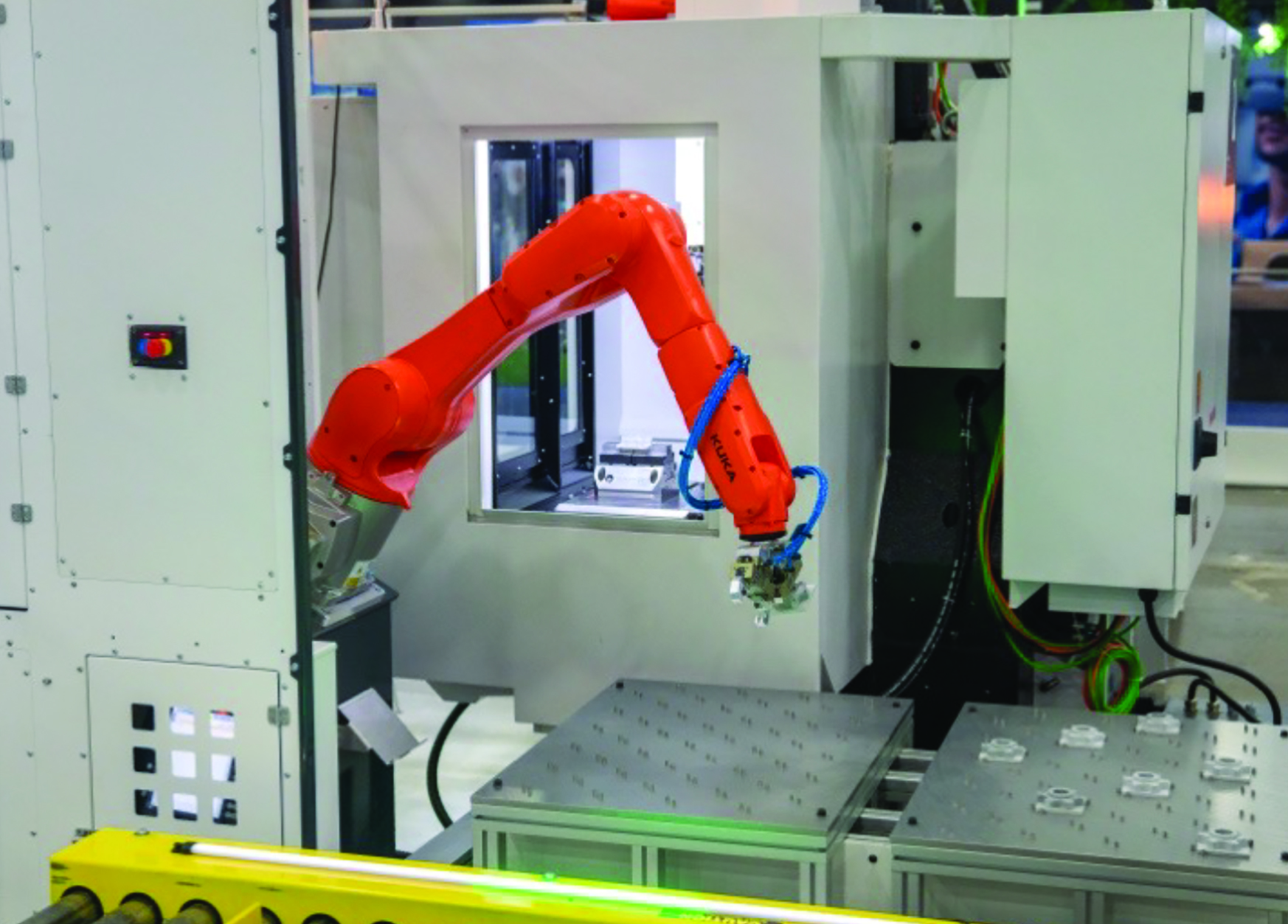
AI machine tool automation is becoming accessible to small and mid-sized job shops through a new integration between Siemens SINUMERIK CNC, KUKA robotics and SYIL machine tools.
Siemens has expanded its SINUMERIK Run MyRobot platform, enabling KUKA robot part handling and articulation functions to be operated directly from the CNC control screen of SYIL machine tools. This allows robot motion, diagnostics and handling routines to be managed within the same interface used for machining operations. AI machine tool automation is increasingly being used to connect CNC control, robotics and part handling into a single operating environment.
AI machine tool automation through partnership in the machine shop
This development is based on a technology partnership between Siemens, KUKA and SYIL, aimed at machine shops that manage multiple part families and short production runs. The system combines a digital twin of the SINUMERIK 828 CNC with integrated robot control to simplify part handling programming for machine tool operators.
The concept was demonstrated at a recent trade show, where KUKA Robotics Corporation showed a robot working alongside a SYIL vertical milling machine. The installation used the SYIL R1 machine-tending automation package, developed with KUKA system partner Waybo. The package integrates pick-and-place, part articulation and CNC communication directly within the control environment.
According to Frans Buikema, Chief Marketing Officer at SYIL, the objective is to give small and mid-sized shops an entry point into automation without major capital investment. Ron Bergamin, Key Technology Manager for Machine Tool Automation at KUKA, adds that the system can support lights-out second or third shifts, potentially shortening return on investment.
For many job shops, AI machine tool automation reduces the need for specialist robot programming and complex external integration.
Simplifying robotics through the CNC
Historically, robot integration in machine tools required specialist programming, separate robot pendants and external system integration. These requirements limited adoption, particularly among smaller shops. Industry data shows that fewer than a quarter of small job shops in the United States currently use robotics in daily production.
Tiansu Jing, Product Manager for SINUMERIK CNC systems at Siemens, explains that this approach removes much of that complexity. Setup, programming, operator interface and diagnostics are all handled through the SINUMERIK Operate HMI. The SINUMERIK Run MyRobot/Handling application connects directly to the KUKA robot controller, allowing teach-in and operation to be carried out within the CNC.
Robot control is displayed on the same screen as the machine tool, eliminating the need for a separate pendant. This reduces training requirements and allows the same operating logic to be used across multiple machines. This approach to AI machine tool automation keeps robot setup, teach-in and diagnostics inside the CNC interface.
From complexity to clarity
The SINUMERIK 828D CNC is designed for turning centres, milling machines and vertical machining centres commonly used in job shops. With Run MyRobot/Handling enabled, programmers can use the same G-code structure for both the robot and the machine tool.
Robot programming, operation and diagnostics are executed from the CNC HMI, providing a unified interface for both machining and handling tasks.
Designed for job shops and affordable lights-out manufacturing
KUKA’s PLC mxAutomation interface allows robot functions to be programmed and controlled directly within the CNC environment using a PLCopen-certified interface. This enables machine builders to offer robotic automation with reduced engineering effort.
Jing notes that the simplified integration allows robotic packages to be offered at lower cost than traditional solutions. Installation uses Ethernet and safety cabling, and Bergamin states that systems can often be operational within a single day.
With the addition of lights-out shifts, machine utilisation can be increased without additional operators, improving spindle uptime and supporting faster payback.
Philip Peloso, Business Development Manager for Machine Tool Automation at KUKA, explains that the system was developed to address skills shortages and price sensitivity in smaller machine shops. Working with Waybo, KUKA created an entry-level solution for the 75 percent of job shops that currently operate without robotic automation.
A new benchmark for machine tool builders
Siemens introduced the robotic integration concept to KUKA, which worked with Waybo to develop the system adopted by SYIL as the R1 automation package.
From the machine builder perspective, SYIL describes the development as aligned with its focus on small and mid-sized manufacturers facing labour shortages and limited automation experience.
Wesley Wang, Managing Director of SYIL North America, highlights the company’s use of SINUMERIK 828D CNC across its product range, citing motion control, monitoring and communications capability alongside built-in support for machine-tending robotics.
Real results on the shopfloor
SYIL states that automation packages priced at around $60,000 can achieve payback within approximately one year, depending on operating conditions. The system enables shops to extend production capacity without increasing headcount while maintaining consistent part quality.
Expanding the vision
SYIL builds CNC milling machines, turning centres and Swiss-type lathes and plans to extend robotic automation across its full product range using the SINUMERIK Run MyRobot/Handling platform.
Buikema describes the integration as a major step toward making automation accessible to small and mid-sized shops. The same technology has been demonstrated jointly by Siemens and KUKA at industry trade shows and is now available as a standard SYIL offering.
SYIL describes its relationship with Siemens as having evolved into a strategic engineering partnership, supporting both machine development and market expansion in North America. Siemens also provides dealer and software support across the United States, Canada and Mexico.
Technical overview of the SYIL R1 automation package
The SYIL R1 system is designed for part handling up to 3 kg, with a robot payload of 6.7 kg and a reach of 901 mm. It carries an IP65/67 rating for industrial environments and automates loading and unloading of metal parts from the cutting zone.
The system supports high-mix, low-volume production and can be integrated with conveyors, bins and pallet systems. Standard equipment includes a pneumatic clamping force block, with an optional dual gripper for parts with different blank and finished geometries. The Siemens, KUKA and SYIL collaboration shows how AI machine tool automation can move from complex projects to standard machine options.
Robot and machine programs are stored within the CNC and accessed through the SINUMERIK Operate interface. Robot teach-in, diagnostics and motion control are executed directly from the SINUMERIK Run MyRobot/Handling application.
SYIL reports that installation can be completed in less than one day, with the system expandable through additional pallet drawers and custom automation options.
MTN Analysis
From a MachineToolNews.ai perspective, this integration reflects a broader trend in machine tool automation toward embedding robotics directly into the CNC environment rather than treating robots as external systems. By allowing robot motion and diagnostics to be managed inside the CNC interface, Siemens and KUKA are reducing one of the main barriers to adoption for smaller manufacturers: operational complexity.
The positioning of the SYIL R1 package also highlights a shift in automation economics. Rather than targeting high-volume automotive or aerospace lines, this solution is designed around high-mix job shop workflows where changeovers and operator usability matter more than raw throughput. This development fits into the broader move toward AI machine tool automation, already visible across European CNC builders adopting robotics and intelligent control systems.
For machine tool builders, the model demonstrates how robotics can be offered as a standardised option rather than a bespoke integration project. For job shops, it shows how AI-enabled CNC platforms are beginning to act as coordination hubs for both machining and handling, laying the groundwork for more autonomous production cells in the future.



2 Comments
hey there and thank you for your information – I have certainly picked up anything new from right
here. I did however expertise several technical points using this web site, since I
experienced to reload the web site lots of times previous to I could get it to
load properly. I had been wondering if your web host is OK?
Not that I’m complaining, but sluggish loading instances times will very frequently
affect your placement in google and could damage your quality score if ads and marketing with Adwords.
Well I’m adding this RSS to my email and could look out for much more
of your respective exciting content. Make sure you update this
again soon.