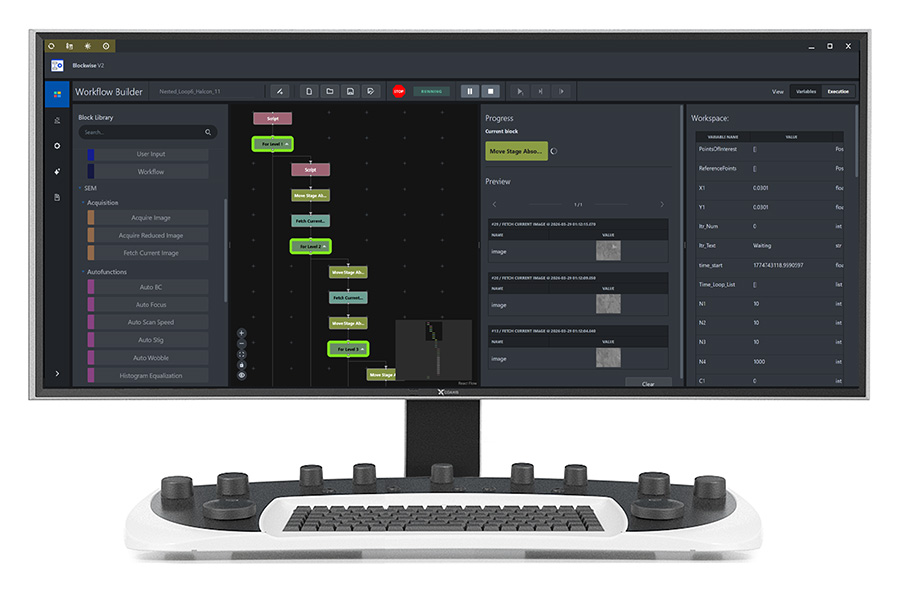
MVTec ZEISS AI inspection is moving into a new phase after MVTec Software and ZEISS announced a strategic collaboration around automated microscopy and machine vision.
The partnership sees MVTec HALCON machine vision software integrated as the image processing foundation for ZEISS Blockwise automated microscopy platform, the new ZEISS software platform for automated microscopy. ZEISS Blockwise was released on April 30, 2026, and is designed to simplify complex measurement, inspection and analysis tasks in electron microscopy.
For manufacturers working in high precision sectors such as semiconductors, microelectronics, battery production, electronics and advanced quality control, the announcement matters because it brings together ZEISS microscopy workflows with MVTec’s established machine vision software.
Why MVTec ZEISS AI Inspection Matters
The MVTec ZEISS AI inspection collaboration is important because industrial inspection is becoming more automated, more software-led and more dependent on intelligent image processing.
In semiconductor and microelectronics production, manufacturers need stable processes, high precision and the ability to process large volumes of data reliably. The release highlights these as key requirements for Blockwise users, especially in semiconductor environments.
By using HALCON as the image processing foundation, ZEISS is building Blockwise around a machine vision platform that supports both rule-based image processing and deep learning methods.
HALCON Becomes the Image Processing Foundation for ZEISS Blockwise
The central point of the collaboration is that MVTec HALCON will form the foundation for image processing within ZEISS Blockwise.
That means Blockwise users can benefit from HALCON’s machine vision capabilities when building automated microscopy workflows. These workflows can support measurement, analysis and inspection tasks that would otherwise require more manual intervention.
MVTec said HALCON is particularly suited to these environments because it combines a broad methodological range with industrial maturity. The software can support both rule-based approaches and deep learning methods within a single environment.
ZEISS Blockwise Targets Complex Measurement and Analysis Tasks
ZEISS Blockwise has been designed as a toolbox for automated microscopy. Its role is to simplify complex measurement and analysis tasks in electron microscopy.
A key strength of Blockwise is that image acquisition can be integrated directly into the microscope workflow. According to the release, this allows Blockwise to define the next steps based on captured data.
That is important for industrial users because inspection becomes part of the workflow itself. The system can move from image capture to image processing and follow-up action in a more connected way.
For production environments where repeatability and speed matter, this kind of workflow automation can support more consistent inspection routines.
Rule-Based Vision and Deep Learning in One Environment
One of the reasons the collaboration is relevant to AI inspection is HALCON’s ability to combine traditional machine vision with deep learning.
Not every inspection task needs AI. Some applications are better handled by rule-based machine vision, especially where the inspection criteria are stable and clearly defined. Other tasks, such as defect detection, classification or visual variation analysis, may benefit from deep learning.
HALCON includes more than 2,100 operators and combines rule-based methods with deep learning-based approaches. This means users can build inspection workflows around the method that best fits the task, rather than being forced into a single approach.
The wider development of HALCON 26.05 machine vision features also shows how MVTec continues to develop its platform across classical and deep-learning-based machine vision workflows.
Why This Matters for Semiconductor and Microelectronics Inspection
The collaboration has a clear relevance for semiconductor and microelectronics manufacturers.
These sectors rely on highly precise, repeatable inspection workflows. They also generate large amounts of image and measurement data. As inspection demands grow, manufacturers need software platforms that can support complex analysis without adding unnecessary friction.
MVTec said HALCON has already proven itself in many applications in the semiconductor and microelectronics industries. Klaus Schrenker, Business Development Manager at MVTec, said the two software products are “an excellent match” because both are designed as comprehensive toolboxes.
What It Means for Wider Manufacturing
Although the direct application is automated microscopy, the wider message is relevant for the machine tool and metal manufacturing sectors.
Across AI in CNC machining, sheet metal production, welding, robotics and metrology, inspection is becoming more software-driven. Manufacturers are looking for ways to reduce manual variation, improve data quality and connect inspection more closely to production decisions.
The MVTec ZEISS AI inspection announcement reflects that wider movement. It shows how major technology suppliers are combining machine vision, workflow automation and AI-enabled analysis to support more autonomous inspection.
This also connects with the wider role of industrial AI software in manufacturing, where data, vision systems and automation platforms are becoming more closely connected.
MTN Analysis: Inspection Software Is Becoming Strategic
For MachineToolNews.ai readers, this story is about more than one software integration.
The bigger trend is the shift from standalone inspection tools toward integrated software platforms that connect image capture, image processing, analysis and workflow automation.
That is where the industrial value lies. Manufacturers do not only need better cameras or microscopes. They need systems that can turn captured data into repeatable inspection actions.
The MVTec and ZEISS collaboration suggests that machine vision is becoming a deeper part of the production intelligence stack. For high precision manufacturers, that could mean faster analysis, more consistent quality control and a stronger foundation for scalable AI inspection.
It also matters for companies exploring machine vision and robotics automation, where inspection, guidance and automated decision-making are increasingly linked.
Key Takeaways
- MVTec and ZEISS have announced a strategic collaboration.
- ZEISS is integrating MVTec HALCON into ZEISS Blockwise.
- HALCON will act as the image processing foundation for Blockwise.
- ZEISS Blockwise is designed for automated microscopy workflows.
- The platform supports complex measurement, inspection and analysis tasks.
- HALCON combines rule-based machine vision with deep learning methods.
- The collaboration is especially relevant to semiconductor and microelectronics inspection.
- The wider trend points toward more integrated AI inspection platforms across manufacturing.
FAQ
What is the MVTec and ZEISS collaboration?
MVTec and ZEISS have announced a strategic collaboration in which ZEISS is integrating MVTec HALCON as the image processing foundation for ZEISS Blockwise.
What is ZEISS Blockwise?
ZEISS Blockwise is a new ZEISS software platform for automated microscopy. It is designed to simplify complex measurement, inspection and analysis tasks in electron microscopy.
What role does MVTec HALCON play in ZEISS Blockwise?
MVTec HALCON provides the underlying image processing foundation for ZEISS Blockwise.
Why is this relevant to AI inspection?
The collaboration is relevant because HALCON combines rule-based image processing with deep learning methods, allowing users to develop flexible inspection workflows.
Which industries could benefit from the collaboration?
The release highlights semiconductor and microelectronics industries, where stable processes, high precision and reliable processing of large data volumes are especially important.
Does HALCON only use AI?
No. HALCON supports both rule-based machine vision and deep learning-based approaches. This allows users to choose the right method for each inspection task.
Is this relevant to metal manufacturers?
Yes. The direct application is automated microscopy, but the wider trend is relevant to metal manufacturers because inspection, metrology and quality control are becoming increasingly software-led and AI-enabled.
For more information visit: MVTech & Zeiss
Further Reading on MachineToolNews.ai
- MVTec HALCON 26.05 Launches May 20 with Faster AI and Machine Vision Performance
- MVTec Interview: Dr. Maximilian Lueckenhaus on HALCON, MERLIC, and the Next Phase of AI Machine Vision
- What Is Industrial AI and How Is It Used in Factories?
- Edge AI in Manufacturing 2026: Powerful Real-Time AI Explained
- GAV AI Guidance and Verification Product Review





One Comment