The Basque technology centre IDEKO will use its presence at BIEMH 2026 as a platform to demonstrate how robotics, digitalisation, computer vision and artificial intelligence are converging to transform aerospace production.
From 2–6 March at the Bilbao Exhibition Centre, the organisation will also mark its 40th anniversary, highlighting four decades of work developing advanced manufacturing technologies in close collaboration with industrial partners.
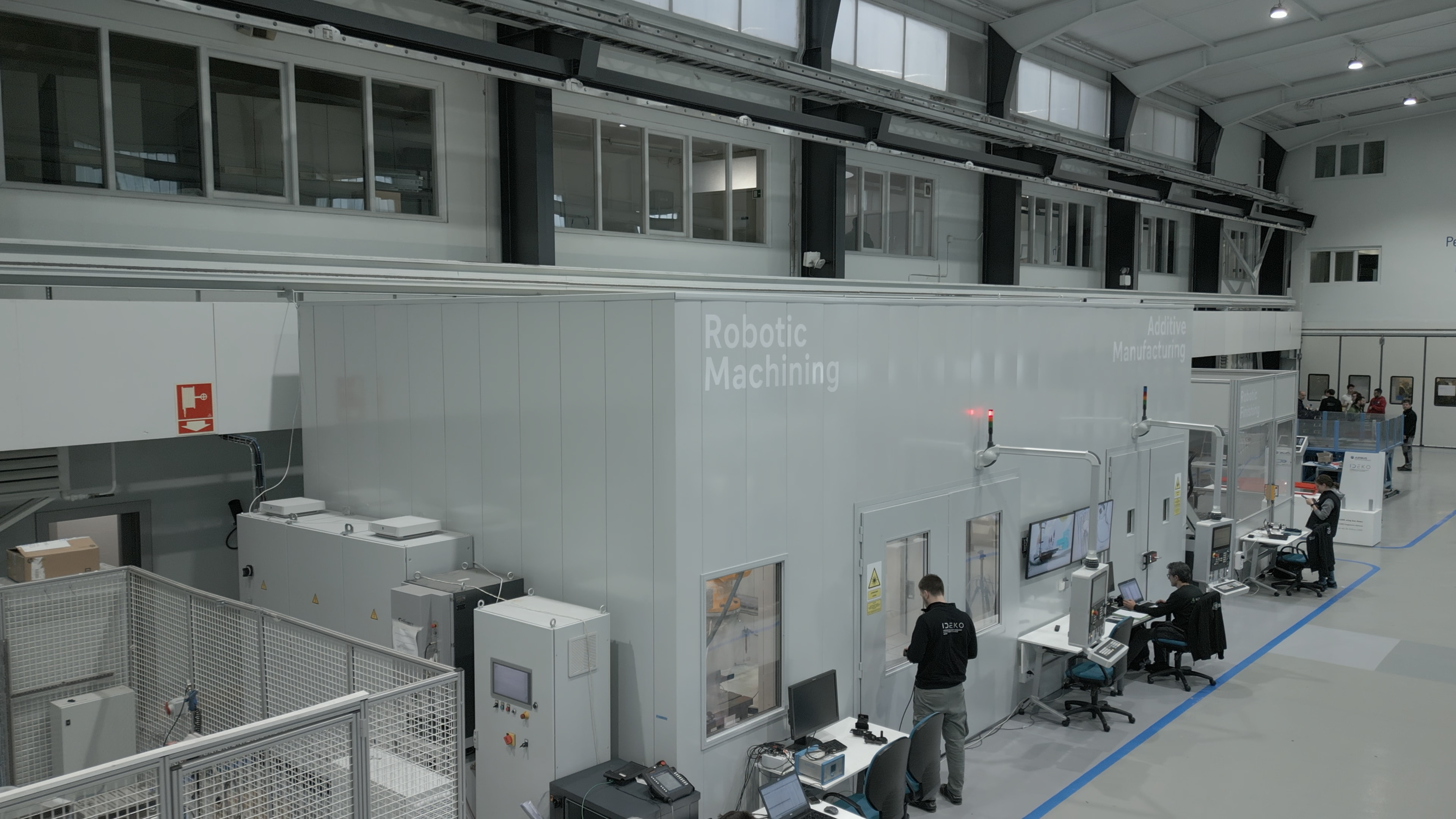
The aerospace sector has become one of IDEKO’s core strategic areas, with long-term partnerships across international manufacturers. At Stand E20, Hall 1, the centre will present solutions designed for real industrial deployment, combining precision machining, robotics and manufacturing digitalisation. This focus on AI aerospace machining at BIEMH 2026 reflects a broader shift toward intelligent, data-driven production cells across the aerospace supply chain.
According to Sales Director Harkaitz Urreta, the technologies on display have already been validated in production environments and are intended to solve concrete aerospace factory challenges, with potential applications in energy, automotive and rail sectors as well.
Precision robotics and AI-driven digital factories
IDEKO’s stand will centre on two aerospace component demonstrators: a structural part and an engine component.
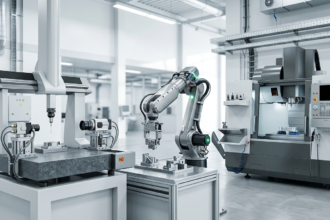
The structural component setup will feature a collaborative robot performing inspection tasks through 3D scanning. The system integrates vision technologies that track the robot end-effector across large workspaces and correct its position in real time, enabling more accurate and efficient machining operations.
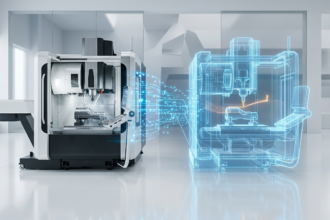
The engine component demonstrator focuses on the digitalisation of an aerospace production line. Here, quality control is embedded into the process through machine monitoring and condition analysis supported by artificial intelligence. The platform is designed for flexible, secure and scalable data management across complex production environments.
IDEKO reports that this approach can improve machine behaviour, availability and overall productivity while significantly reducing scrap and rejected parts.
Vision systems, vibration control and surface quality
Another demonstrator will present MULTISense, a solution combining several advanced vision technologies to detect defects in casting and machining operations.
The stand will also feature technologies for vibration mitigation during machining, including the DynAQ portable tool, which measures, diagnoses and resolves vibration issues to improve machine efficiency and reliability.
In addition, IDEKO will present solutions for detecting and mitigating microscopic surface marks in high-precision grinding and machining, as well as surface texturing techniques aimed at improving friction, wear and lubrication performance.
40 years of advanced manufacturing R&D
IDEKO’s anniversary at BIEMH highlights a long track record in advanced manufacturing research. The centre currently participates in more than 200 technological projects each year, has coordinated European projects for over 35 years, and holds 42 patents as of the end of 2025.
The organisation operates across four main research areas: Dynamics and Control, Manufacturing Processes, ICT and Automation, and Design and Precision Engineering.
MTN analysis: AI moves deeper into aerospace production
IDEKO’s BIEMH showcase reflects a broader trend across the aerospace supply chain, where AI is being embedded directly into production processes rather than treated as an external analytics layer.
The focus on robotic inspection, real-time vision correction and AI-based machine condition monitoring points to a shift toward fully digitalised production cells. In aerospace, where tolerances are tight and scrap costs are high, these systems can deliver measurable gains in uptime, yield and traceability. Similar developments can be seen across the wider AI in CNC sector.
What stands out is the integration of multiple technologies into a single environment. Robotics, machine monitoring, advanced vision and data platforms are being presented as one coordinated system rather than separate upgrades. That approach is becoming a defining pattern across high-value manufacturing sectors.
For machine tool builders and aerospace suppliers, this signals where investment is heading over the next few years: intelligent robotic cells, AI-driven quality control and digital production platforms designed to run continuously with minimal manual intervention.