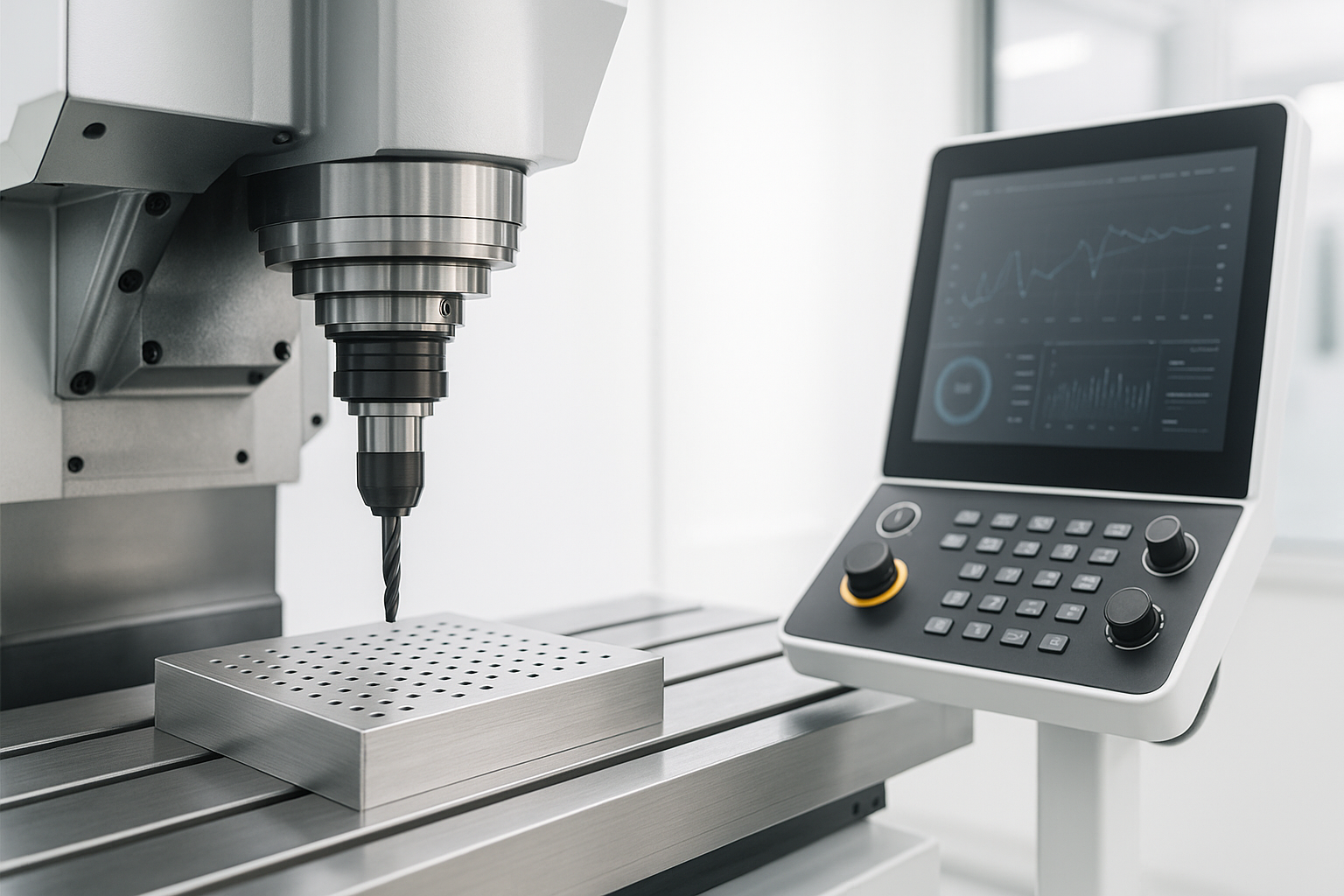
In precision manufacturing, a single defect can derail an entire production run – or worse, reach a customer. Traditional quality checks often rely on sampling, human inspection, and fixed tolerance limits. But with tighter delivery cycles and greater complexity in CNC machining and sheet-metal fabrication, this approach leaves too many blind spots. That’s where AI anomaly detection steps in – automatically identifying subtle process deviations before they escalate into scrap, rework, or warranty claims.
From Reactive to Predictive Quality Control
Conventional quality systems trigger alarms only after a measurement exceeds a threshold. AI quality control software flips that model. Instead of waiting for defects, it continuously learns what “normal” looks like across thousands of process parameters – spindle load, vibration, temperature, vision data, and even acoustic signals.
When it detects behaviour outside this learned baseline, it flags an anomaly – often hours or even days before a part fails inspection. The result: faster root-cause analysis, fewer customer returns, and higher process uptime.
How AI Anomaly Detection Works
Modern AI-based systems typically combine three data layers:
- Sensor and machine data – Collected from CNC machines, robots, and process sensors.
- Machine-learning models – Unsupervised algorithms (e.g. autoencoders, isolation forests) that detect deviations from normal patterns.
- Decision layer – Integrates with MES or ERP systems to automatically adjust tool paths, issue maintenance alerts, or pause production.
For instance, a milling machine might log a slight increase in spindle torque while cutting titanium. On its own, this wouldn’t trigger an alarm. But when AI correlates this signal with micro-vibration and tool-wear patterns, it can predict a potential tool failure long before scrap is produced.
Real-World Impact Across Manufacturing
Manufacturers adopting AI anomaly detection report measurable benefits:
- Up to 40% reduction in scrap and rework through early deviation alerts.
- Shorter root-cause analysis cycles – from days to minutes.
- Improved OEE (Overall Equipment Effectiveness) by catching process drift in real time.
- Enhanced customer satisfaction due to consistent part quality and fewer returns.
Companies like Siemens, Fanuc, and Renishaw have begun embedding AI quality-control modules directly into CNC and metrology platforms, allowing shops to deploy advanced analytics without complex data-science infrastructure.
Integrating AI Quality Control Software in Your Workflow
To implement AI-driven anomaly detection effectively:
- Start with clean, high-frequency data – Quality AI models depend on rich input from sensors, vision systems, and controllers.
- Use a pilot cell – Begin with one process or product family to prove ROI before scaling across lines.
- Integrate alerts into existing systems – Link to MES dashboards or operator HMIs, not separate screens that cause alert fatigue.
- Feed the AI with feedback – Tag anomalies as true or false positives to continually improve accuracy.
An ideal deployment doesn’t replace operators – it amplifies their situational awareness, turning each workstation into a smart, self-monitoring process node.
Linking Quality to Sustainability and Competitiveness
Fewer defects mean less material waste, lower energy consumption, and reduced rework – all of which directly support sustainability goals. For European manufacturers under increasing ESG pressure, AI quality control software delivers both compliance and cost advantage.
And with predictive maintenance built into the same framework, it helps balance productivity with equipment longevity – a win-win for profitability and environmental performance.
For technical insights, see Fraunhofer IPA’s research on data-driven quality assurance and Siemens’ Predictive Quality Analytics platform – both excellent references for practical integration paths.



One Comment