AI CNC Predictive Maintenance 2026 is becoming a critical investment area for manufacturers trying to reduce downtime, extend machine life, and protect part quality. For a broader view of how software is transforming machining, see our coverage of AI in CNC machining.
We spoke with Karoly Szipka, CEO & Co-Founder of IPercept Technology AB, about the real problems behind CNC downtime, what measurable gains shops are seeing, and how AI-driven machine intelligence could redefine maintenance over the next five years.
MTN: What problem in CNC manufacturing did you originally set out to solve with IPercept, and why is it so critical for machine shops today?
IPercept didn’t start with a business idea. It started with a real industrial need, coming directly from some of Sweden’s largest manufacturing enterprises.
This is one of the great strengths of the Swedish innovation ecosystem: large enterprises, in many cases competing directly with each other, choose to collaborate through Swedish research institutions to solve shared challenges. In our case, leading Swedish manufacturers had been benchmarking every available solution to lift the efficiency and reliability of their CNC machines to the next level. They couldn’t find anything that delivered the depth of insight they needed, so they turned to academia. That’s where I worked as a researcher at KTH Royal Institute of Technology, specialising in precision engineering and metrology.
Every time we worked with manufacturers, regardless of industry, we saw the same pattern: incredibly expensive, high-precision CNC machines running without anyone truly knowing what was happening inside them. Maintenance teams relied on fixed schedules, gut feeling, or waited until something broke. And when it broke, the costs were staggering.
The scale of this problem is hard to overstate. Manufacturing globally loses roughly one trillion euros every year to machine downtime, inefficiencies, and quality failures. And the tools available to address this? Most are based on principles dating back to the 1970s – simple vibration sensors that work for basic rotating components but completely miss the complex, interconnected degradation patterns inside a modern CNC machine. That means most manufacturers still perform just two thorough inspections per year per machine, and the rest of the time they’re essentially flying blind.
I watched brilliant maintenance engineers waste days trying to diagnose problems that our early prototypes could pinpoint in minutes. Technicians spent more time debating what might be wrong than fixing things. That’s not a technology problem, that’s a knowledge and maybe most importantly a data gap. And that’s what we set out to close.
Today, with skilled workers retiring faster than they can be replaced and supply chains still under pressure, this knowledge gap is more critical than ever. If you can’t see what’s happening inside your machines, you can’t plan maintenance intelligently, you can’t prevent quality deviations, and you certainly can’t compete at the level the market demands.
MTN: For a typical machining company, what measurable improvements can they expect after implementing the IPercept system?
I always prefer to let the numbers speak, because the improvements are significant enough that they don’t need exaggeration. We serve essentially all industrial verticals where CNC machines are used. From aerospace and automotive to defence, energy, mining, and general equipment manufacturing. Across our customer base, we consistently see a 30% improvement in overall equipment effectiveness, a 50% reduction in unplanned downtime, and a 40% reduction in scheduled maintenance that turns out to have been unnecessary in the first place. On top of that, our customers report roughly 10% savings on maintenance parts and tools, because they’re replacing components based on actual condition rather than calendar-based assumptions.
But what really brings this to life are the individual stories. One customer had a large metal-working machine where we were introduced to monitor the linear axes. On the very first test cycles, our system identified a significant degradation on a ball screw nut. As the calibration continued, the degradation further developed, and we could predict that the risk of quality issues or failure was imminent. Knowing this, the customer could order specific replacement parts and schedule a maintenance action – saving significant costs in unplanned downtime.
Another case from equipment manufacturing: a sudden localized defect emerged on the drive-side bearing of a linear axis after a collision event. The defect was severe and could have propagated to other components in the feed drive. Our system immediately alerted the maintenance team, who inspected and replaced the bearing before further damage occurred. Later part inspection confirmed that the machine had started producing scrap right after the collision. Estimated impact: 150,000 to 180,000 euros saved from preventing both scrap production and fault escalation.
In the automotive industry, we helped a customer with several mill-turn machines and with three spindles each. They lacked objective data to prioritize which spindle required replacement first. IPercept benchmarking identified the one spindle showing early degradation, and maintenance was scheduled for it first, avoiding unnecessary replacements on the other five. The result: 315 hours of avoided downtime and supported warranty claims, with an estimated financial effect of approximately 94,500 euros.
Customers typically see their first actionable insight within seven days of installation, and many report a 10x return on investment within weeks, not months.
MTN: Many shops struggle with mixed fleets and older machines. How does IPercept work across different brands, controllers, and IT environments?
This is actually where we believe IPercept changes the game most fundamentally, because the mixed-fleet reality is the norm, not the exception. Most machine shops I visit have a floor that looks like a United Nations of CNC machines: a Mazak from 2005 next to a DMG Mori from last year, an Okuma mill-turn that’s been running since the early 2000s, maybe a Burkhardt+Weber or Unisign for heavy operations. Different controllers, different ages, different levels of digital readiness. And every traditional monitoring solution I’ve seen requires access to the machine controller, IT integration, network configuration. It becomes a six-month project before you get your first data point.
We designed IPercept from day one to be completely independent of all of that. Our Smart Device mounts directly onto the machine’s kinematic chain. It uses aerospace-grade motion sensors to capture the machine’s mechanical behaviour with extraordinary precision. It requires no connection to the machine controller, no IT integration, and no changes to your network. All you need is a power outlet after a simple 1–3 hours installation process.
We deliberately built it this way because we know that IT and OT integration is the single biggest barrier to industrial digitalization. Maintenance teams want machine intelligence – but they don’t want to wait eighteen months for their IT department to approve a network integration. With IPercept, a machine can be set up in under an hour and the device communicates through its own secure, independent connection.
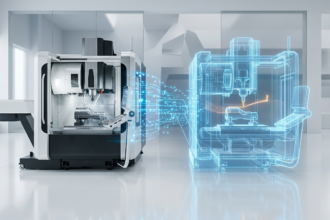
This means we work equally well on a twenty-year-old manual-change machine and a brand-new five-axis machining centre. The physics of mechanical degradation are the same regardless of the brand badge on the machine, and our physics-based digital twin models understand that universal language.
MTN: Your platform focuses heavily on predictive insights into wear, misalignment, and degradation. How does this change the way maintenance teams operate day to day?
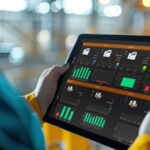
The shift is profound, and I’d describe it in three layers. The first is eliminating the guesswork. Today, when a quality issue or unusual vibration appears, a maintenance team’s first reaction is to gather around the machine and start debating: is it the spindle? A ball-screw? A guideway issue? That diagnostic phase alone can consume days. With IPercept, they open the portal and see exactly which subsystem is degrading, what the failure mode is, and what stage the degradation has reached. From stable to observable to accelerated to critical.
One of our customers told us they saved one full workday per week just on root cause analysis and troubleshooting preparation. That’s a maintenance engineer who can now spend that time on actual improvements instead of detective work.
The second layer is acting at the right time, not the scheduled time. We have a case where an aerospace manufacturer discovered localized defects in axis guideways. Traditional practice would have been either to panic-replace them or to ignore it until the next planned shutdown. Instead, our continuous monitoring showed the defects were stable and predictable, and later inspections confirmed the precise positions, validating our insights. The customer safely delayed the replacement until their summer maintenance window, avoiding both premature action and the risk of an unplanned stoppage. Estimated savings: 20,000 to 30,000 euros – just from better timing.
The third and perhaps most transformative layer is building institutional knowledge. Every insight IPercept generates becomes part of a documented machine history. When a technician is replaced or retires, the knowledge doesn’t walk out the door. Our CNC Copilot, our AI assistant built specifically for production and maintenance teams, can guide a Level 4 technician through troubleshooting workflows that previously required a Level 6 engineer. We’re seeing 75% faster troubleshooting for maintenance technicians and 30% faster onboarding of new team members.
In short: maintenance teams go from reactive firefighting to proactive, fact-based decision-making. They maintain what needs maintaining, not what has always been maintained. That’s a fundamental shift in how a factory operates.
MTN: Looking ahead three to five years, how do you see AI changing the role of CNC machines and the people who run them?
I’ll give you the bold prediction first: we believe that within five years, most new industrial machines will come with machine intelligence built in. Just as you wouldn’t buy a car today without basic diagnostics and health monitoring, the idea of investing a million euros in a CNC machine with no continuous insight into its condition will seem absurd.
But the bigger transformation isn’t about the machines, it’s about the people. We’re already seeing the early stages of this with our CNC Copilot, which is an AI assistant that adapts its guidance based on the user’s role. From shop floor operator to maintenance engineer to factory manager.
A technician with five years of experience, supported by AI that has the collective knowledge of thousands of machines, can make decisions that previously required decades of expertise. That’s not replacing human judgement. It’s amplifying it.
I think three things will fundamentally change. First, maintenance will shift from a cost centre to a strategic function. When you can prove with data that a proactive intervention saved 150,000 euros, or that delaying a replacement by six months was safe because the degradation was stable, maintenance leaders earn a seat at the strategy table.
Second, the relationship between machine builders and machine users will transform. Builders will sell machines with lifetime health monitoring as a standard feature, and they’ll use that data to improve their next generation of products. It creates a virtuous cycle of continuous improvement that simply doesn’t exist today.
Third, and this is what motivates me most personally: we’ll attract a new generation of talent to manufacturing and introduce a new era of industrialism that is organised around people but powered by machines on an entirely new level. Young engineers are excited about AI, data, and intelligent systems. When you can offer them a role where they’re working with cutting-edge machine intelligence instead of clipboards, manufacturing becomes a career of choice rather than a career of necessity.
Our vision has always been that people bring the best out of machines, to the benefit of society. AI doesn’t change that. It accelerates it. The change-makers of industry have always been the people on the factory floor. We’re just making sure they finally have the tools they deserve.
MTN Analysis: Why AI CNC Predictive Maintenance Matters Now
The interview highlights a key shift happening across the CNC sector. For years, predictive maintenance has existed, but most solutions were built around vibration thresholds or basic condition monitoring. Those approaches work well on simple rotating assets but struggle with complex multi-axis CNC machines.
IPercept’s focus on motion-based analysis and physics-driven digital twins points to a broader industry trend: machine intelligence that understands the full kinematic system rather than isolated components. The discussion with IPercept shows how AI CNC Predictive Maintenance 2026 is moving from theory into measurable factory results.
Three points stand out from the interview:
1) Measurable ROI is becoming a standard expectation
The company reports a 30% improvement in overall equipment effectiveness, a 50% reduction in unplanned downtime, and a 40% reduction in unnecessary scheduled maintenance across its customer base.
2) Mixed fleets remain the biggest opportunity
Most factories run machines from multiple OEMs across different decades. Controller-independent approaches remove a major barrier to adoption.
3) Maintenance is moving toward an AI-assisted model
AI copilots are beginning to support technicians with diagnostics, troubleshooting, and decision-making.
Key Takeaways
- Predictive AI maintenance can significantly reduce downtime.
- Controller-independent systems suit mixed-fleet factories.
- AI copilots support maintenance technicians.
- Machine intelligence will likely become standard on new CNC machines within five years.
AI CNC Predictive Maintenance FAQ
What does IPercept’s system actually monitor?
It monitors the mechanical motion of CNC components using sensors on the kinematic chain.
How quickly can results appear?
Many customers receive actionable insights within seven days.
Does it need controller integration?
No. It works independently without IT or network integration.
What failures can it detect?
Close to 100 fault types across CNC subsystems.
Which industries adopt this fastest?
Aerospace, automotive, heavy equipment, and energy.
About IPercept Technology AB
IPercept Technology is a Stockholm-based KTH Royal Institute of Technology spin-off, founded in 2019. The company’s AI-powered CNC machine intelligence platform serves close to 25 blue-chip manufacturing companies globally. IPercept has raised €7.5M in total funding. The company was named a CB Insights Leader in Equipment AI Copilots, 2023 industrial company of the year in Sweden, and won Ny Teknik’s 33-list Gold Company status three consecutive years.
Website: www.ipercept.io