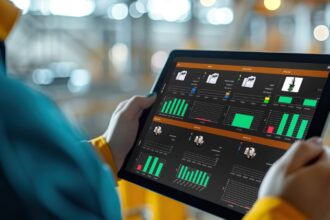
In manufacturing, ERP systems have long served as the backbone, connecting finance, inventory, production, procurement, and more. But traditional ERPs often struggle with latency, siloed data, and limited adaptability to disruptions. By embedding AI into ERP, manufacturers can close the gap between the shop floor and the finance ledger – delivering real-time intelligence, better forecasts, and cross-domain coherence.
AI ERP Manufacturing can automate routine tasks, elevate forecasting, and enable adaptive decision-making across departments. And in manufacturing, the benefits are already showing: use cases around predictive maintenance, quality control, and dynamic scheduling are proving ROI.
Today’s challenge: how do you embed AI into ERP without disrupting operations or creating “yet another system”?
Core Pillars: What AI Brings Into ERP for Manufacturers
1. Predictive & prescriptive analytics across the value chain
AI ERP manufacturing analyzes historical and real-time data to forecast demand, optimize inventory, and flag anomalies. For instance, ML models integrated into ERP can refine production schedules dynamically in response to machine downtime or supply disruptions.
2. Automated finance and process flows
Generative AI and agents can automate tasks such as invoice reconciliation, expense processing, and budget alerts. The recent FinRobot architecture shows how AI agents embedded in ERP can reduce error rates and accelerate cycle times significantly.
3. Quality control via computer vision
Linking shop-floor imaging systems (vision, cameras) into ERP modules enables real-time defect detection and automatic traceability. Deviations detected in-line can trigger alerts or correction workflows inside ERP workflows.
4. Smart scheduling and resource allocation
AI can resolve complex trade-offs: which job to schedule next given machine bottlenecks, material availability, labor constraints, and financial impact. ERP becomes a decision engine instead of just a data store.
5. Conversational UX & natural language
ERP modules with natural language interfaces allow managers and engineers to query production KPIs, ask “why did we lose margin this month?” or “suggest next-best use of idle capacity” in plain English.
Implementation Roadmap & Prerequisites
Begin with a scoped use case
Don’t try to AI-enable everything at once. Start with a high-impact, narrow domain-demand forecasting, maintenance, or invoice processing. Focus on measurable gains.
Clean data and eliminate silos
AI can only be as good as the data that feeds it. Ensure your ERP has unified, clean, timestamped data across production, purchases, and finance. Fragmented data sources kill prediction quality.
Use a modular AI architecture
Architect your system so that ML models, generative agents, and vision modules are loosely coupled to ERP core functions. This enables you to gradually upgrade or replace models without rewriting your ERP.
Monitor, validate, and govern
Always maintain human oversight for AI decisions. Log predictions vs actuals, flag drift, and validate model outputs. Think of AI as a co-pilot, not a black box.
Iterate and expand
Once you validate ROI in one domain, expand to adjacent domains-say from maintenance to quality, or from finance to supply chain. Maintain consistency in governance and monitoring.
Case in Point: DualEntry & ERP Modernization
A standout example: AI native startup DualEntry recently raised $90 million to redefine ERP finance workflows. Its “NextDay Migration” feature drastically reduces migration time from months to 24 hours. This underscores how AI-first architectures are challenging legacy ERP models from the ground up.
On the vendor side, legacy ERP providers are now embedding AI. Epicor’s cognitive ERP for manufacturers is pushing toward auto-optimizing production workflows and inventory decisions.
Risks & Mitigations
| Risk | Mitigation |
|---|---|
| Model errors, blind spots | Deploy conservative thresholds, allow human override, backtest on historical data |
| Vendor lock-in | Favor open APIs and modular AI layers |
| Change resistance | Train teams early, show quick wins, involve domain experts in AI validation |
| Data security | Encrypt data, isolate model training environments, audit access |
Outlook: The AI-ERP Frontier in Manufacturing
As ERP systems evolve into AI-first platforms, manufacturers will gain agility that rivals pure software firms. Intelligent ERP becomes the single point where finance, production, and supply chain converge and adjust in real time. In specialized domains like CNC machining or sheet metal fabrication, that gives you a leg up when reacting to design changes, material variance, or mix diversions.
But success will depend on pragmatic deployment: maintain clean data, start small, and treat AI as collaborators-not replacements. If you get that right, AI ERP becomes not just a tool-but the nerve center of your smart factory.