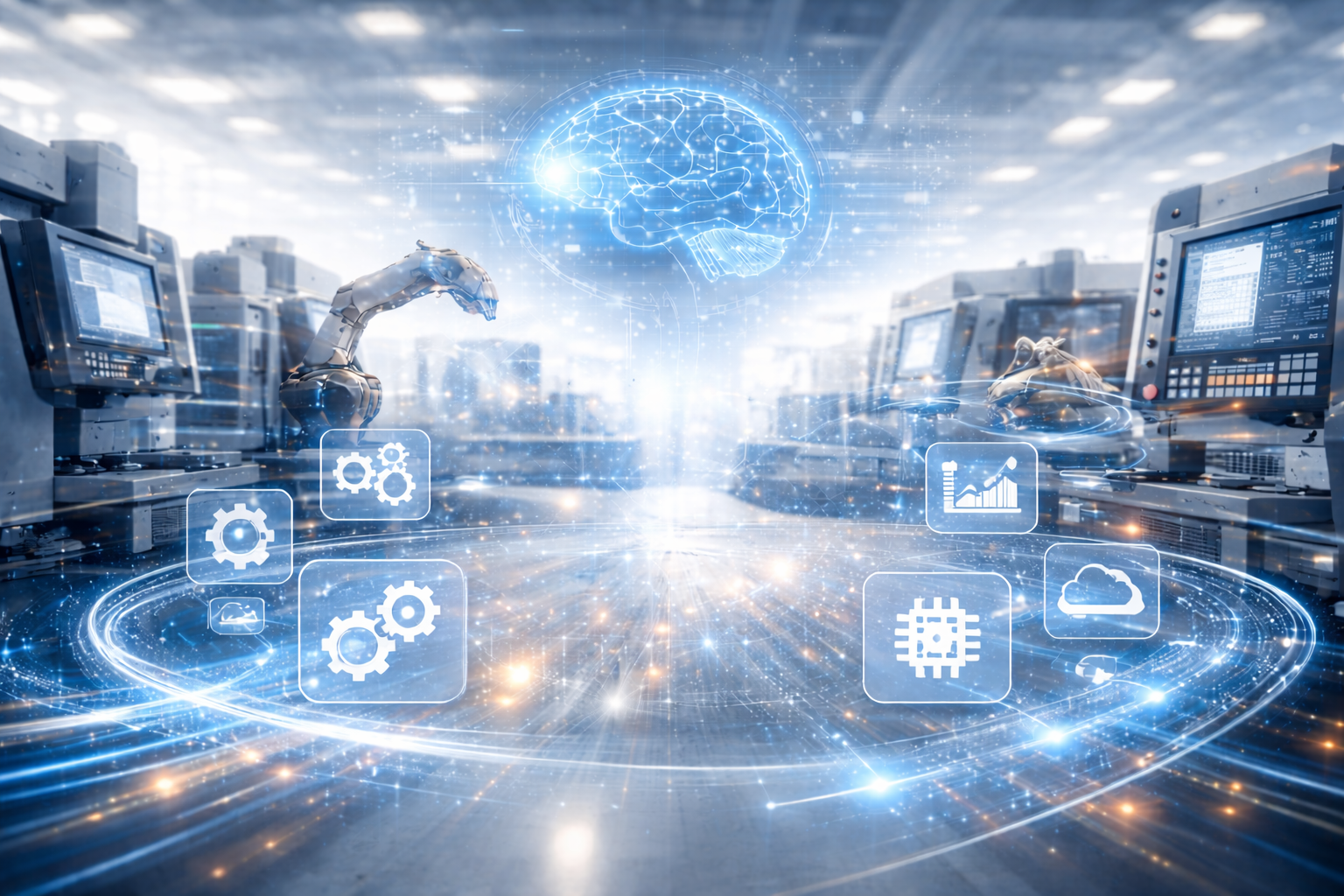
AI in machine tools 2026 has entered a new phase as leading automation suppliers move artificial intelligence directly into CNC control, robotics, inspection, and motion systems. The announcements made in January 2026 show that AI in machine tools 2026 is no longer limited to analytics or dashboards. It is becoming part of how machines are designed, programmed, and optimised for real production in metal manufacturing.
Below are the ten most important industrial announcements shaping this shift.
Siemens and NVIDIA expand industrial AI partnership
Siemens announced deeper integration of NVIDIA AI and simulation into Siemens Xcelerator. The goal is to create AI-driven digital twins of machine tools and robotic systems that behave like their real-world counterparts.
Why it matters:
This lays the foundation for AI-native CNC and robot control architectures. Instead of tuning processes only on physical machines, optimisation can be trained inside virtual factories and transferred to production with far lower risk.
ABB unveils Autonomous Versatile Robotics
ABB introduced adaptive robotic systems capable of changing workflows using AI rather than relying only on fixed programs.
Why it matters:
This represents a move toward self-adjusting production lines. For machine tending, welding, and handling, robots can respond to variation instead of stopping when conditions change. This is critical for high-mix metal manufacturing.
KUKA and Algorized launch predictive robot safety
KUKA and Algorized introduced an AI system that uses radar and machine learning to predict collisions between humans and robots before they happen.
Why it matters:
Safety has limited how closely robots and humans can work together. Predictive safety allows robots to anticipate human movement, enabling more compact cells and higher utilisation of collaborative automation.
Qualcomm launches full robotics AI platform
Qualcomm launched a suite of edge AI processors and a robotics software stack designed specifically for automation and robotics.
Why it matters:
Physical AI requires real-time processing close to the machine. This creates dedicated compute hardware for robots and automation cells rather than relying on repurposed consumer chips.
Siemens expands SINUMERIK Run MyRobot
Siemens expanded SINUMERIK Run MyRobot so that robots and CNC machines can be programmed as a single coordinated system.
Why it matters:
Machine tending and hybrid automation become easier to deploy. CNC and robot motion no longer need separate engineering workflows, lowering the barrier for job shops to automate machining cells.
GrayMatter Robotics opens AI finishing facility
GrayMatter Robotics opened a 100,000-square-foot facility dedicated to AI-driven robotic grinding, polishing, and deburring.
Why it matters:
Finishing has been one of the hardest metalworking operations to automate. This facility shows that AI can now replace manual finishing in real production environments.
Schunk announces AI-driven gripping platform
Schunk introduced grippers that adapt in real time to part geometry using AI control.
Why it matters:
Flexible gripping enables random-part handling and reduces dependence on dedicated fixtures. This supports bin picking, CNC automation, and mixed-part production.
Hexagon expands AI metrology portfolio
Hexagon launched AI-based surface defect detection and predictive measurement tools.
Why it matters:
Inspection moves from post-process checking toward in-process intelligence. AI detects problems during machining, reducing scrap and closing the loop between quality and production.
Siemens launches Industrial AI OS concept
Siemens revealed a software architecture designed to deploy AI consistently across machines and factories.
Why it matters:
This prepares factories for AI-native CNC platforms where learning and optimisation are built into the control layer rather than added as external software.
Bosch Rexroth launches AI motion optimisation
Bosch Rexroth introduced motion systems that tune themselves using AI based on load, vibration, and cycle conditions.
Why it matters:
Machines begin self-optimising for performance and energy use. This shifts motion control from fixed parameter tuning to continuous optimisation.
MTN Analysis: What these announcements mean for metal manufacturing
These developments confirm that AI in machine tools 2026 is moving into machine control, robotics coordination, and inspection workflows rather than remaining in external analytics platforms. The boundary between CNC, robot, and inspection system is starting to disappear.
Digital twins are becoming training environments for AI models. Robots are shifting from programmed sequences to learning-based behaviour. Quality control is moving inside the machining process instead of sitting at the end of the line.
Over the next three years, AI in machine tools 2026 will define competitiveness for CNC machining, robotics integration, and metal manufacturing automation.
Key Takeaways
• AI in machine tools 2026 is driving convergence between CNC and robots
• AI is enabling flexible automation instead of rigid cells
• Inspection is moving inside the process
• Motion systems are becoming self-optimising
• Digital twins are now part of production strategy
FAQ: AI in machine tools 2026
What is AI in machine tools 2026?
AI in machine tools 2026 refers to artificial intelligence embedded directly into CNC machines, robots, inspection systems, and motion control to optimise cutting, handling, and quality in metal manufacturing.
How does AI in machine tools 2026 improve CNC machining?
It improves CNC machining by monitoring cutting stability, tool wear, vibration, and part quality in real time, allowing machines to adjust parameters automatically.
Is AI in machine tools 2026 only for large factories?
No. AI in machine tools 2026 is increasingly available for mid-sized and small manufacturers through integrated robot cells, AI-driven inspection, and edge computing platforms.
What is the biggest benefit of AI in machine tools 2026?
The biggest benefit is flexible automation. Machines can adapt to variation instead of relying on rigid programs and fixtures.