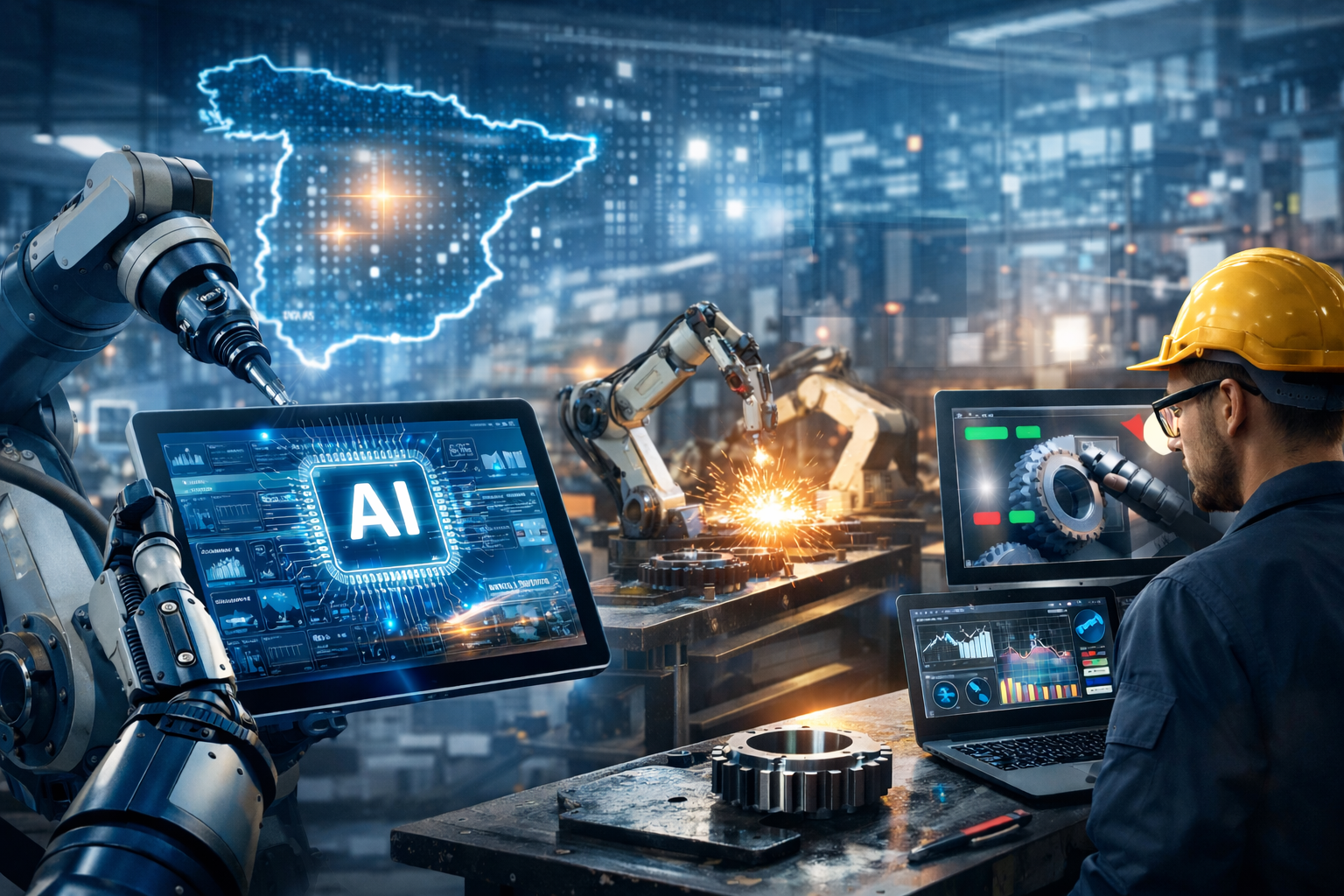
AI in Spanish manufacturing is accelerating fast in early 2026
AI in Spanish manufacturing is accelerating rapidly in 2026, as manufacturers across Spain move from AI pilots to real-world deployment in production, maintenance, and quality control.
Since 1 January 2026, Spain has emerged as one of Europe’s most active environments for applied industrial AI, driven by factory digitisation, strong industrial software startups, and growing alignment with EU-level AI infrastructure programmes.
It is accelerating its investment in AI infrastructure, with the government backing the development of the country’s first AI factory to support industrial applications at scale, backed by nearly €62 million in funding from national and EU sources.
This week’s round-up highlights the most important developments shaping how Spanish manufacturers are using artificial intelligence across production, maintenance, quality, and automation.
Spain’s industrial AI infrastructure push gains momentum
Spain is positioning itself as a strategic European hub for industrial AI infrastructure. National and regional authorities are actively backing large-scale AI compute and industrial data initiatives aligned with EU InvestAI and EuroHPC programmes.
A key signal this January is Spain’s bid to host a future European AI gigafactory, designed to support the training and deployment of advanced AI models for industry, science, and manufacturing. While these facilities are pan-European in scope, Spanish manufacturing would benefit directly through local access to high-performance AI compute for simulation, optimisation, and autonomous systems.
These developments reinforce how AI in Spanish manufacturing is being shaped by access to industrial-scale compute, data, and factory-ready AI systems rather than experimental tools.
MTN analysis:
For manufacturers, this is not about research prestige. It is about access to industrial-grade AI capacity that supports real production challenges such as process optimisation, energy efficiency modelling, and multi-factory scheduling. Spain is aligning infrastructure with industrial demand, not consumer AI hype.
Industrial software and predictive maintenance lead adoption
One of the strongest AI adoption signals in Spain continues to come from industrial software rather than machine hardware alone.
In practice, AI in Spanish manufacturing is delivering its fastest return through predictive maintenance systems that reduce downtime, stabilise production, and extend machine life.
Predictive maintenance remains the most mature and ROI-positive AI application in Spanish manufacturing, particularly for CNC machining, metal forming, and automated production lines.
Spanish industrial AI platforms focused on asset performance, predictive maintenance, and factory intelligence are scaling rapidly. These systems use machine learning to analyse sensor data, maintenance logs, and production metrics to predict failures, optimise maintenance intervals, and reduce unplanned downtime.
This is particularly relevant for Spain’s large base of mid-sized manufacturers in machining, metal forming, automotive components, and industrial equipment, where uptime and cost control remain decisive competitive factors.
MTN analysis:
Predictive maintenance has become the lowest-risk entry point for AI in Spanish factories. It delivers measurable ROI, integrates with existing equipment, and builds the data foundations needed for more advanced AI applications such as autonomous production optimisation.
AI reshapes quality control and inspection in Spanish factories
Another clear trend gaining traction is AI-driven quality inspection. Vision-based AI systems are increasingly used to detect defects, deviations, and surface anomalies in metal parts, assemblies, and finished products.
Spanish manufacturers are adopting AI inspection not only to improve quality but also to address skills shortages and consistency challenges on production lines. These systems can operate continuously, learn from historical defect data, and reduce reliance on manual inspection processes.
MTN analysis:
Quality AI is becoming a strategic lever rather than a cost-saving tool. Manufacturers using AI inspection gain traceability, faster root-cause analysis, and data feedback loops that improve upstream processes such as machining, forming, and welding.
The adoption gap remains the biggest challenge
Despite growing enthusiasm, many Spanish manufacturers still face a gap between AI ambition and operational execution. Industry surveys and business commentary in January highlight a recurring issue: companies invest in AI tools without a clear deployment roadmap or measurable production targets.
This is especially visible in factories attempting to deploy generic AI platforms without aligning them to operational technology, machine data, and production workflows.
MTN analysis:
Successful AI in manufacturing is not driven by tools but by integration. Spanish manufacturers that treat AI as part of their production system, not as an IT add-on, are the ones seeing sustained value.
Talent and integration skills are now critical bottlenecks
Spain’s AI momentum is also exposing a growing shortage of specialised industrial AI talent. While data scientists are available, fewer professionals have experience integrating AI with CNC machines, robots, PLCs, and MES environments.
This skills gap could slow adoption unless manufacturers invest in upskilling engineering teams or partner more closely with industrial AI specialists.
MTN analysis:
The winning manufacturers in 2026 will not be those with the most AI pilots, but those who can operationalise AI at the machine and factory level. Integration capability is now a strategic asset.
Why this week matters for Spanish manufacturing
Taken together, January’s developments show that AI in Spanish manufacturing is entering a more mature phase. The focus is shifting from experimentation to scalable, production-ready systems tied directly to cost, quality, and productivity.
AI adoption in European manufacturing is accelerating sharply, with the artificial intelligence in manufacturing market expected to grow from around USD 1.7 billion in 2025 to more than USD 30 billion by 2033, reinforcing why Spain’s industrial AI push matters now.
Key takeaways for manufacturers:
- AI infrastructure investment is aligning with industrial needs
- Predictive maintenance and quality AI are delivering fast ROI
- Adoption success depends on integration, not software alone
- Skills and execution will define competitive advantage in 2026
MTN outlook
Spain is no longer following AI trends in manufacturing. It is shaping them. With strong industrial foundations, growing AI software capabilities, and closer alignment with European AI infrastructure, Spanish manufacturers are positioned to compete at a higher technological level.
The next phase will be defined by who scales AI beyond pilots and embeds it deeply into production reality.