AI Manufacturing Netherlands February 2026 is defined by practical industrial deployment, structured robotics validation, shared data infrastructure, and coordinated ecosystem scaling. This month, developments across Eindhoven and the wider Dutch manufacturing landscape show that the Netherlands is operationalising AI in production environments rather than running isolated pilot projects.
Below are seven concrete February 2026 developments shaping CNC machining, robotic automation, predictive systems, and materials innovation.
Brainport’s Industrial Data Infrastructure to Unlock AI Scaling
On February 2, Brainport Eindhoven published detailed updates on regional grid congestion and its impact on manufacturing expansion. More than a thousand companies remain on waiting lists for electricity connections.
Rather than delay innovation, Brainport is coordinating structured data exchange between manufacturers and grid operator Enexis using the Data Safe House framework. Over 200 companies across 21 municipalities are participating in structured annual data updates to improve capacity forecasting and sustainability planning.
AI Manufacturing Netherlands February 2026 depends on this foundation. Industrial AI systems scale only when operational data flows securely across stakeholders. The Netherlands is building that backbone deliberately.
Energy Hubs Supporting AI-Ready Production Planning
Energy Hubs within Brainport allow companies to stagger high-consumption processes such as cleanroom startups.
For advanced CNC operations, predictable capacity planning supports AI-driven scheduling, predictive maintenance modelling, and intelligent production balancing. AI Manufacturing Netherlands February 2026 therefore includes ecosystem-level optimisation, not only machine-level intelligence.
TNO’s Remanufacturing Lab as a Test-and-Experimentation Facility
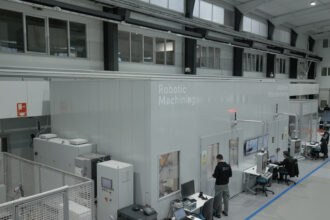
TNO’s Remanufacturing Lab at Brainport Industries Campus continues operating as a European AI Test and Experimentation Facility under the AI-MATTERS programme.
The facility supports:
- AI-based decision support systems
- Human-robot interaction validation
- Autonomous parts handling
- AI-driven quality inspection
Manufacturers can test robotics and AI systems in industrial conditions before committing to full deployment. For SMEs, this reduces adoption risk and shortens integration timelines.
AI Manufacturing Netherlands February 2026 shows structured validation pathways rather than experimental automation.
Vision-Language-Action Robotics for Machine Tending
Mid-February updates from the Operator of the Future programme detailed Vision-Language-Action AI applied to robotic machine tending.
The validation involved:
- Five part geometries
- Five matching machine cavities
- Simulation training prior to physical deployment
This architecture allows robots to interpret part orientation and contextual instructions rather than follow fixed motion routines.
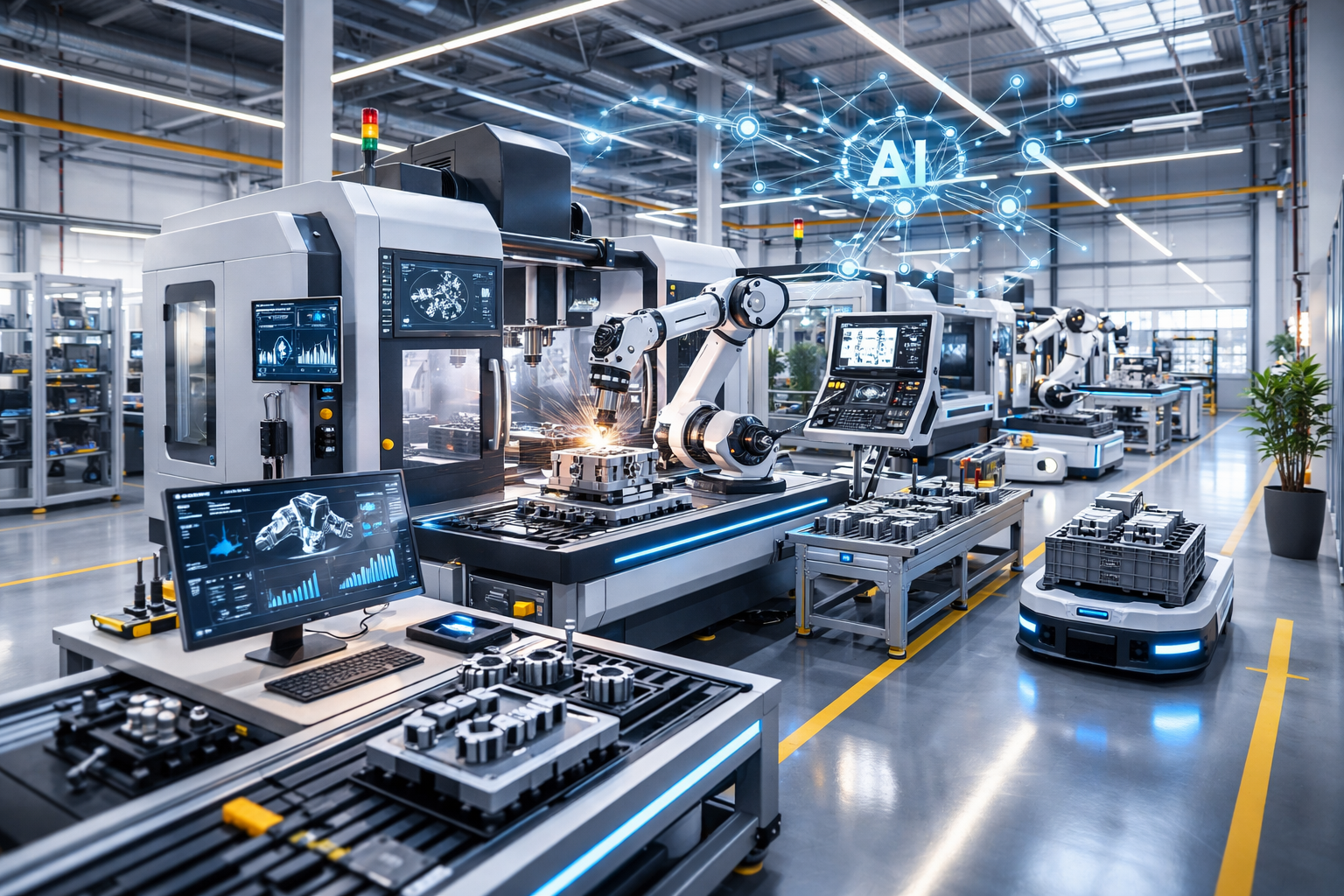
For CNC environments with frequent changeovers, AI Manufacturing Netherlands February 2026 now includes adaptive robotic tending that reduces manual programming overhead.
SEAMIIC Autonomous Handling and Quality Control
Within TNO’s experimentation ecosystem, the SEAMIIC module focuses on autonomous parts handling combined with quality verification.
This supports:
- Reduced manual inspection workload
- Integrated robotic quality control
- Digital traceability across production steps
AI Manufacturing Netherlands February 2026 demonstrates convergence between robotics, inspection, and compliance.
TU Eindhoven’s €1.5 Million AI Materials Initiative
Eindhoven University of Technology secured €1.5 million through Horizon Europe’s SimuLingua project to develop multimodal AI models for materials discovery.
The objective is a scientific foundation model capable of linking natural language queries with physics simulations, image data, and experimental results.
Although upstream from machining, this research influences material performance characteristics, cutting behaviour, and process optimisation strategies.
AI Manufacturing Netherlands February 2026 therefore extends into long-term capability building.
SME Digitalisation Through Smart Industry
The Smart Industry initiative continues coordinated digital transformation across Dutch SMEs.
The programme promotes:
- Digital twins
- Predictive maintenance frameworks
- Robotics integration
- AI-enabled production monitoring
This ensures AI Manufacturing Netherlands February 2026 is not limited to flagship technology leaders but diffused across the broader supply chain.
Why AI Manufacturing Netherlands February 2026 Matters for European Machine Tool Buyers
The Dutch model in February highlights three strategic realities:
- Infrastructure readiness is treated as part of AI strategy
- Robotics validation environments reduce deployment risk
- Adaptive automation is moving from lab concept to industrial validation
For UK and German manufacturers, the Netherlands provides a near-term reference model for integrated intelligent production cells.
MTN Analysis
AI Manufacturing Netherlands February 2026 reflects coordinated ecosystem development rather than isolated machine upgrades.
The Netherlands is aligning:
- Regional data governance
- Physical robotics testbeds
- Adaptive machine tending
- Advanced materials research
This layered strategy reduces friction between pilot and production.
Manufacturers evaluating AI investments in 2026 should note that competitive advantage may increasingly depend on ecosystem alignment rather than standalone machine capability.
FAQ
What is the most practical AI trend for CNC environments in the Netherlands this month?
Vision-Language-Action robotic machine tending validated through simulation and industrial deployment.
Where can manufacturers test AI robotics in the Netherlands?
At TNO’s Remanufacturing Lab within Brainport Industries Campus under the AI-MATTERS programme.
Is AI adoption limited to large Dutch firms?
No. Smart Industry programmes are structured to support SME integration across supply chains.
How does this influence European machine tool purchasing decisions?
It raises expectations around adaptive automation, predictive capability, and secure data integration.