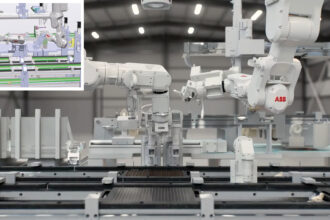
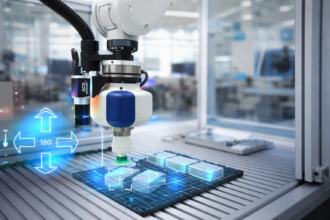
In manufacturing, deburring is often the least glamorous yet most time-consuming task on the floor. Sharp edges, burrs, and surface imperfections from cutting or milling can delay assembly, create safety risks, and compromise part quality. Traditionally, it’s been done by hand – a repetitive, high-skill operation that’s costly and hard to scale.
Enter AI robotic deburring: a new generation of automated finishing systems that combine force-sensitive robots with machine learning to deliver consistent, fast, and adaptive results – even on complex geometries.
From Manual Labor to Intelligent Automation
Manual deburring has always been a bottleneck. Skilled operators can sense burr thickness and adjust force by instinct – something traditional robots struggled to replicate. Early robotic deburring cells were rigid: fixed toolpaths, static parameters, and frequent teaching cycles whenever part designs changed.
AI now changes that equation. Using vision systems, force-torque sensors, and real-time learning models, robotic cells can identify burrs, adjust tool pressure, and modify their paths autonomously. The result? Finishing that’s both precise and flexible – without constant operator intervention.
A recent study from Fraunhofer IPA found that AI-assisted robots can reduce deburring time by up to 40% while maintaining tighter tolerances and repeatability than manual work.
How AI Robotic Deburring Works
At its core, an AI-enabled deburring system integrates three key technologies:
- 3D Vision and Scanning – Cameras or laser scanners capture high-resolution geometry to detect burrs and sharp edges.
- Adaptive Path Planning – AI algorithms analyze geometry in real time to generate optimized toolpaths.
- Force-Controlled Execution – The robot dynamically adjusts spindle speed, feed rate, and contact force to achieve the desired edge finish.
These systems continuously learn from feedback – adjusting parameters for different materials (aluminum, steel, titanium) or part shapes. When combined with MES or digital twin software, they can even track tool wear and predict when maintenance is needed, closing the loop between finishing and quality control.
The Business Case: Faster, Safer, Cheaper
Manufacturers adopting AI robotic deburring report measurable ROI within months. Key benefits include:
- Reduced Labor Dependence – A single operator can supervise multiple robotic cells, freeing skilled staff for higher-value tasks.
- Consistent Quality – Every part receives uniform finishing, regardless of batch size or shift changes.
- Shorter Lead Times – Automated cells run continuously, often doubling throughput compared to manual operations.
- Lower Safety Risk – Reduced exposure to sharp parts, noise, and repetitive strain.
In sectors like aerospace, automotive, and medical device manufacturing, where edge quality directly affects performance, these systems are becoming essential.
Integration with the Smart Factory
AI robotic deburring doesn’t exist in isolation – it thrives in the Industry 4.0 ecosystem. When integrated with CNC machining data and production planning systems, it enables end-to-end process visibility.
Imagine a workflow where a machined part automatically triggers a deburring robot, which verifies edge geometry, logs finishing data, and feeds results back to the CAD/CAM model. This level of digital continuity reduces rework, ensures traceability, and supports closed-loop manufacturing.
Vendors like ABB, KUKA, and FANUC are now offering AI-driven finishing cells that plug directly into digital factory frameworks. Fraunhofer IPA’s research and other initiatives in Europe are accelerating this convergence between robotics and smart manufacturing.
Challenges and Considerations
Adoption isn’t without hurdles. AI robotic deburring systems require high-quality training data, robust edge detection algorithms, and careful calibration to avoid over-processing delicate features. Integration with legacy machines and tool libraries can also be complex.
However, as AI models become more transferable and cloud training improves, these barriers are shrinking. The next generation of systems will come pre-trained for specific materials or part types, allowing faster deployment even in small and mid-sized workshops.
The Bottom Line
AI robotic deburring is more than automation – it’s intelligent finishing. By combining adaptive robotics with real-time analytics, manufacturers gain the consistency of automation with the finesse of human craftsmanship.
As cost pressures rise and skilled labor shortages deepen, this technology is quickly shifting from “nice to have” to strategic necessity for any plant looking to modernize its finishing line.