Hybrid manufacturing – the integration of additive (3D printing) and subtractive (CNC machining) processes – is no longer just a lab curiosity. It’s becoming a cornerstone of advanced production, and the catalyst driving that transformation is AI-powered robotics.
By merging the precision of machining with the design freedom of additive manufacturing, AI robotics hybrid manufacturing enables the production of complex, high-value parts faster, cleaner, and more intelligently than ever before.
What Hybrid Manufacturing Really Means
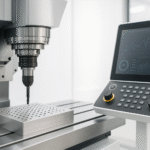
Hybrid manufacturing combines additive processes, such as laser metal deposition or wire-arc additive manufacturing (WAAM), with traditional CNC machining in a single cell or system.
- Additive builds material layer by layer, reducing waste and enabling near-net-shape geometries.
- Subtractive finishes and refines those shapes to micron-level precision.
Traditionally, these processes were separate – involving multiple setups, re-clamping, and machine changes. But robotic systems, guided by AI and advanced path-planning, are now fusing both stages seamlessly in one environment.
Why Robots Are the Missing Link
Robots introduce a level of flexibility and scalability that fixed hybrid machines can’t match.
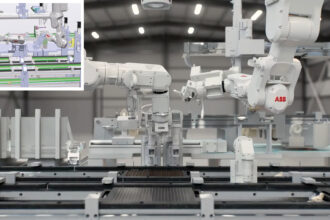
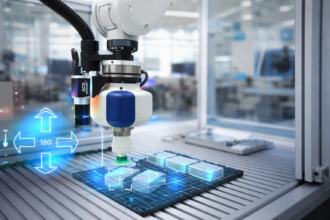
A 6-axis or 7-axis robotic arm equipped with both deposition and milling tools can switch between printing and cutting modes autonomously. AI algorithms analyze sensor data in real time – including thermal imaging, force feedback, and tool wear detection – to dynamically adjust tool paths, feed rates, and deposition patterns.
Key advantages of AI robotics hybrid systems:
- Multi-material capability: Robots can alternate materials (e.g. steel, Inconel, titanium) without human intervention.
- Automated calibration: AI ensures tool alignment and offsets are continuously corrected.
- Adaptive control: Predictive models prevent thermal distortion and chatter during transitions between additive and subtractive operations.
- Scalable footprint: Unlike integrated hybrid CNC machines, robotic cells can grow modularly and handle larger parts.
Real-World Applications
Aerospace and Energy
Turbine blades, impellers, and combustion chambers benefit from WAAM-based repair and remanufacturing. Robots can rebuild worn surfaces with additive layers, then switch instantly to milling for precision finishing – reducing material waste and downtime.
Automotive and Tooling
For prototype and low-volume tooling, hybrid cells driven by AI robotics can reduce lead times by over 50%, combining 3D metal deposition with robotic milling for near-finished tools in one setup.
Heavy Industry and Defense
Large-format robotic additive systems, like those developed by MELD Manufacturing and GE Additive, are using AI-enhanced path optimization to produce massive, structurally sound components with minimal distortion – something traditional CNC setups can’t achieve alone.
The Role of AI in Hybrid Robotics
AI is the glue that makes hybrid robotics viable. Through machine learning models, robots learn the relationships between deposition parameters, surface temperature, and final part quality. Over time, they self-optimize, improving accuracy and reducing rework.
Some emerging AI functions include:
- Defect prediction: Using computer vision to detect porosity or layer inconsistencies mid-print.
- Toolpath learning: AI refines tool trajectories based on vibration and force sensor feedback.
- Digital twins: Virtual replicas simulate additive/subtractive sequences to prevent collisions and ensure geometry accuracy before the real build.
According to Siemens’ research on digital twin integration, AI-assisted hybrid workflows can reduce cycle times by up to 30% compared to standalone CNC or additive setups.
Challenges and Integration Considerations
Despite the promise, AI robotics hybrid manufacturing faces several hurdles:
- Software interoperability – bridging additive and subtractive CAM toolchains remains complex.
- Thermal control – managing heat accumulation during deposition is critical.
- Certification – especially in aerospace, quality validation for hybrid parts still lags.
Yet, these are engineering challenges, not dealbreakers. As vendors such as FANUC, KUKA, and ABB continue integrating AI-driven process monitoring, hybrid systems will become plug-and-play solutions rather than R&D curiosities.
The Takeaway
AI robotics are redefining what hybrid manufacturing can achieve. By uniting the creative freedom of additive with the precision of subtractive, manufacturers gain agility, efficiency, and control – all in a single intelligent cell.
The next generation of factories won’t just print or machine.
They’ll think, adapt, and build smarter, thanks to hybrid systems powered by AI robotics.