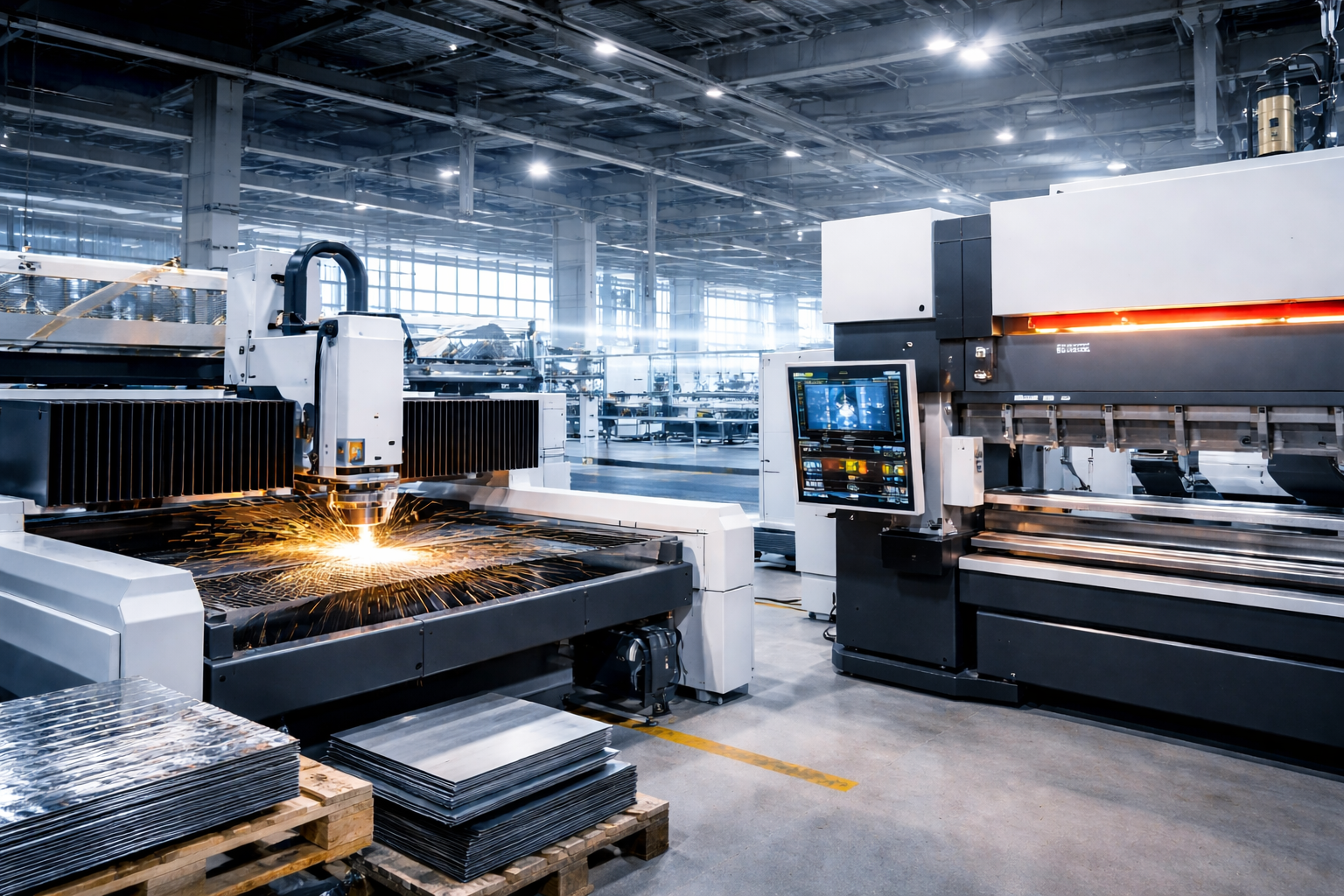
AI sheet metal automation Italy is moving quickly inside mid-sized job shops and subcontractors, especially where high mix, short runs, and tight delivery windows decide who gets repeat work.
Italy’s strength is flexibility. Thousands of firms ship parts for machinery, HVAC, food equipment, furniture, transport, and specialist industrial systems. The bottleneck is no longer the laser or the press brake. It is the flow of decisions around them.
Across the manufacturing landscape, AI sheet metal automation Italy is being adopted quietly through software, workflow intelligence, and modular production upgrades rather than large-scale automation projects.
In 2026, the winning shift is clear: factories are putting intelligence into quoting, nesting, programming, changeovers, and quality loops, then connecting machines into stable, repeatable production sequences.
This is not a science project. Italy’s Transition 5.0 incentives are actively pushing digital upgrades when they deliver measurable energy improvements, which increasingly aligns with modern automation and software-led optimisation.
What is driving the change in Italy’s mid-sized sheet metal sector
These drivers explain why AI sheet metal automation Italy is accelerating in mid-sized factories without the need for radical production redesigns.
Italy has an unusually dense ecosystem of sheet metal machine builders, automation suppliers, and software platforms. That matters because mid-sized firms adopt technology when it is packaged, serviceable, and upgradeable without long disruption.
At the policy level, Italy is also backing SME adoption of AI, IoT, and automation through programmes including Transition 5.0 and related support mechanisms.
7 shifts that are reshaping Italian mid-sized factories
1) Nesting and material intelligence is becoming the first ROI lever
Nesting used to be a pure CAM task. AI features are increasingly focused on reducing scrap, speeding nest creation, and improving cut sequencing decisions.
For a mid-sized shop, this is immediate money. A few percentage points of material yield improvement can outpace many “headline” AI features.
2) Adaptive bending is moving from expert instinct to repeatable process
In bending, the economics are simple. Rework and inspection time destroy margin.
Factories are adopting smarter, sensor-informed bending workflows, supported by software that shortens setup cycles and increases repeatability. This is showing up as more consistent first-time-right output, especially for mixed operators and frequent changeovers.
3) Programming is shifting toward one-click and template-driven production
The fastest productivity gains are coming from reducing manual programming steps, standardising tool libraries, and using guided workflows that cut the time from CAD to production-ready code.
That direction is echoed by suppliers building integrated ecosystems where data flows from upstream systems through to bending and cutting operations.
4) Automation is being packaged for job shops, not only large OEM lines
Mid-sized Italian factories rarely need a mega cell. They need reliable, flexible automation that supports short runs and frequent part change.
This is why compact, job-shop-focused automation packages are getting attention at European shows. Prima Power’s Laser Next Core positioning is explicitly aimed at job shops and flexible production, with emphasis on compact footprint, fast ROI, simplified programming, and automation integration options.
5) Connected production flow is replacing “islands of automation”
Many Italian firms already have a laser and a press brake with high capability. The productivity ceiling is often the gap between them.
The practical shift is connecting quoting, scheduling, nesting, and machine execution into a single flow where:
- Jobs enter once
- Material decisions happen earlier
- Exceptions are visible fast
- Rework loops shrink
This is where software strategy becomes the differentiator, not machine specs.
6) Energy-driven upgrades are accelerating digital adoption
Transition 5.0 is tied to measured energy improvement. The thresholds commonly referenced include at least 3% reduction in facility energy consumption or 5% reduction in the process affected by the investment, with certification steps required.
That matters in sheet metal because energy and gas consumption sit inside cutting and compressor-heavy environments. Smarter scheduling, reduced idle time, improved nesting, and stable automation can support the case for measurable improvement.
7) “Soft automation” is scaling faster than robotics in many mid-sized shops
For many mid-sized Italian firms, the fastest wins are coming from software-led automation that improves throughput without forcing a full robotics redesign.
Examples include:
- Faster quoting and routings
- CAM automation and templates
- Bend simulation and setup guidance
- Automated reporting and traceability
This is why the adoption curve is rising without a visible wave of new robots on every floor. Intelligence is showing up in decisions, not in marketing photos.
What to watch in 2026
In 2026, AI sheet metal automation Italy will increasingly focus on connected production flow, faster decision-making, and measurable efficiency gains rather than standalone machine upgrades.
This reflects the broader AI power shift in machine tools, where control over software and data layers is becoming more important than machine hardware alone. This direction aligns with the wider Industry 5.0 manufacturing framework, which emphasises human-centric automation, resilience, and smarter use of digital technologies rather than full autonomy. Three developments are likely to shape the next 12 months for Italy’s mid-sized fabricators:
- More packaged, modular automation designed for high mix production
- Tighter integration between software layers and machine execution
- Incentive-led upgrades that prioritise measurable efficiency gains
Key takeaways
- AI sheet metal automation Italy is moving fastest in programming, nesting, changeovers, and flow control.
- Mid-sized firms are adopting packaged automation built for flexibility, not only high-volume lines.
- Transition 5.0 is accelerating upgrades where energy improvement can be measured and certified.
- Software strategy is increasingly the main competitive weapon in Italian sheet metal operations.
FAQ
What is the fastest AI-driven ROI lever in mid-sized sheet metal shops?
Nesting and programming automation, because they reduce scrap, speed throughput, and cut office-to-machine delays.
Why are Italian mid-sized factories adopting AI without major “AI announcements”?
Adoption often arrives as software upgrades, workflow integration, and packaged automation that improves delivery and margin without changing the factory identity.
How does Transition 5.0 connect to sheet metal automation projects?
Transition 5.0 incentives are linked to certified energy improvements, which can align with modern digital control, scheduling, and efficiency improvements in cutting and forming processes