AI vs robotics ROI in sheet metal is becoming a decisive factor for fabricators as AI-driven software delivers faster and lower-risk payback than robotic automation. Quoting, nesting, scheduling, quality control, and uptime all sit upstream of production. When these improve, the financial impact compounds across material, labour, and throughput.
Across modern fabrication businesses, AI vs robotics ROI in sheet metal has become a central decision point as manufacturers compare software-led gains with capital-intensive automation investments.
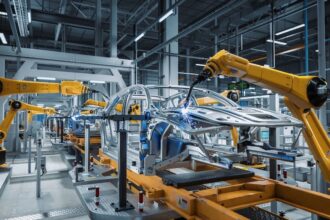
Robotics still plays a critical role in modern fabrication, especially in welding, handling, and repetitive loading. The difference is not effectiveness, it is timing and risk. AI tends to pay back earlier because it attaches to high-frequency decisions across the entire business rather than concentrating capital into a small number of automated cells.
AI vs robotics ROI in sheet metal
UK and European fabricators are operating in a high-mix, low-margin environment. Volatile demand, skilled labour shortages, and rising material costs mean that improvement projects must show results quickly. Faster payback reduces risk and allows companies to modernise incrementally rather than betting heavily on a single automation project.
AI-led improvements also scale across mixed machine fleets, including older lasers, punches, press brakes, and inspection steps, which reflects the reality of many job shops.
Where AI delivers faster payback in sheet metal
Quoting speed and margin accuracy
Quoting remains one of the most underestimated profit levers in fabrication. Slow quotes lose work. Inaccurate quotes win work at the wrong margin.
As The Fabricator has noted in its coverage of digital quoting workflows:
“Quoting is one of the most underestimated bottlenecks in a fabrication shop. If it takes too long or relies on guesswork, you either lose the job or lose money on it.”
This front-end impact is a key reason why AI vs robotics ROI in sheet metal increasingly favours AI-first investments.
AI-assisted quoting systems draw on CAD data, historical jobs, and actual production outcomes. This reduces reliance on tribal knowledge and dramatically cuts the time spent preparing estimates.
The same publication highlights why the financial impact shows up quickly:
“AI-assisted nesting and quoting tools focus on the two biggest cost drivers in fabrication: material and time. Even small percentage improvements here have a major effect on profitability.”
The payback comes from higher quote throughput, faster response times, and fewer margin leaks caused by underestimating setup, cutting, or handling time.
Nesting, material yield, and shop-floor flow
Material is often the single largest cost in sheet metal fabrication. AI-assisted nesting focuses directly on scrap reduction, remnant reuse, and cut-time optimisation.
According to Lantek, material efficiency is one of the fastest ways to see measurable return:
“Material optimization remains one of the fastest routes to measurable ROI in sheet metal. Digital and AI-based planning tools allow fabricators to reduce scrap without changing machines.”
Improvements in material efficiency and workflow stability are a major reason why AI vs robotics ROI in sheet metal continues to favour AI-led investments in high-mix fabrication environments.
Because these gains apply to every sheet processed, even small improvements in yield translate into immediate cost savings. Better nesting logic also stabilises downstream processes by reducing urgent re-nesting, part confusion, and scheduling disruption.
AI quality inspection and defect capture
Quality inspection is another fast-payback area because it reduces scrap, rework, and customer complaints simultaneously.
Oxmaint, which has analysed multiple Vision AI deployments in metal processing, explains the appeal:
“Vision AI systems are being adopted because they catch defects earlier and more consistently than manual inspection, particularly in high-volume metal processing environments.”
In applications where defect costs are high, the return can be rapid:
“In applications where defect costs are high, AI-based visual inspection can reach return on investment in under twelve months by reducing scrap, rework, and customer complaints.”
The key is early detection. Catching a defect after cutting or bending is far cheaper than discovering it after welding, finishing, or shipment.
Bending and forming intelligence
Press brake efficiency is highly sensitive to setup time, bend sequencing, and feasibility errors. AI-driven feasibility checks and automated bend validation reduce engineering iterations and shop-floor trial runs.
Research published in the Computer-Aided Design Journal notes:
“Automated feasibility checks and bend sequence validation reduce engineering iteration and shop-floor trial runs, which directly impacts lead time and labor efficiency.”
The result is fewer aborted setups, higher first-pass success, and reduced dependence on individual operator experience.
Predictive maintenance and uptime
Downtime in sheet metal operations rarely affects a single job. It cascades across schedules, deliveries, and labour utilisation.
Optimi AI highlights why predictive maintenance can pay back quickly when applied correctly:
“Predictive maintenance delivers the most value when applied to bottleneck equipment, where even short periods of unplanned downtime have cascading effects on production schedules.”
When AI models are focused on critical assets, many manufacturers report payback well within the first year.
Why robotics payback often takes longer
Robotics delivers clear benefits when processes are stable, repeatable, and highly utilised. In sheet metal fabrication, that is not always the case.
According to analysis from AMD Machines on automation ROI:
“Robotic automation delivers strong returns when utilization is high and process variation is low. In mixed or high-mix fabrication environments, integration time and changeover complexity can extend payback periods.”
Robotic welding benchmarks reinforce this reality:
“Most successful robotic welding installations achieve payback between one and three years, depending on part consistency, volume, and programming requirements.”
These timelines are not a failure of robotics. They reflect the capital intensity, integration effort, and dependency on upstream process stability.
A simple payback model fabricators can use
A practical way to compare projects is to calculate weekly value rather than theoretical annual ROI.
Payback in months equals total implementation cost divided by weekly benefit multiplied by 4.33.
Weekly benefit can include:
- Material saved through scrap reduction
- Engineering and inspection labour hours avoided
- Increased shipped value due to higher throughput
- Quality-related costs avoided such as rework and claims
AI often wins this model early because its benefits start in quoting and engineering and then cascade onto the shop floor. Robotics tends to win later when a cell is fully loaded and replacing a persistent labour constraint.
MTN analysis
AI is delivering faster payback in sheet metal because it improves decisions before metal is ever cut. Robotics delivers its value after the process is already stable.
For many manufacturers, AI vs robotics ROI in sheet metal has become the clearest benchmark for deciding where to invest first in digital and automation technologies.
The most resilient strategy for many fabricators is AI-first, cell-ready. Stabilise quoting, nesting, quality, and scheduling with AI. Then deploy robotics where utilisation is guaranteed and variation is controlled.
That sequencing reduces risk, accelerates payback, and increases the chance that automation investments deliver their full potential.