AltForm AI Powder Bed Fusion is the company’s software-driven approach to Powder Bed Fusion, placing artificial intelligence, operator guidance, and fleet intelligence at the centre of metal additive manufacturing.
From Prima Additive to AltForm within the Sodick Group
AltForm began operations in 2018 under the name Prima Additive, focusing on industrial laser technologies and metal additive manufacturing. The company developed expertise in Laser Powder Bed Fusion and Direct Energy Deposition with the objective of moving additive manufacturing from prototyping into industrial production.
In May 2025, Sodick Group acquired a majority stake in the business. The company rebranded as AltForm in November 2025. The new name represents “Advanced Laser Technologies for Manufacturing” and reflects an expanded scope covering additive manufacturing, laser-based processes, automation, and digital intelligence.
While the brand changed, the company states that its engineering culture and industrial focus remained the same. The expansion in scope also created an opportunity to rethink machine tools in the context of artificial intelligence.
Why software and AI are becoming central to machine tool builders
AltForm positions software and artificial intelligence as critical to the future competitiveness of European machine tool manufacturers. The company argues that in mature technologies such as Powder Bed Fusion, mechanical performance, laser power, and build volume are becoming increasingly standardized.
As a result, differentiation is shifting toward software intelligence, usability, data exploitation, and operational efficiency. AltForm applies this logic across laser technologies including PBF, Direct Energy Deposition, remote laser welding, laser hardening, and surface treatment processes.
The company identifies a common challenge across these technologies: making complex laser processes accessible, repeatable, cost-effective, and scalable.
Rethinking the human-machine interface
AltForm has focused on redefining the human-machine interface in the context of AI. Traditional PBF systems often require highly skilled operators, typically engineers rather than technicians. This increases total cost of ownership due to training and staffing requirements.
AltForm identified this as a barrier to wider industrial adoption. The company prioritised reducing operational complexity, lowering skill requirements, and supporting operators in daily decision-making.
This strategy also supports a shift in business model. Rather than remaining only a machine builder, AltForm aims to become a platform provider where value is created through data, intelligence, services, and ecosystem integration.
Partnership with Connect Reply
To implement this strategy, AltForm partnered with Connect Reply, part of the Reply Group, to develop a fully integrated software suite for Powder Bed Fusion systems.
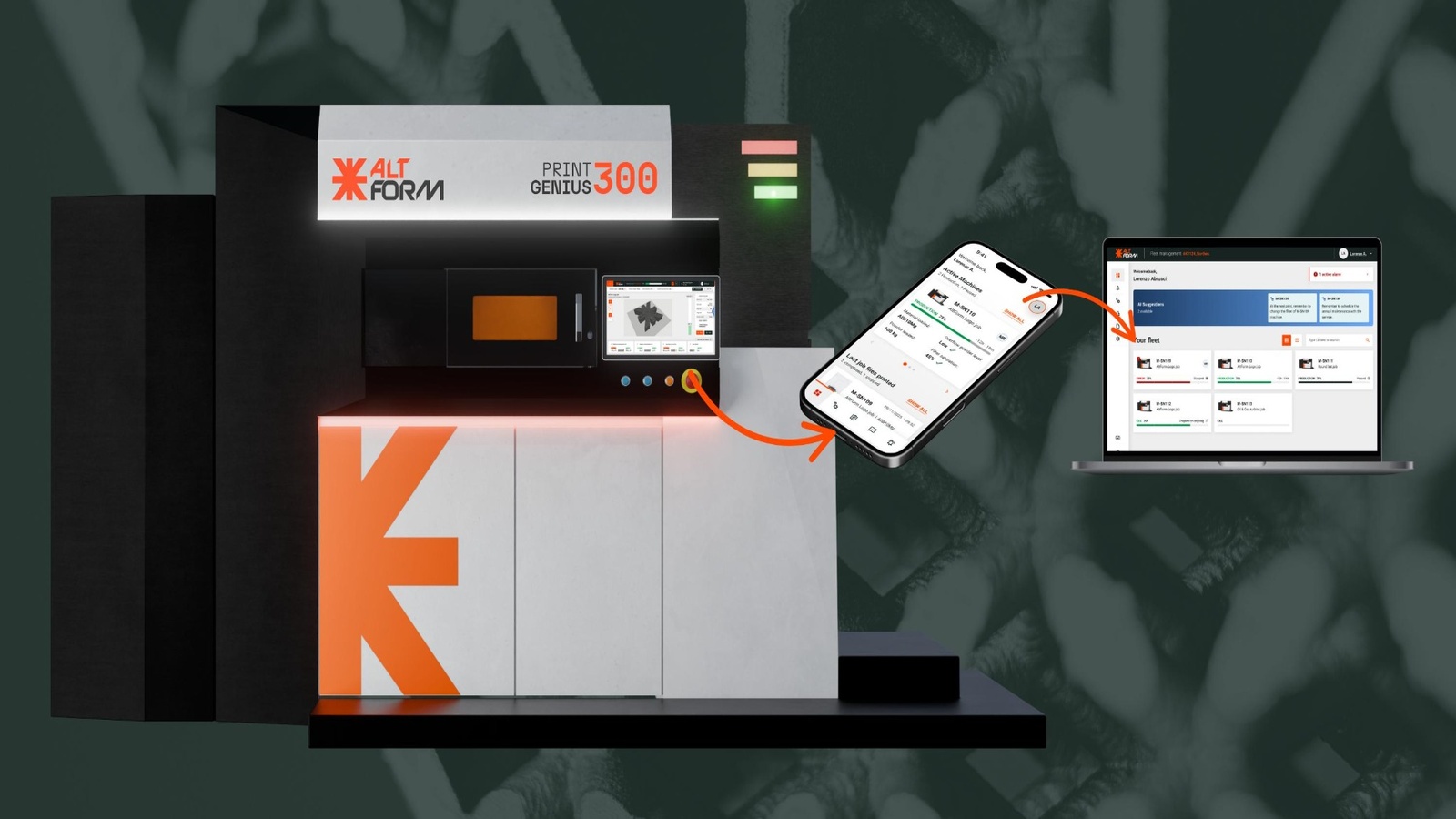
The software was designed as a core component of machine architecture rather than as an add-on. The system consists of three connected layers:
• On-machine human-machine interface
• Mobile interface for remote monitoring and control
• Centralized fleet-management platform
Across all layers, AltForm introduced an AI-based virtual assistant as the first concrete step in AI adoption.
The AI virtual assistant
The virtual assistant is designed as a support tool for operators rather than a black-box optimizer. It is embedded into the machine interface, mobile interface, and fleet-management system.
Its functions include:
• Guided operation for build setup, job preparation, parameter selection, and workflows
• Troubleshooting support for anomaly detection and alarm interpretation
• Maintenance guidance for scheduled and corrective procedures
• Predictive maintenance recommendations based on machine behavior and usage patterns
AltForm states that embedding intelligence directly into the interface reduces reliance on deep process knowledge, lowers training requirements, and improves consistency and reliability.
Mobile control and fleet intelligence
The mobile interface enables users to monitor machine status, job progress, and key production data remotely. This provides real-time access for operators, supervisors, and managers without requiring physical presence at the machine.
Fleet-management software provides centralized oversight of multiple systems. It supports production scheduling, performance analysis, maintenance planning, and data traceability across PBF production environments.
This is intended to support customers scaling from single systems to multi-machine production.
Blockchain, digital passports, and IP protection
AltForm’s software suite also addresses traceability, certification, and intellectual property protection.
The system creates a digital passport for each component containing process data, machine parameters, and production history. Blockchain technology is used to ensure data integrity and support audit and certification requirements.
The same framework enables encrypted build files to be sent to third-party producers such as service bureaus. Machines can execute the job without exposing the underlying geometry, addressing IP protection in distributed manufacturing.
Why Powder Bed Fusion was chosen first
AltForm selected Powder Bed Fusion as the initial focus for its software transformation because it is one of the most mature metal additive processes. With hardware performance converging, the company chose to compete through software intelligence, usability, and operational efficiency.
AltForm’s PBF systems integrate a native AI virtual assistant, positioning software as a primary differentiator rather than a secondary feature.
What comes next
Future development areas include:
• AI-based real-time process monitoring
• Correlation of sensor data, parameters, and part quality
• Continuous learning mechanisms
• Expanded predictive maintenance models
AltForm also plans to extend the same software and AI logic to Direct Energy Deposition and later to remote laser welding and surface treatment processes.
Integrating lasers, automation, and AI
AltForm’s long-term strategy is to integrate advanced laser processes, automation, and artificial intelligence into unified manufacturing platforms. The company states that the goal is to augment human expertise rather than replace it, making complex manufacturing technologies more accessible, efficient, and scalable.
By positioning software as a strategic asset, AltForm is moving from machine building toward a platform model for intelligent laser manufacturing.