Machine Tool News weekly roundup February 2026: This week we have seen how the industry is moving from pilot projects to full production-scale intelligence.
This is one of the clearest financial signals, showing investor confidence in intelligent production.
This week, capital investment, AI robotics deployments, and strategic industry events all pointed in the same direction: artificial intelligence is moving deeper into the core of machine tools, not as an add-on, but as a control-level technology.
From Monday 2 February to Friday 6 February 2026, the industry showed clear signs that AI is moving deeper into the core of manufacturing systems, from the control loop to the balance sheet.
Our Weekly MachineToolNews Round-Up: What Moved in AI This Week
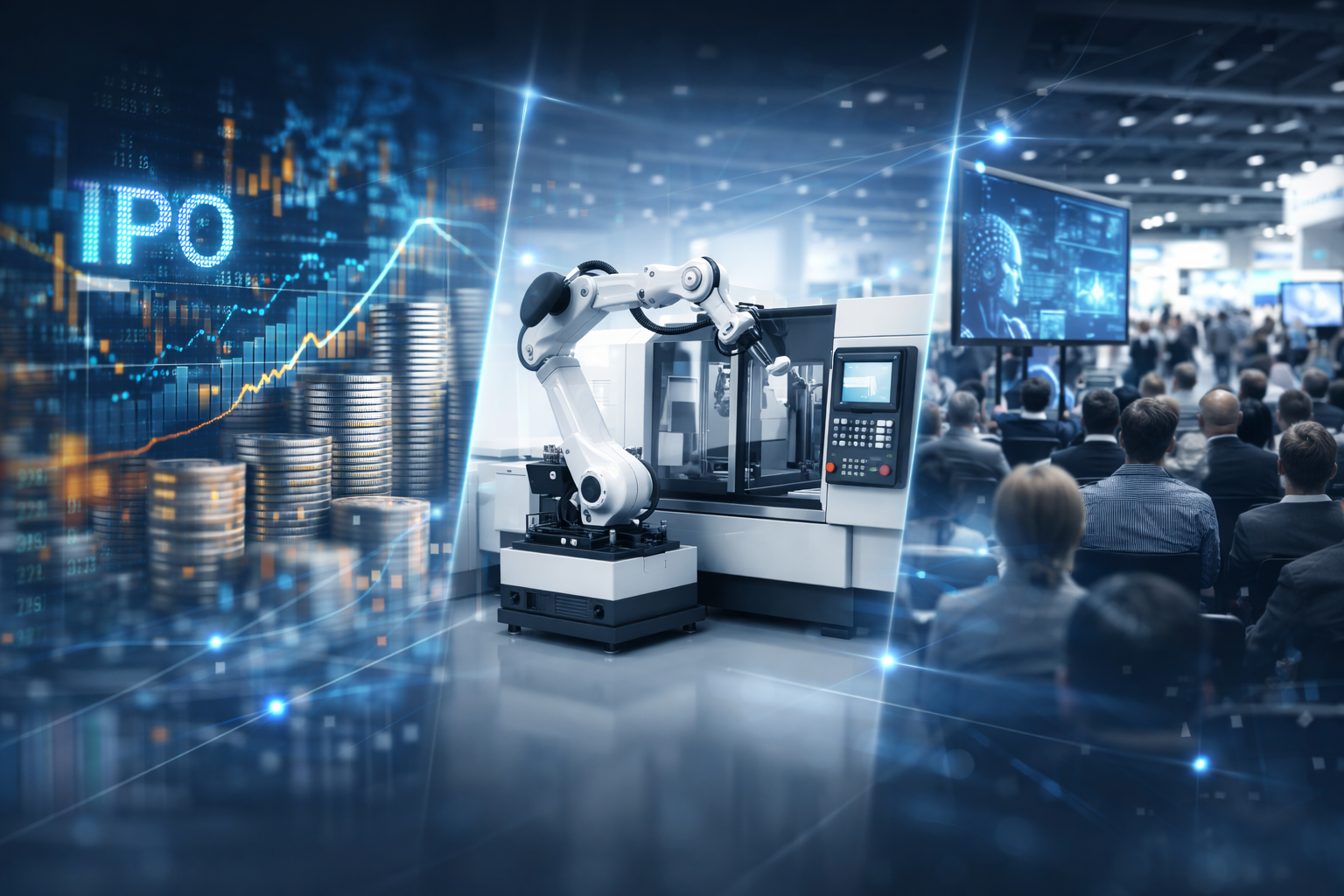
One of the week’s most important developments came from China, where Shenzhen Han’s CNC Technology set the price for its Hong Kong listing at the top end of the range, with shares expected to begin trading on 6 February 2026. According to a Reuters report on Han’s CNC’s planned listing, strong investor demand is pushing the company’s IPO pricing to the top of its expected range.
The company is offering around 50 million shares at HK$95.80 each, aiming to raise billions of Hong Kong dollars in fresh capital.
Han’s CNC specialises in high-precision equipment used in advanced manufacturing sectors. Strong demand for the listing reflects growing investor confidence in companies positioned around automation, smart factories, and AI-enabled production.
MTN analysis
Capital markets are increasingly treating machine tool companies as technology plays rather than pure hardware suppliers.
Large-scale funding rounds like this typically accelerate:
- AI-driven control development
- Robotics integration
- Digital twin platforms
- Smart factory software stacks
In practical terms, this means more AI features will reach production machines faster.
AI robotics facility demonstrates full-scale finishing automation
This week also saw continued momentum in AI robotics, with major industry coverage focusing on the expansion of AI-driven production systems and the shift toward what analysts are calling “physical AI” inside factories.
According to semiconductor supplier NXP, demand is growing rapidly for AI integrated directly into factory automation, robotics, and industrial systems, with its industrial chip business expanding at around 20% growth driven by these applications.
Why this matters for metalworking
Finishing, polishing, and complex handling processes have long resisted traditional automation. AI-enabled robotics, combining vision and adaptive force control, is now making these tasks viable for production cells.
These developments reinforce the direction highlighted in the machine tool AI weekly roundup February 2026, where AI is moving from monitoring tools into real production processes.
MTN analysis
The significance is not only in robotics adoption.
It shows that AI is moving:
- From monitoring systems
- Into real-time physical processes
- Inside machines and robots themselves
This is the transition from digital analytics to physical machine intelligence.
Global AI events confirm shift from pilots to production
Several major AI-focused industrial events took place this week, including the AI & Big Data Expo Global in London (4–5 February 2026), one of Europe’s leading enterprise AI conferences.
The event brought together thousands of attendees to focus on:
- Enterprise AI deployment
- Real-world industrial applications
- Scaling AI beyond pilot projects
Coverage from the same event highlighted the emergence of agentic and enterprise-scale AI systems, with organisations preparing for autonomous digital co-workers and intelligent production environments.
MTN analysis
For years, AI discussions in manufacturing centred on proof-of-concept projects.
This week’s event agenda shows a different conversation:
- How to scale AI across entire factories
- How to integrate AI into daily operations
- How to build AI-first production strategies
That language signals a maturity shift across the industry.
“Physical AI” becomes a core industrial trend
Multiple announcements this week pointed to the same strategic direction:
AI is moving out of dashboards and into machines.
Industry executives described strong demand for “physical AI”, meaning artificial intelligence embedded directly in industrial systems, robotics, and automation platforms.
At the same time, enterprise AI events highlighted the rise of agent-style AI systems designed to act autonomously within production environments.
What “physical AI” means in machine tools
In practical CNC and metalworking terms, this translates into:
- Real-time feed and speed adjustments
- AI-driven toolpath optimisation
- Autonomous inspection and correction
- Self-tuning machining processes
MTN analysis
The biggest structural shift in machine tool AI is not better dashboards or analytics.
It is the integration of AI directly into the control loop. A similar trend can be seen in applications like this autonomous welding robot for maritime maintenance, where AI is already being used to handle complex metalworking tasks in real industrial environments.
This creates three new capabilities:
- Real-time process adaptation
- Autonomous error correction
- Self-optimising production cells
This is the technical foundation for autonomous machining.
Southern Manufacturing show reinforces automation focus
In the UK, the Southern Manufacturing show took place this week from 3–5 February 2026, bringing together machinery, automation, and supply-chain technology suppliers.
While not exclusively an AI event, the show reflects how automation, digitalisation, and intelligent production technologies are becoming central to mainstream manufacturing exhibitions. The machine tool AI weekly roundup February 2026 also shows how investment, robotics, and strategic industry events are now moving in the same direction across global manufacturing.
MTN analysis
Trade shows often reveal buying intent earlier than product launches.
When automation and AI dominate exhibition themes, it usually indicates:
- Strong buyer demand
- Budget allocation for digitalisation
- Competitive pressure to adopt AI
The three strategic signals from this week
Across all developments between 2 and 6 February, three consistent signals emerge.
1) Capital is flowing into AI-ready machine tool companies
The Han’s CNC IPO shows that investors are backing smart manufacturing platforms.
2) AI robotics is entering physical production environments
Industrial demand for “physical AI” indicates real deployment, not only pilot projects.
3) The industry is moving from pilots to autonomous systems
Events and executive commentary confirm a shift toward enterprise-scale, agent-style AI.
The industry is progressing through three stages:
Monitoring → Prediction → Autonomous control
This week shows the third phase is beginning to take hold.
What this means for machine tool buyers
For many manufacturers, the machine tool AI weekly roundup February 2026 highlights how quickly intelligent machining features are moving from optional upgrades to core machine capabilities.
Short term (2026–2027)
- AI-assisted machining becomes standard in new machines
- Inspection moves inside the process
- Hybrid CNC-robot cells grow in adoption
Mid term (2027–2029)
- Self-optimising machines reduce programming time
- Autonomous cells handle mixed-batch production
- AI becomes a core purchasing criterion
Key takeaways
- Major CNC IPO signals strong investor confidence in smart machines.
- Industrial demand grows for “physical AI” inside robotics and automation.
- Global AI events shift focus from pilots to production-scale deployment.
- Trade shows increasingly centred on intelligent manufacturing.
Why it matters
This week did not revolve around a single breakthrough product.
Instead, it showed a deeper structural shift:
- Investors funding AI-ready OEMs
- Factories deploying AI in physical processes
- Executives planning AI-first production strategies
That combination signals the next phase of the machine tool industry.
The machine tool AI weekly roundup February 2026 highlights how investment, robotics, and strategic events are now shaping the direction of intelligent manufacturing.
FAQ: Week in AI for machine tools February 2–6 2026
What was the biggest AI story this week?
The planned listing of Han’s CNC at the top of its range, showing strong investor demand for intelligent manufacturing companies.
What is “physical AI” in manufacturing?
It refers to AI embedded directly into machines, robots, and industrial systems to control processes in real time.
Is the industry moving beyond AI pilots?
Yes. Events and executive commentary this week indicate a clear shift toward full production-scale AI deployments.