Metal Fabrication Trends 2025: What’s Changing
Metal fabrication trends 2025 are defined by AI-driven automation and sustainability. In 2025, three forces are rewriting the rulebook: AI-driven automation, digital connectivity, and sustainability mandates. Fabricators that embrace this shift are reporting higher margins, fewer defects, and stronger positioning with OEM customers. Those that don’t risk being left behind.
Trend 1: AI-Powered Automation Moves Beyond Pilots
AI is moving out of R&D labs and into production cells:
- Vision-based quality control now inspects every bend, weld, and cut in real time.
- Predictive maintenance algorithms monitor machine health, cutting downtime by double digits.
- AI nesting software reduces material waste in laser cutting and punching operations.
For many shops, the first win comes from applying AI to existing machines rather than buying all-new hardware.
Trend 2: Robotic Cells Become Standard, Not Special
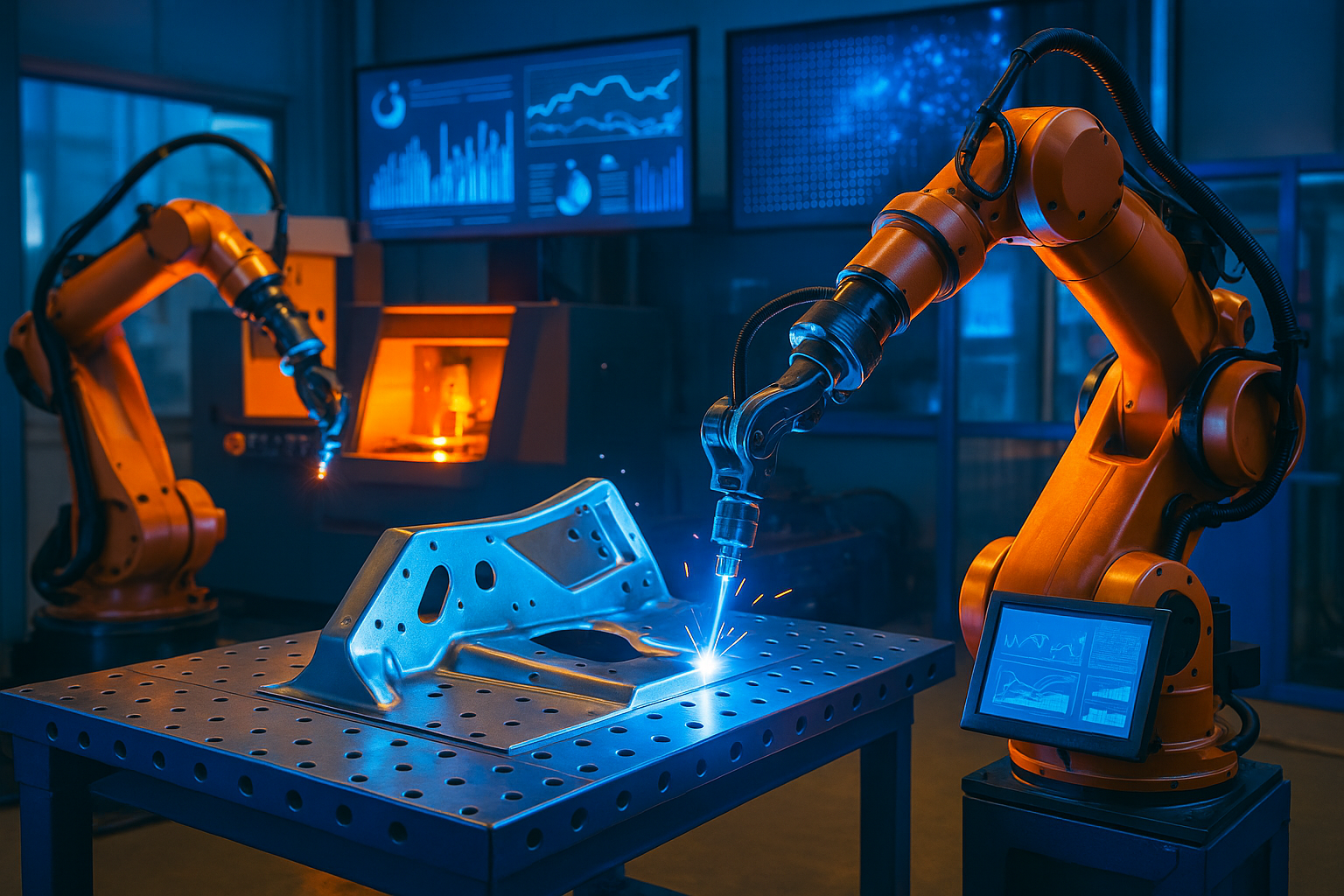
Until recently, robotic bending and handling cells were considered a “nice-to-have.” In 2025, they’re fast becoming standard kit:
- Collaborative robots (“cobots”) now manage repetitive handling with safer, adaptive gripping.
- Fully automated punch–laser–bend combos reduce floor space while boosting throughput.
- Lights-out manufacturing is no longer reserved for Tier 1 OEMs — SMEs are finding modular systems that scale affordably.
Trend 3: Sustainability as a Procurement Requirement
OEMs are demanding data on energy use, emissions, and scrap rates from their suppliers. Fabricators are responding with:
- High-efficiency laser cutting machines that cut power consumption by up to 30%.
- Smarter extraction and filtration systems that lower shop-floor emissions.
- Recycling initiatives, where AI sorts scrap for resale.
For many suppliers, demonstrating sustainability performance is becoming just as important as price in winning contracts.
Trend 4: Lightweight Materials and EV Growth
Electric vehicles (EVs) are reshaping demand for aluminium, advanced steels, and hybrid assemblies. Fabricators are adapting by:
- Investing in tooling for high-strength alloys.
- Pairing sheet metal parts with additive components for lightweight structures.
- Training operators on new material behaviours to avoid costly trial-and-error.
Trend 5: Digital Twins Connect the Entire Workflow
Digital twins are moving beyond CNC machining and into sheet metal cells:
- Virtual prove-outs of punching and bending cycles.
- Real-time energy and material monitoring.
- Linking ERP/MES systems to production cells for closed-loop optimisation.
By 2025, the digital twin is no longer a buzzword — it’s a practical tool for reducing risk.
What It Means for Fabricators
The winners in 2025 will be those that:
- Adopt AI incrementally — starting with software upgrades before big capex.
- Pilot robotic or hybrid cells in high-mix/low-volume areas.
- Track and report sustainability metrics to meet OEM procurement rules.
- Upskill teams in both data and materials.
FAQs
What is the biggest trend in metal fabrication for 2025?
AI-powered automation and robotics, combined with sustainability demands, are leading the transformation.
How can small shops afford automation?
Modular robotic bending cells and software-based AI upgrades allow SMEs to scale step by step.
Is sustainability really affecting contracts?
Yes. Many OEMs now require carbon and energy reporting as part of supplier qualification.
Internal Links
Links:
Sheet Metal Fabrication Market 2025
Digital Twins in Quality Control