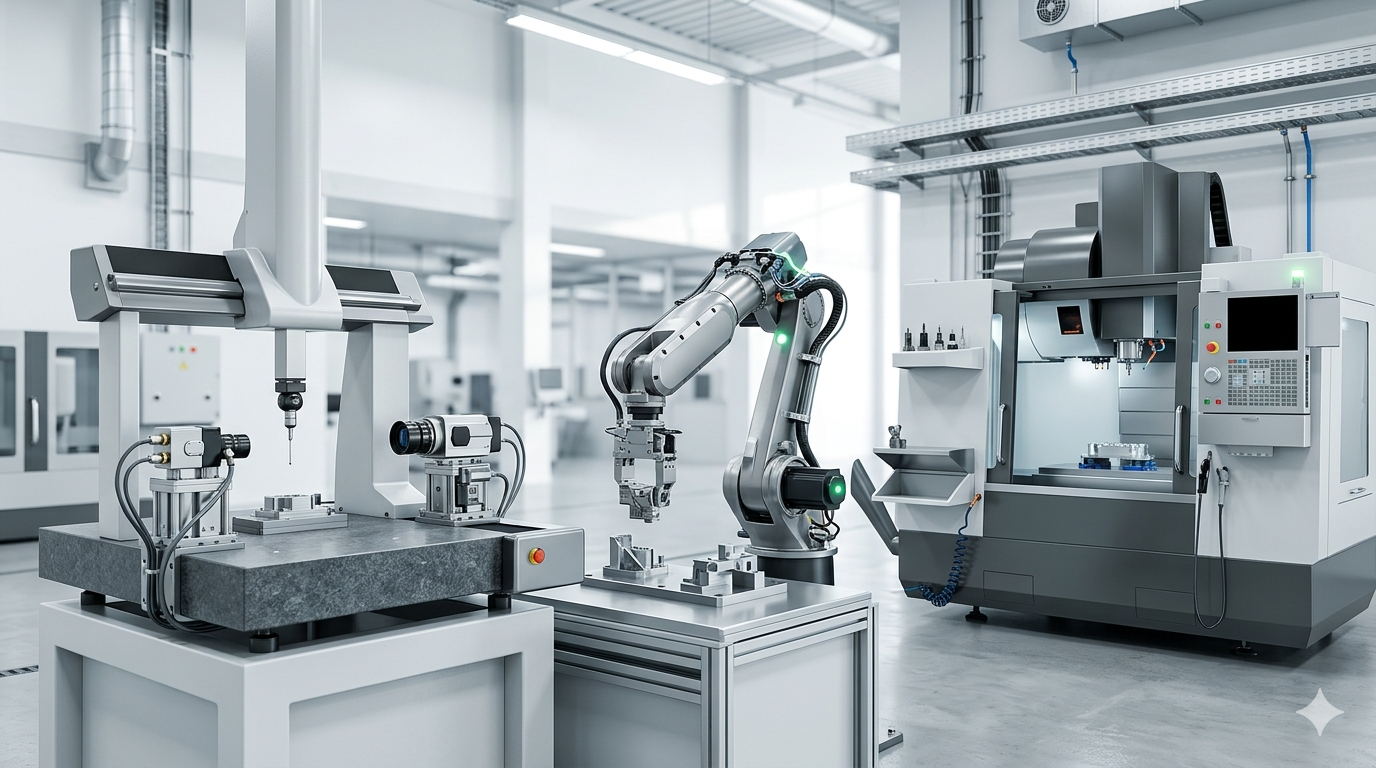
AI in manufacturing March 2026 shows a shift away from experimentation and toward real deployment across metrology, robotics, and production software. The announcements this month are fewer in number, but they are far more targeted, focusing on measurable impact inside real factory environments.
Rather than broad AI claims, this month’s developments highlight specific use cases where manufacturers are already seeing value. For a broader understanding of how AI is being applied across factories, see our breakdown of what industrial AI means for manufacturing.
Here are the key announcements and what they actually signal.
Hexagon Introduces Apollo AI for Predictive Metrology Monitoring
In March 2026, Hexagon AB launched Apollo, an AI-powered predictive condition monitoring system designed specifically for metrology equipment.
This is not a generic monitoring tool. It is built around the realities of inspection environments where:
- Equipment is high value
- Downtime directly impacts production validation
- Measurement accuracy must remain consistent
Apollo uses machine data to identify patterns that indicate wear, drift, or failure before they occur. The goal is to move metrology from a reactive maintenance model to a predictive one. This makes it one of the strongest examples of AI in manufacturing March 2026 being applied to critical production systems.
Why this matters
Most AI maintenance systems have focused on production machines such as CNCs or robots. By targeting metrology, Hexagon is addressing a critical bottleneck.
If inspection fails, production stops. That makes this one of the highest ROI areas for AI deployment.
Lantek Positions AI as Core to Sheet Metal Software Strategy
Also in March 2026, Lantek confirmed its global 2026 trade show programme, with a clear emphasis on AI across its software stack.
While this is not a single product launch, it is strategically important. Software-driven optimisation is becoming a defining theme of AI in manufacturing March 2026.
The company is doubling down on:
- AI-driven nesting to reduce material waste
- Automated production planning
- Real-time decision support across connected factories
What this actually signals
Software providers are no longer treating AI as a feature. It is becoming the decision-making layer of the factory.
In sheet metal specifically, where margins are tight and material costs are high, even small optimisation gains translate directly into profit.
Lantek’s positioning shows that AI in this segment is now:
- Commercial
- Competitive
- Expected by customers
ABB Advances AI Simulation Through NVIDIA Integration
ABB Ltd continued development of its RobotStudio platform in March 2026, building on integration with NVIDIA technologies.
The focus is on enhancing:
- AI-driven simulation environments
- Digital twin accuracy
- Robot programming workflows
This allows manufacturers to simulate entire production processes before deployment, reducing risk and commissioning time. Simulation is now a key pillar of AI in manufacturing March 2026, especially in robotics and automation.
The deeper shift
Simulation is becoming the first step in manufacturing, not an optional extra.
AI adds another layer by enabling:
- Scenario testing
- Automated optimisation
- More accurate prediction of real-world performance
This is where digital twins move from visual tools to decision engines.
MTN Analysis
March 2026 may look quiet on the surface, but the direction is clear. Across all announcements, three patterns stand out:
AI is targeting high-cost failure points
Not generic use cases. Not experimental pilots.
The focus is on:
- Machine downtime
- Programming inefficiency
- Material waste
These are areas where ROI is immediate and measurable.
AI is being embedded, not added
None of the March announcements position AI as a standalone product.
Instead, it is:
- Built into metrology systems
- Integrated into software platforms
- Embedded in simulation tools
This is a critical shift. Adoption increases when AI becomes invisible and part of the workflow.
Software is becoming the control layer
From Lantek to ABB, software platforms are evolving into systems that:
- Analyse
- Decide
- Optimise
The physical machine is no longer the only source of value.
The intelligence layer is where competitive advantage is being created.
AI in manufacturing March 2026 is clearly focused on practical implementation rather than experimentation.
Key Takeaways
- Hexagon AB introduced AI predictive monitoring for metrology, targeting a critical failure point in production
- Lantek confirmed AI as central to software-driven manufacturing workflows
- ABB Ltd continued advancing AI simulation through NVIDIA integration
- AI in manufacturing is now focused on measurable outcomes, not experimentation
- The shift toward embedded intelligence is accelerating across the industry
FAQ
Why were there fewer AI announcements in March 2026?
March sits just before major industrial events such as Hannover Messe, where many companies time their largest product launches. As a result, March tends to focus on strategic positioning and targeted releases.
Which area showed the strongest AI progress this month?
Metrology and simulation stood out, with clear applications of AI in predictive maintenance and digital twin environments.
Is AI now essential in manufacturing software?
Yes. The March announcements reinforce that AI is no longer optional in competitive software platforms, particularly in CAM, nesting, and production planning.
What should manufacturers be paying attention to next?
The next wave of announcements is expected around major trade shows, where AI capabilities will expand further into machining, robotics, and factory-wide optimisation.





One Comment