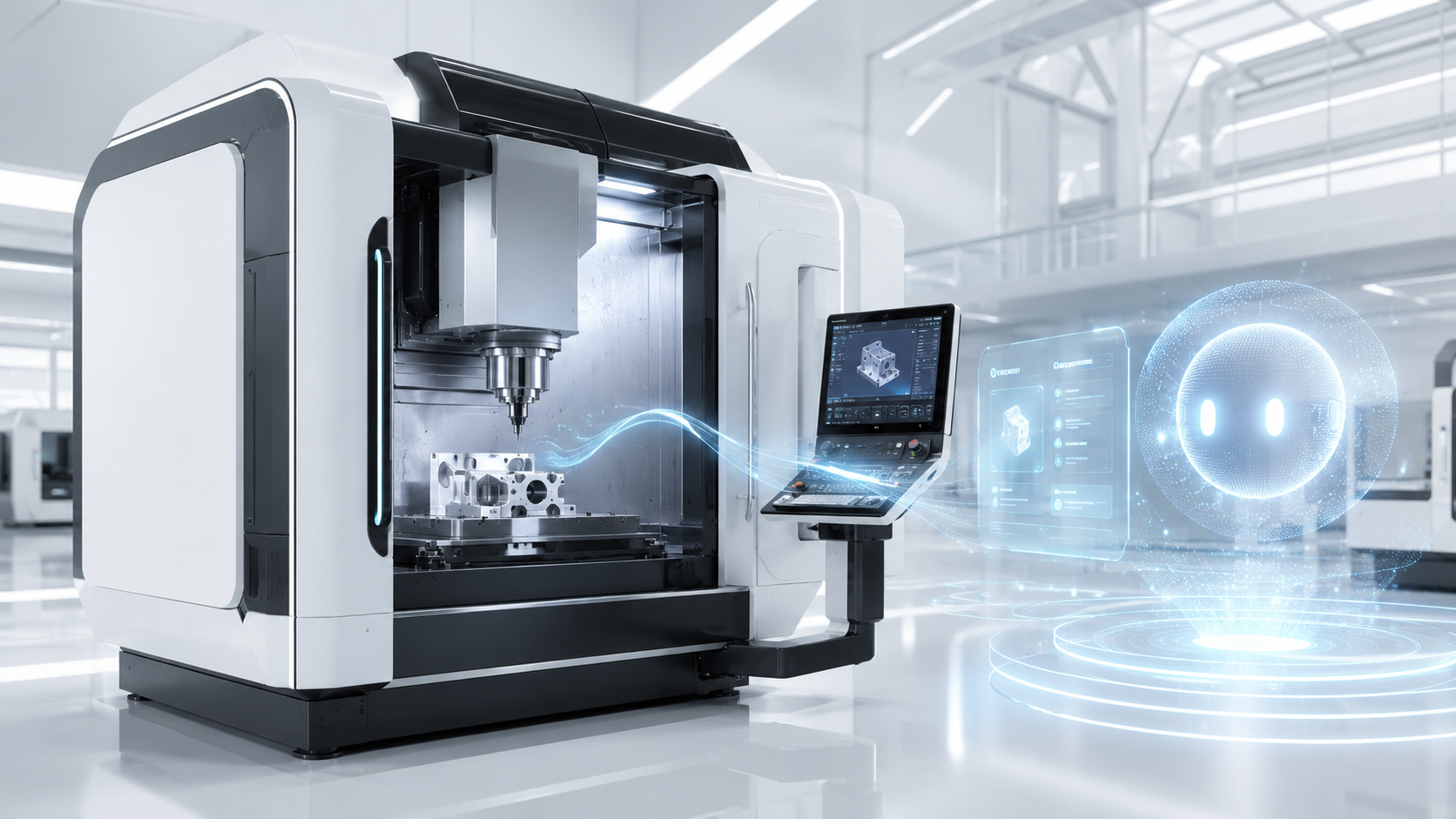
Manufacturing copilot technology is becoming one of the clearest industrial AI trends of 2026. Across Hannover Messe, MACH, Tube, BIEMH and Global Industrie, manufacturers and industrial software companies are moving beyond broad promises about artificial intelligence and starting to place AI directly inside the tools used by CNC programmers, automation engineers, robot users, maintenance teams and production managers.
That raises a serious question for the sector: is 2026 the rise of the manufacturing copilot?
The answer is increasingly yes.
CloudNC, Siemens, Bosch, Schneider Electric, Beckhoff, KUKA, ABB, Mastercam, Hexagon, OPEN MIND, BLM Group and other industrial technology companies are all pushing AI into practical manufacturing workflows. Some call these systems copilots. Others call them AI agents, industrial assistants, co-intelligence platforms or agentic manufacturing systems. The names differ, but the direction is the same: AI is becoming a working interface between people, software and machines.
What is a manufacturing copilot?
A manufacturing copilot is an AI assistant or AI agent built into an industrial workflow. Instead of sitting outside the factory as a generic chatbot, it appears inside CAM software, automation engineering platforms, robotics tools, maintenance systems, production dashboards or industrial data platforms.
That matters because manufacturers do not need AI that gives vague answers. They need AI that understands machines, production data, engineering logic, toolpaths, robot simulations, maintenance issues, cycle times and process constraints.
The strongest manufacturing copilot examples in 2026 are not standalone chat tools. They are embedded into the systems engineers, programmers and operators already use.
CloudNC CAM Assist puts the copilot idea directly into CNC programming
One of the strongest CAM examples in the manufacturing copilot trend is CloudNC CAM Assist.
CloudNC does not brand the product as “CloudNC Copilot,” but the company now clearly places CAM Assist inside the wider CAM copilot category. In its 2026 guide to AI-assisted CNC programming, CloudNC defines a CAM copilot as AI CAM software that helps CNC programmers inside or alongside their CAM system, including guidance, setup support, strategy suggestions and toolpath generation. CloudNC also says CAM Assist fits the CAM copilot category because it integrates with CAM packages to generate machining strategies and toolpaths.
CAM Assist is designed to reduce the manual effort between CAD model and machine-ready CAM program. CloudNC says the software integrates with CAM software to generate machining strategies and toolpaths using AI, helping users complete up to 80% of a CAM program in minutes.
The company’s dedicated pages for CAM Assist for Mastercam and CAM Assist for Siemens NX show how the product is being positioned across major CAM ecosystems. Both pages describe CAM Assist as a way to generate precise and efficient machining strategies inside established CAM workflows.
For machine shops, this is one of the most practical versions of the copilot idea. AI does not sit outside the programming process. It helps generate machining strategies and toolpaths inside the workflow CNC programmers already use.
For MTN readers, CloudNC is important because it brings the manufacturing copilot discussion directly into one of the biggest bottlenecks in metalworking: CAM programming productivity. CNC shops are under pressure to quote faster, program faster and reduce reliance on scarce specialist programming time. CAM Assist is one of the clearest examples of AI being used to attack that problem.
Mastercam brings AI assistance into everyday CNC programming
Mastercam is another major CAM example. Mastercam Copilot is an AI-powered assistant built directly into the Mastercam CAM environment. Users can ask questions in plain language using voice or text, receive answers without leaving the workflow, adjust feeds and speeds, and create machine groups from simple instructions.
Mastercam 2026.R2 also includes AI-powered assistance that allows users to control feed rates, spindle speeds and machine parameters across Mill, Lathe and Router operations using voice or text commands. The release also includes hands-free operation using the “Copilot” keyword.
This matters because many CNC manufacturers already rely heavily on CAM software, but the systems can be complex. A copilot inside the CAM environment could help experienced programmers move faster and help newer users understand software functions, toolpath options and programming steps more easily.
Hexagon adds Copilot to EDGECAM
Hexagon is also moving directly into the CAM copilot space. In April 2026, Hexagon introduced Copilot for EDGECAM as part of EDGECAM 2026.1.
Hexagon says the Copilot brings natural-language assistance into the CAM environment, allowing programmers to ask questions, locate functions and access guidance more easily inside the workflow. The aim is to reduce the time programmers spend searching menus or documentation inside increasingly capable CAM systems.
This is a strong example of where manufacturing copilot technology is likely to gain traction first. CNC programmers do not always need AI to take over. They often need help finding the right function, understanding an option, speeding up repetitive steps or reducing time spent searching documentation.
Siemens NX brings AI suggestions into CAM programming
Siemens is also pushing AI into CAM. In 2026, Siemens highlighted AI Make Machining Suggestion inside NX X Manufacturing.
Siemens describes the new capability as a copilot that gives CNC programmers multiple options for machining specific areas of a part. The programmer then reviews the options and selects the most suitable approach, reducing manual effort in toolpath planning while maintaining human control over the final decision.
That is a strong fit for the manufacturing copilot trend. The value is not only in automation. It is in shortening the decision process, reducing repetitive programming work and helping programmers compare machining strategies more quickly.
OPEN MIND shows the automation-first version of CAM intelligence
OPEN MIND also belongs in the wider CAM copilot conversation. At MACH 2026, the company promoted hyperMILL Intelligence, a technology platform combining rule-based automation, tool-based automation, machine-based optimisation and AI-supported programming.
OPEN MIND’s MACH 2026 material says hyperMILL Intelligence includes an AI assistant designed to personalise real-time guidance for programming workflows.
This is important because not every manufacturing copilot will look like a chatbot. In CAM, the strongest systems may combine rules, automation, digital twins, machine knowledge and targeted AI support. OPEN MIND’s approach shows how AI can sit alongside proven manufacturing logic rather than replacing it.
Bosch brings Manufacturing Co-Intelligence to industrial AI
Bosch is one of the most important names in the 2026 manufacturing copilot story. At Hannover Messe 2026, Bosch Connected Industry expanded its Manufacturing Co-Intelligence® portfolio around agentic AI for production.
Bosch says the approach combines industrial production expertise, data capabilities, AI and Microsoft technologies to increase production efficiency. Its Hannover Messe exhibitor profile describes Manufacturing Co-Intelligence as intelligent collaboration between humans, machines and agentic AI, supported by semantic data management and shopfloor solutions.
Bosch does not use the word “copilot” as its main label here, but the direction is closely aligned. The company is positioning AI as a practical production layer that supports human decision-making, process improvement and coordinated industrial workflows.
Siemens moves from industrial copilot to engineering agent
Siemens has been one of the most active companies in industrial AI, and 2026 has taken that further with the Eigen Engineering Agent.
Launched at Hannover Messe 2026, the Siemens Eigen Engineering Agent connects to TIA Portal, Siemens’ Totally Integrated Automation engineering platform. Siemens says it is production-ready and available to more than 600,000 TIA Portal users.
Siemens also says the agent understands project data structures, blocks, parameters and component relationships, allowing it to deliver outputs tailored to real automation engineering projects, including legacy or undocumented systems.
This is a major step because the manufacturing copilot is moving beyond basic support. In automation, it is becoming a tool that can help engineers with project context, repetitive work and practical control system tasks.
Schneider Electric pushes the industrial copilot into agentic manufacturing
Schneider Electric also belongs near the top of the 2026 copilot story. At Hannover Messe 2026, Schneider Electric unveiled next-generation agentic manufacturing capabilities powered by Microsoft Azure AI.
The company’s industrial copilot approach is designed to help manufacturers improve engineering, diagnostics and operational efficiency. Schneider Electric’s 2026 announcement said the industrial copilot can cut engineering time by up to 50%, with some production changes moving from weeks to hours.
That is why this trend matters. The value of a manufacturing copilot is not only about answering questions. It is about reducing the time taken to configure, diagnose, adapt and optimise industrial systems.
Beckhoff TwinCAT 3 CoAgent targets the automation lifecycle
Beckhoff is another key 2026 example. At Hannover Messe 2026, the company highlighted TwinCAT 3 CoAgent as AI agents for the entire automation lifecycle and machine control.
Beckhoff’s 2026 press kit also describes TwinCAT CoAgent as translating natural language into machine commands and enabling intuitive control of complex mechatronic systems.
For machine builders, system integrators and automation teams, this is important because Beckhoff technology is deeply embedded in industrial control. If AI agents become part of commissioning, diagnostics, machine control and service support, the manufacturing copilot becomes a practical engineering tool rather than a marketing concept.
KUKA brings the copilot into robot simulation
Robotics is another area where the manufacturing copilot is becoming more practical.
KUKA iiQWorks.Copilot is an AI copilot for robot simulations. KUKA says users can control simulations and robots through natural language, using text input to add components, move them, change properties and start simulations.
KUKA has also explained that iiQWorks.Copilot uses Azure OpenAI, Azure AI Search and Azure cloud infrastructure to enable natural-language robot programming and faster simulation workflows.
This could be highly relevant for manufacturers that want to use robotics but do not have large in-house automation teams. Robot programming and simulation can be complex. A natural-language copilot could make it easier for more people to create, test and adjust robotic workflows.
ABB adds Copilot integration to industrial maintenance
ABB’s 2026 AI activity shows how manufacturing copilots are spreading into maintenance and operations.
In April 2026, ABB announced that My Measurement Assistant+ now features multilingual Copilot integration. The solution provides device-specific assistance and is designed to help maintenance teams resolve technical issues faster.
ABB’s approach matters because downtime, diagnostics and maintenance support are obvious industrial AI use cases. A manufacturing copilot that can help a technician understand equipment behaviour, identify issues and act faster could deliver value beyond programming and engineering.
BLM Group shows how AI assistance is entering tube processing
The copilot trend is also starting to reach tube and sheet metal processing.
At Tube 2026, BLM Group presented an AI-enhanced tube bending ecosystem. The company described a new integrated solution combining hardware, software and AI to simplify programming and production changeovers, making tube bending more accessible for less experienced operators.
BLM Group’s Tube 2026 material also framed the system as an answer to the challenge of finding skilled tube bending operators, combining machine software and digital services to make the process simpler and faster.
This is a useful example because it shows that manufacturing copilot-style thinking is not limited to CAM and robotics. It is also moving into specialist production processes where operator knowledge, setup experience and programming skills are hard to replace.
Industrial software companies are joining the copilot wave
The 2026 trend is not limited to machine tools, CAM and automation. Wider industrial software companies are also building AI assistants and agentic factory systems.
AVEVA presented an Industrial AI Assistant on CONNECT at Hannover Messe 2026, powered by OpenAI and intelligent agents. The system is designed to deliver contextual insights, task assistance and conversational intelligence in the cloud.
Accenture, Avanade and Microsoft also announced Agentic Factory, aimed at reducing manufacturing downtime through AI agents.
At BIEMH 2026, TECNALIA presented OMNIA, an ecosystem of smart actors designed for industrial environments. TECNALIA describes a first level of industrial conversational assistance, followed by intelligent agent orchestration and proactive industrial AI.
The wider message is clear. The manufacturing copilot is not one product category. It is becoming a new layer across industrial software, production intelligence, maintenance, automation and factory decision-making.
MTN Analysis: 2026 is the year the copilot becomes an industrial interface
The biggest change in 2026 is that the manufacturing copilot is becoming part of the industrial user experience.
For years, manufacturers have worked through complex menus, dashboards, manuals, software settings, programming languages and specialist engineering tools. These systems will remain essential, but AI copilots are starting to sit alongside them.
That means a CNC programmer can ask a CAM system for help. A programmer can generate machining strategies faster. An automation engineer can work with an AI agent inside a control platform. A robot user can create a simulation through natural language. A maintenance technician can receive device-specific support. A factory manager can query production data more easily.
This is why the rise of the manufacturing copilot matters. It is not about replacing skilled people. It is about giving skilled people better access to complex systems.
The most important early use cases are already visible:
- CNC programmers using AI inside CAM software.
- Automation engineers using AI inside engineering platforms.
- Robot users creating and adjusting simulations through natural language.
- Maintenance teams diagnosing equipment issues faster.
- Tube and sheet metal operators receiving AI-supported programming assistance.
- Factory managers using AI to understand production data.
- Operators receiving support without searching through manuals.
Some of these tools are mature. Some are early-stage. Some are branded as copilots, while others are described as AI agents, co-intelligence platforms or industrial assistants. The direction is now clear.
2026 is shaping up to be the year the manufacturing copilot moves from concept to workflow. For machine tool companies, CAM vendors, automation specialists and factory software providers, that could mark one of the most important changes in how people interact with industrial technology.
Key Takeaways
- The manufacturing copilot is becoming a major 2026 industrial AI trend.
- CloudNC CAM Assist is one of the clearest CAM copilot-style examples because it uses AI to generate machining strategies and toolpaths inside established CAM workflows.
- Mastercam, Hexagon, Siemens NX and OPEN MIND show how CAM software is becoming one of the most active areas for AI assistance.
- Bosch, Siemens, Schneider Electric and Beckhoff show how AI agents are moving into automation, engineering and production intelligence.
- KUKA shows how copilots can make robot simulation and programming more accessible.
- ABB, AVEVA, Accenture and TECNALIA show how the trend is expanding into maintenance, operations and factory decision support.
- The biggest impact may come from making complex industrial software easier to use, faster to navigate and more accessible to manufacturing teams.
FAQs
What is a manufacturing copilot?
A manufacturing copilot is an AI assistant or AI agent built into industrial software, CAM systems, automation platforms, robotics tools, maintenance systems or production data platforms. It helps users work with complex factory systems through natural language, contextual guidance or AI-supported recommendations.
Why is 2026 important for manufacturing copilots?
2026 is important because several major industrial companies have launched or expanded AI copilots, AI agents and industrial AI assistants. The trend is appearing across CAM, robotics, automation engineering, maintenance, asset performance, tube processing and factory operations.
Which companies are leading the manufacturing copilot trend?
Key companies include CloudNC, Siemens, Bosch, Schneider Electric, Beckhoff, KUKA, ABB, Mastercam, Hexagon, OPEN MIND and BLM Group. Wider industrial software companies including AVEVA, Accenture and TECNALIA are also part of the broader AI assistant and agentic factory trend.
Are manufacturing copilots replacing CNC programmers or engineers?
The strongest current use cases are focused on assisting skilled people. Manufacturing copilots help users find functions, understand options, adjust parameters, create simulations, diagnose problems and reduce repetitive work.
Why are CAM copilots important for machine shops?
CAM copilots are important because CNC programming can be complex and time-consuming. AI assistance inside CAM software can help programmers generate machining strategies, adjust feeds and speeds, create machine groups, understand toolpath options and work more efficiently.
Further reading on MachineToolNews.ai
CloudNC’s CAM Assist 2.0 Brings AI-Powered CNC Programming to 1,000+ Machine Shops Worldwide
AI CAM Software 2026: hyperMILL vs NX vs Mastercam



2 Comments