Well, that’s “sorted” then, as we say here in the UK, meaning something has been properly dealt with, efficiently and without unnecessary complication.
And in many ways, TCI Cutting have well and truly sorted one of the most persistent challenges in modern sheet metal manufacturing.
Because while cutting technology has advanced rapidly, what happens after the cut has often remained slow, manual and inefficient.
With the launch of AI Smart Sorting®, TCI Cutting is directly targeting that bottleneck, bringing intelligent automation to a stage of production that has long limited overall factory productivity.
To understand exactly how this works in practice, we sat down with TCI Cutting to find out more.
Q&A: AI Smart Sorting® and the Future of Sheet Metal Manufacturing
TCI Cutting unveiled AI Smart Sorting® at BIEMH. Can you explain, in practical shop-floor terms, what the system does?
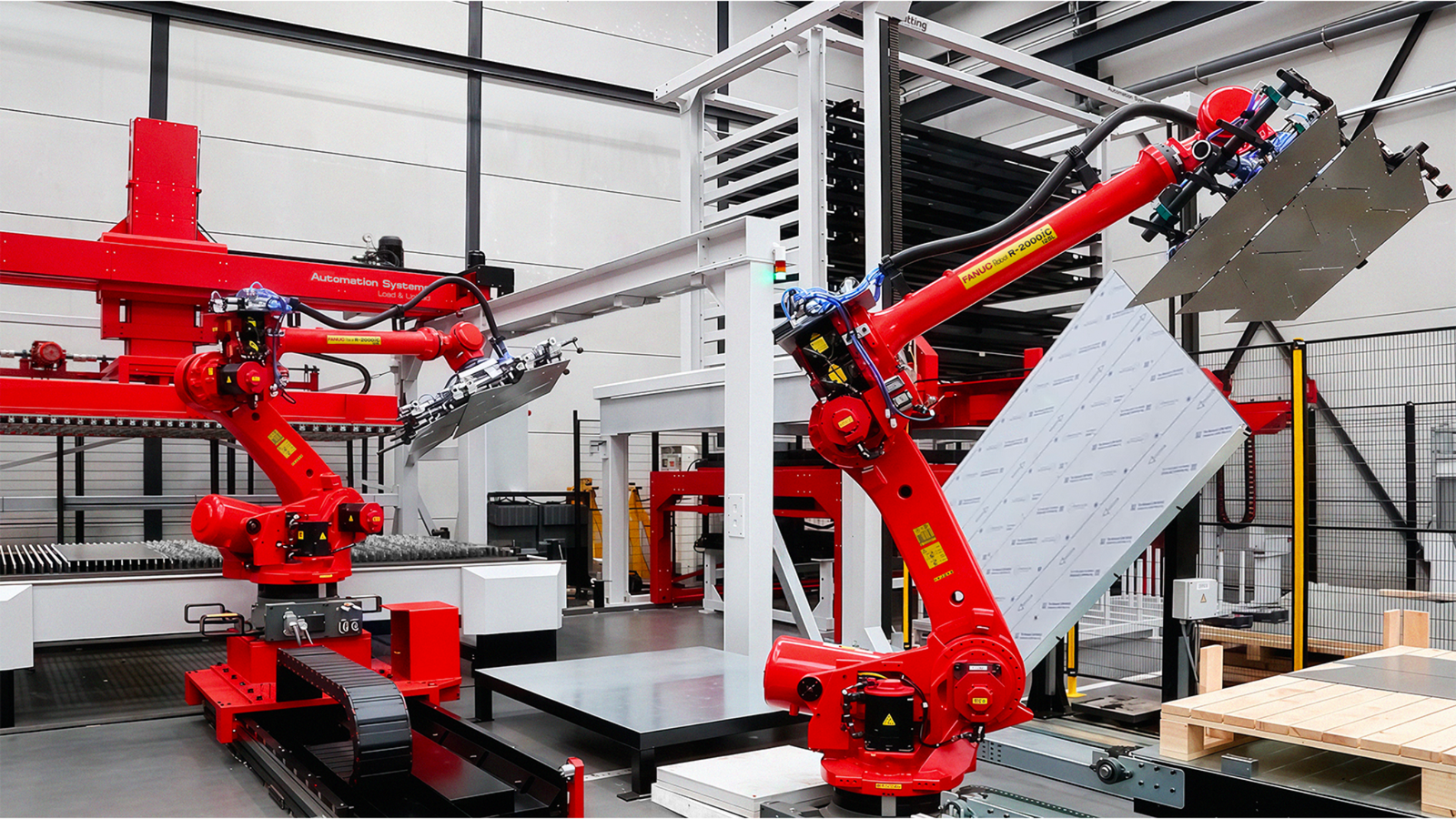
In practical terms, AI Smart Sorting® takes care of a critical stage that begins immediately after cutting: unloading, identifying, sorting and palletising the parts. In other words, it automates a process that in many factories still depends heavily on manual handling, downtime and significant operator intervention.
What sets it apart is that the system does not simply move parts. Using production data, it can automatically calculate the optimum extraction formula from the cutting table, so that each part is removed in the most efficient way possible and directed correctly to the pallet, container or production flow to which it belongs. This logic is executed by the robot in real time, with self-learning capability and continuous improvement.
In addition, extraction and palletising can be carried out simultaneously, reducing unproductive time and clearly accelerating the manufacturing flow. Ultimately, what matters is that parts do not just leave the machine cut, but already prepared and linked to downstream processes such as bending, welding or assembly.
All of this fits fully within our MAS Concept®, which integrates machinery, automation and software into a connected digital ecosystem. For us, Smart Sorting® is not a standalone solution, but a very clear example of where industrial manufacturing is heading: smarter, more autonomous, digital environments increasingly supported by AI to optimise real plant productivity.
What specific sheet metal processing challenges were you aiming to solve with AI Smart Sorting®?
The challenge was to solve one of the sector’s major bottlenecks: what happens after cutting. In many plants, the process of unloading, separating, sorting and organising parts is still slow, labour-intensive, unsafe and prone to error. That is often where a significant part of the productivity gained at the cutting machine is lost.
With AI Smart Sorting®, we address precisely that critical point. The solution automates post-cutting operations in order to reduce manual handling, minimise errors and ensure that parts leave the system already organised for the next production step.
Ultimately, it is not just about automating a task, but about preventing a factory that is highly advanced in cutting from still relying on inefficient downstream processes. That is where there is a major opportunity to raise overall plant productivity and bring greater continuity to the entire value chain.
How does the system actually “understand” and identify the parts? What role does AI play compared with traditional automation or rules-based sorting?
The main difference is that we are not talking about rigid automation. Conventional systems usually operate with fixed programming or predefined rules. In our case, AI Smart Sorting® works with production data and nesting information to recognise the parts, calculate the best extraction logic and manage sorting in the most efficient way.
That is where AI comes in: not as a label, but as a genuine capability to optimise decisions in real time and improve performance as the system accumulates experience and data. In other words, it is not just automation; it is intelligent automation.
This approach is aligned with how many of our customers see us: as a company at the forefront of industrial AI adoption, always applied to real factory needs. We are not interested in using AI for the sake of trend; we apply it where it delivers speed, consistency, autonomy and measurable operational value.
From the customer’s perspective, where are you seeing the biggest measurable gains? Is it labour reduction, speed, fewer errors, or something else?
In most cases, the improvements do not come from a single factor, but from the combination of several. There is a clear reduction in manual handling, but customers also see faster post-cutting flow, fewer sorting errors, greater traceability and a much more structured connection between cutting and subsequent operations.
What the customer gains is overall productivity, greater process stability and a stronger ability to sustain demanding production rates with less friction between stages.
And that is highly important, because competitiveness today is not only about cutting quickly, but about ensuring that the entire production cell operates as a coordinated system. That is precisely the logic behind MAS Concept®: the integration of cutting, automation and software to maximise productivity and autonomy.
How easily can AI Smart Sorting® be integrated into an existing cutting line or factory?
Our approach is based on real industrial flexibility. AI Smart Sorting® is designed to adapt to the customer’s production environment, not the other way round. This means it can be integrated into existing cutting lines and can also form part of a broader intelligent manufacturing ecosystem, depending on each company’s level of automation and growth strategy.
One of the keys to this ease of implementation is TCI Sorter 3.0®, our software for full sorting and palletising programming, which makes it possible to configure, adjust and prioritise operations very quickly, in just a few clicks. This greatly simplifies commissioning and system adaptation for different part types, stacking criteria and production requirements, making automation far more accessible and practical for the customer.
One of our strengths is precisely this end-to-end vision. We do not approach automation as an isolated module, but as part of a scalable architecture that can grow with the customer. Under MAS Concept®, a company can integrate highly autonomous cutting machinery, loading and unloading automation, intelligent sorting, robotics and production management software within a single connected environment.
This allows each customer to move at their own pace towards a more autonomous, data-driven factory, without having to undertake a closed or rigid transformation from day one.
Many manufacturers remain cautious about AI because of complexity and cost. How are you addressing those concerns with this solution?
That caution is entirely understandable, and we fully recognise it. That is why our message is not “AI for AI’s sake”, but rather an industrial solution with a clear operational return. What matters is not introducing a striking technology, but solving a real production problem in a useful, measurable and sustainable way.
Our approach is to simplify implementation, support the customer throughout integration and demonstrate value in very concrete terms: less manual intervention, greater process reliability, higher productivity and improved overall factory flow.
In addition, we have a technological foundation that reinforces that credibility. We do not only apply AI in Smart Sorting®, but also in the production software environment with Manager PRO®, which incorporates analytics, traceability, monitoring and real-time decision-support capabilities. This gives customers confidence, because they can see that we are speaking from real industrial solutions, not from an abstract promise.
Looking beyond this launch, how do you see AI evolving in sheet metal manufacturing over the next three to five years?
We believe that in the coming years AI will significantly expand its role within the factory. It will not only be used to optimise specific tasks, but also to support planning, order prioritisation, equipment coordination, material flow, traceability and real-time decision-making.
The major shift will not simply be having more automation, but enabling factories to become more connected, more adaptive and more capable of self-optimisation. That is the direction in which the sector is moving, and also the direction increasingly demanded by our customers.
That evolution only makes sense when machinery, automation, software and data work as one. And that is precisely what MAS Concept® represents: a scalable digital ecosystem in which production is connected from machine to data in order to improve every shift and every decision.
How is TCI Cutting positioning itself within the broader shift towards autonomous or self-optimising factories?
Our vision is to act as a technology partner in the industrial transformation of our customers, integrating machinery, automation and software into a single connected production ecosystem.
Our goal is to make cutting part of an intelligent, highly efficient and data-driven production flow. Within that model, solutions such as Smart Sorting®, loading and unloading automation, robotics, TCI Sorter® software and Manager PRO® do not operate separately, but as coordinated elements within the same industrial logic.
That is also what differentiates us in the market. Our customers see us as a company with strong technical capability, a highly practical approach to digitalisation and an advanced position in the industrial use of AI. Not because we say so, but because we bring it to real installations, concrete solutions and industrial projects with a direct impact on factory productivity and autonomy.
MTN Analysis: Why AI Smart Sorting® Matters
AI Smart Sorting® highlights a critical shift in manufacturing.
For years, innovation has focused on cutting speed and precision. But productivity is often lost in the stages that follow.
By addressing unloading, sorting and flow between processes, TCI Cutting is not improving a single machine. It is improving the entire production system.
That is where the next wave of competitive advantage will be found.
FAQ: AI Smart Sorting® and TCI Cutting
What is AI Smart Sorting®?
AI Smart Sorting® is an automated system developed by TCI Cutting that handles unloading, identifying, sorting and palletising parts after cutting using AI and production data.
Why is post-cutting automation important?
Because manual sorting and handling often slow production, introduce errors and reduce the overall efficiency gained from high-speed cutting machines.
How does AI improve sorting compared to traditional systems?
AI enables real-time decision-making, optimisation and continuous improvement, rather than relying on fixed rules or programming.
Can AI Smart Sorting® be integrated into existing factories?
Yes, it is designed to adapt to existing cutting lines and scale within broader manufacturing environments.
What is MAS Concept®?
MAS Concept® is TCI Cutting’s framework for integrating machinery, automation, software and data into a connected, intelligent production ecosystem.
For Further information Visit www.TCI Cutting.com
Read More: Sheet Metal