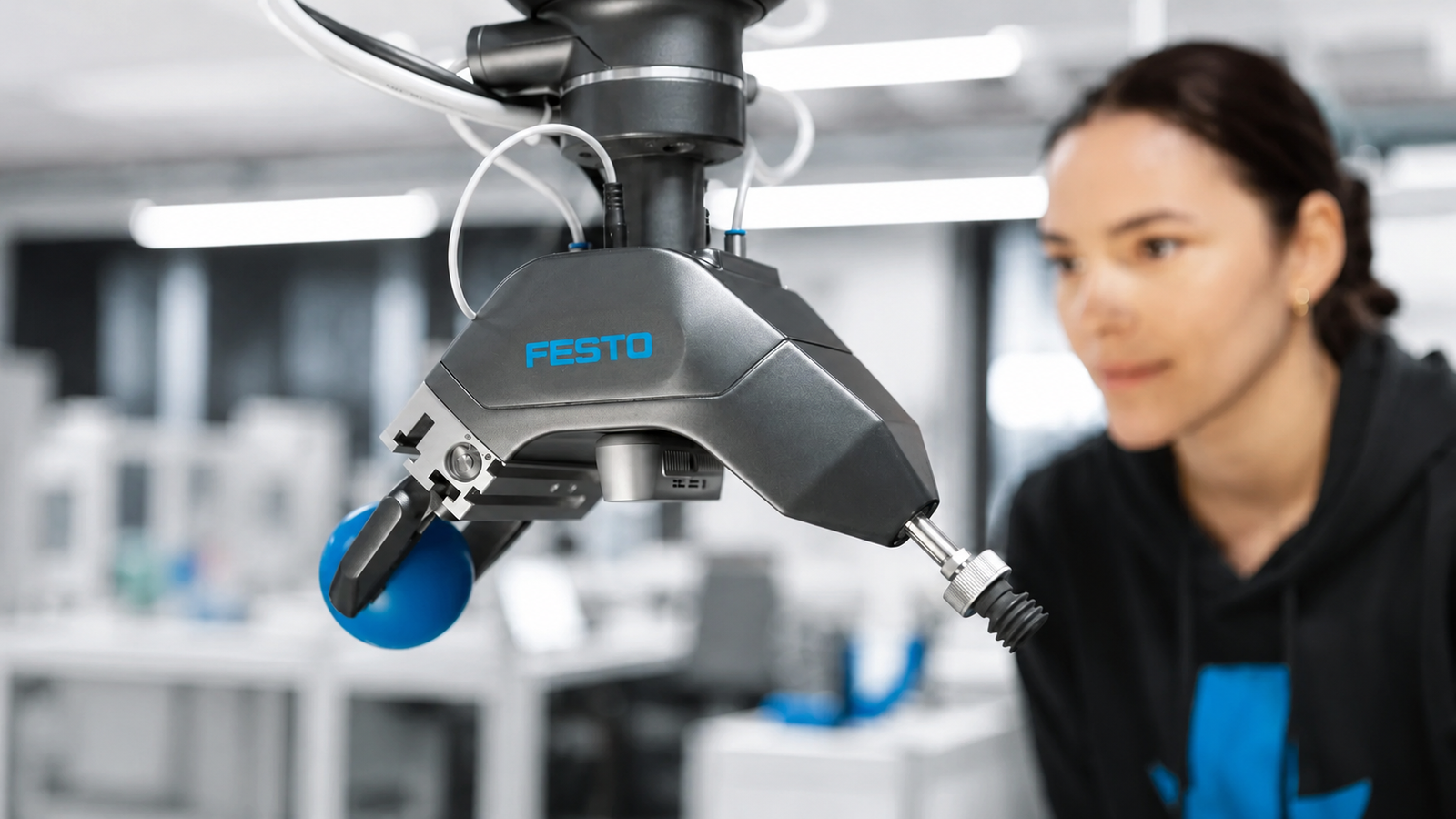
Festo is attacking one of the most stubborn problems in robotic automation: product variation.
At Würth’s logistics centre in Künzelsau, Germany, products arriving at final packaging can range from small items such as USB sticks and spray cans to boxes weighing as much as 20 kilograms. Instead of following a fixed gripping routine, a robot using Festo GripperAI examines each item, calculates where it should be gripped and selects the most appropriate tool available.
The result is a robot cell designed to cope with the unknown, rather than a predictable sequence of identical components.
That distinction matters. Manufacturers have become extremely effective at automating repetitive tasks where every component arrives in the same position. Mixed products, changing batches, unfamiliar geometries and inconsistent surface conditions remain far harder and more expensive to automate.
Festo GripperAI is designed to reduce that complexity by turning the gripping decision into an AI-driven software process.
The Real Challenge Is Product Variation
Traditional robot cells work best when engineers can define exactly what the robot will encounter. The gripping point, tool, component orientation and robot movement can then be programmed and repeatedly executed.
That model becomes increasingly difficult when hundreds or thousands of different products pass through the same operation.
Würth has approximately one million products within its wider portfolio. Its final packaging stations therefore have to deal with enormous differences in product size, shape, weight, material and surface finish. Heavy products also place considerable physical strain on employees responsible for removing items from sorter trays and packing them into shipping cartons.
Festo’s answer was to develop a robot cell capable of making several decisions autonomously:
- Where should the product be gripped?
- Which available gripper or suction cup is most suitable?
- How should the robot approach the product?
- What should happen when the first gripping attempt fails?
This is where GripperAI moves beyond conventional pick-and-place programming.
A Robot That Identifies Its Own Gripping Tool
The Würth robot cell includes a tool station containing different mechanical grippers and suction cups.
An integrated camera captures information about the objects arriving in the trays. GripperAI then assesses characteristics including the object’s type, shape and surface before deciding which gripping tool should be used. The selected gripping position is sent to the robot’s path-control system, which performs the movement.
When a gripping attempt is unsuccessful, the software can recalculate the gripping point and try again. This allows the cell to continue operating without immediately requiring an engineer to stop the system and create a new programme.
The software operates locally on a standard industrial PC connected to a 3D camera. Processing at the cell supports real-time performance while allowing operational data to remain within the factory or logistics facility, according to a technical overview of Festo’s AI-based picking system.
Festo Recreated Würth’s Conveyor System in Its Laboratory
The project involved more than installing a camera and connecting an AI model.
Festo’s Advanced Development Analytics and Control team built a replica of Würth’s sorter conveyors inside its own laboratory. Over a development period of more than two years, the team worked on object-dependent gripper selection, removing different objects from trays, packing shipping cartons and handling the trays and cartons themselves.
This approach gave Festo a controlled environment in which it could repeatedly test the application before transferring the technology into Würth’s live logistics operation.
The completed robot cell has been operating at Würth since spring 2023 and can serve the designated sorter lines. Festo and Würth have also identified further optimisation and development steps for the system.
That live deployment provides an important proof point. GripperAI is already being tested against the variation, interruptions and physical demands found in a genuine industrial logistics operation.
Robot-Agnostic Software Could Be the Bigger Breakthrough
Festo says GripperAI is compatible with most industrial robots, cobots and Cartesian handling systems equipped with path control.
Its software architecture can also operate across different camera types, allowing manufacturers and system integrators to select suitable vision hardware without becoming tied to one proprietary camera platform.
This could become one of the system’s most commercially important qualities.
Flexible automation projects frequently become dependent on a tightly integrated combination of robot, vision system, gripper and specialist software. Changing one part of that combination can require additional integration, testing and programming.
A robot-agnostic AI layer gives manufacturers greater freedom to use existing equipment, expand cells with different robot models and select vision hardware according to the application and budget.
Standard integration work is still required. The camera must be mounted and aligned, lighting conditions must be checked, the robot and camera coordinate systems must be calibrated, and the relevant picking parameters must be configured. Once that work has been completed, the system can handle product changes without loading individual templates between SKUs.
MTN Analysis
The breakthrough within GripperAI lies in reducing the amount of engineering required every time the product mix changes.
Robot hardware has long been capable of moving quickly, accurately and repeatedly. The commercial difficulty appears when manufacturers need the same robot cell to handle unpredictable objects, short production runs, changing packaging and components that cannot be presented in a perfectly controlled orientation.
Each variation can create additional programming, tooling, fixturing and vision-integration work. That engineering burden makes many potential automation projects too expensive or inflexible to justify.
GripperAI shifts more of those decisions into software. The system sees the object, calculates a gripping point, selects the available tool and automatically attempts a revised strategy when necessary.
Peter Potters, Product Manager for End-of-Arm Tooling at Festo, described the technology as “a strong example of AI being applied practically to address operational issues” in Festo’s announcement about the GripperAI system.
For manufacturers, the practical test will be whether this approach can deliver dependable cycle times and gripping success rates across their own product mix.
The Würth pilot shows where the opportunity is strongest today: operations with high SKU variation, difficult manual handling, changing product geometries and limited appetite for constant robot reprogramming.
Festo GripperAI is therefore more than an intelligent gripper application. It represents a different automation model, where robots can respond to the product placed in front of them instead of requiring every possible variation to be engineered in advance.
FAQ
What is Festo GripperAI?
Festo GripperAI is AI-powered software that calculates gripping points and helps robots select the most suitable available gripper for mixed, unfamiliar or randomly positioned products.
Where is Festo GripperAI being used?
A pilot robot cell has been operating at Würth Group’s logistics centre in Künzelsau, Germany, since spring 2023.
How much weight can the Würth GripperAI system handle?
The application is designed to handle products and packages weighing up to 20 kilograms.
Does GripperAI require programming for every product?
The robot cell requires standard camera, robot and application integration. Once configured, GripperAI can adjust to different products without individual template loading or repeated programming between SKUs.
Can Festo GripperAI work with different robot brands?
Festo says the software is compatible with most industrial robots, cobots and Cartesian handling systems that have a suitable path-control system.
What happens when the robot misses a grip?
GripperAI can recalculate the gripping point and retry the operation, helping the cell continue working without immediately stopping for reprogramming.
Further Reading
June 2026 AI Manufacturing Releases: Kawasaki, ABB, Siemens, Mitsubishi, Festo and More
What Is Physical AI in Robotics and Automation?
Comau AI Robotics 2026: How AI Is Changing Flexible Automation