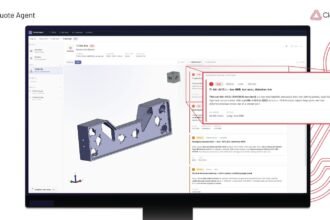
C-Infinity is developing AI that connects engineering and production, using geometry and physics-based reasoning to automate manufacturing and assembly planning. Sai Nelaturi explains how AutoAssembler is designed to help manufacturers respond to engineering changes and bring manufacturing intelligence earlier into the product development process.
Artificial intelligence is moving deeper into manufacturing.
The focus is increasingly shifting from AI as a tool for analysing production data to AI that can support engineering decisions, process planning and the way products are actually built.
That is the problem C-Infinity is targeting with AutoAssembler.
The company is developing AI that can interpret product models from CAD and PLM systems and translate them into validated, production-ready manufacturing plans. Its approach combines AI with geometry and physics-based reasoning to understand assembly sequences, accessibility, tooling and manufacturing constraints.
For manufacturers, the challenge is familiar. CAD and PLM systems can define what a product should look like, while ERP and MES systems support planning and execution. But the engineering work connecting those stages can still depend heavily on manual decisions.
When a product changes, engineers may need to revisit assembly sequences, tooling, fixtures and manufacturing documentation. C-Infinity believes AI can automate much of this work and bring manufacturing knowledge closer to the point where design decisions are made.
In this MTN Q&A, Sai Nelaturi discusses how C-Infinity approaches that problem, where AI is already delivering value, why integration and trust matter, and how manufacturing AI could change the relationship between product design and production.
MTN Q&A: C-Infinity on AI and the Future of Manufacturing
MTN: For anyone who hasn’t come across C-Infinity before, what are you building and what problem are you trying to solve for manufacturers?
Sai Nelaturi:
At C-Infinity, we’re building AI that understands how products are actually manufactured. Our platform, AutoAssembler, takes product models from CAD and PLM systems and turns them into validated, production-ready manufacturing plans.
The problem we’re solving is the gap between engineering and production. Manufacturers have invested heavily in tools to design products and systems to run factories, but a huge amount of work still happens manually in between. Engineers have to determine how a product should be assembled, in what sequence, with which tools and fixtures, and then revisit that work every time the design changes.
AutoAssembler uses AI combined with geometry and physics-based reasoning to automate much of that process. We sometimes describe it as a “manufacturing compiler”: you give it the product definition, and it helps translate that into how the product can be built.
MTN: There is a huge amount of discussion around AI in manufacturing at the moment. Where do you think it is genuinely delivering value today, rather than still sitting at the pilot or proof-of-concept stage?
Sai Nelaturi:
The clearest value today is in areas where engineers are spending large amounts of time interpreting complex information and making repeatable decisions.
Process planning is a good example. When you have an assembly with hundreds or thousands of parts, determining the sequence, checking accessibility and interference, identifying the tooling required, and keeping all of that aligned with engineering changes can consume enormous amounts of engineering time.
AI can now reason through much of that complexity very quickly. That is where we see the opportunity moving beyond the proof-of-concept stage: not using AI simply to summarize a document or create a chatbot but embedding intelligence directly into the engineering-to-production workflow.
MTN: What does C-Infinity do differently from the traditional manufacturing software and automation platforms already used on the factory floor?
Sai Nelaturi:
We’re not trying to replace CAD, PLM, ERP, MES or factory automation. Those systems are extremely important, but they primarily manage product information, business processes, or execution.
C-Infinity adds a reasoning layer between the product definition and production. AutoAssembler can understand geometry, spatial relationships, assembly constraints, motion, and manufacturing logic. It can reason about whether something can be assembled, how it should be assembled, and what changes when the product changes.
That distinction is important. Traditional software is very good at storing and moving information. We’re focused on helping manufacturers reason about that information and turn it into an executable manufacturing plan.
MTN: When you go into a manufacturing business, what tends to be the biggest barrier to using AI effectively: the technology, the quality of the data, integration with existing systems, or getting people to actually use it?
Sai Nelaturi:
Usually it isn’t just one of those things. The bigger challenge is fitting AI into the way manufacturing actually works.
Manufacturers already have decades of investment in CAD, PLM, ERP, MES and automation, and they have experienced engineers who understand their products and processes incredibly well. An AI system has to work with that environment rather than asking the manufacturer to rebuild everything around a new platform.
Trust is also critical. In manufacturing, an answer that sounds plausible isn’t enough. Engineers need to understand that the output respects geometry, physics and manufacturing constraints, and they need to remain in control of the process.
That’s why we think the successful applications of AI in manufacturing will be the ones that integrate into existing workflows, produce outputs engineers can trust, and make skilled people more productive rather than asking them to completely change how they work.
MTN: Can you give us a real example of how C-Infinity can change an existing manufacturing process and what the manufacturer gets out of it in practical terms?
Sai Nelaturi:
Consider what happens when an engineering change is made to a complex assembly. Traditionally, someone has to determine which manufacturing steps are affected, whether the assembly sequence still works, whether tooling or fixtures need to change, and then update the relevant manufacturing documentation.
With AutoAssembler, the system can evaluate the change against the existing production plan, identify what is affected, and replan those portions while preserving what has not changed.
The practical benefit is that engineers spend less time manually reconstructing the impact of every change. That can shorten the path from an engineering change to production readiness, reduce repetitive work and help identify manufacturing issues before they reach the factory floor.
MTN: A lot of manufacturers have machines and software from several different suppliers. How important is it for an AI platform to work across that existing technology rather than requiring companies to replace what they already have?
Sai Nelaturi:
It’s essential. Very few manufacturers operate in a completely homogeneous technology environment, and no serious AI strategy can assume they are going to replace years of investment just to adopt a new platform.
Our philosophy is that AI should connect the systems manufacturers already rely on. AutoAssembler works with product information coming from CAD and PLM and can generate structured manufacturing outputs that can flow into ERP, MES and other factory systems.
Ultimately, AI becomes much more useful when it connects information across the manufacturing lifecycle. The goal shouldn’t be to create another silo. It should be to make the existing technology stack more intelligent.
MTN: Over the next two or three years, where do you think AI will have the biggest impact inside manufacturing businesses, particularly around machining, production and factory operations?
Sai Nelaturi:
I think one of the biggest changes will be AI moving earlier in the manufacturing lifecycle.
Today, manufacturers often discover production problems after a design is largely complete. Engineers then have to work backwards: Can we manufacture this? Can we assemble it efficiently? Do we have the right tooling and equipment? What needs to change?
AI creates the opportunity to answer more of those questions while the product is still being designed. Instead of waiting until process planning or production to identify an issue, manufacturers will increasingly be able to understand the manufacturing impact of a design decision as that decision is being made.
Over time, that creates a much tighter feedback loop between design, process planning, and the factory.
MTN: If we sit down again in a year’s time, what do you want C-Infinity to have achieved, and what will manufacturers be able to do with the technology that they cannot do today?
Sai Nelaturi:
A year from now, I’d like to see manufacturers using this kind of intelligence much earlier and more broadly in their product-development process.
Today, a lot of manufacturing knowledge is applied downstream, after engineers have already made important design decisions. We want to move that intelligence upstream so manufacturers can understand manufacturing and assembly implications while designs are still evolving.
The bigger vision for C-Infinity is to move manufacturing software from managing data to reasoning about how products are built. If we do that well, engineers will be able to evaluate more alternatives, respond to changes much faster and reach production with greater confidence that what they designed can be built efficiently.
MTN Analysis
C-Infinity’s approach points to an important development in industrial AI.
Much of the manufacturing AI conversation has focused on analysing machine data, improving inspection, optimising production and supporting factory operations. At the same time, AI is beginning to move further upstream into engineering and product development.
That is where process planning becomes particularly important.
A product can be correctly designed in CAD and documented in PLM while still creating difficult manufacturing questions. How should it be assembled? In what sequence? Can the required tools reach the relevant areas? Will a design change affect existing tooling or fixtures?
Those decisions can require significant engineering time.
C-Infinity’s AutoAssembler is designed around that problem. Rather than simply moving information between engineering and production systems, the platform is intended to reason about the relationship between product geometry and manufacturing requirements.
This is also why integration matters.
Manufacturers already have established CAD, PLM, ERP and MES environments. AI will have to operate within those environments if it is going to become part of everyday manufacturing workflows.
The same applies to trust.
Manufacturing decisions cannot rely solely on an AI system producing a plausible answer. Engineers need confidence that the output respects the physical and manufacturing constraints of the product. They also need to retain control over the resulting process.
This could make manufacturing process planning an important area for AI adoption.
If AI can analyse engineering changes and identify their impact on assembly sequences, tooling and production plans, engineers could spend less time repeating manual analysis and more time making higher-level manufacturing decisions.
The longer-term opportunity is even broader.
C-Infinity’s vision is to move manufacturing knowledge upstream, so that engineers can understand the production implications of design decisions while those decisions are still being made.
That could create a tighter feedback loop between design, engineering, process planning and production.
For manufacturers, the significance of that shift is not simply faster planning. It is the possibility of identifying manufacturing constraints earlier, when changes are easier to make.
FAQ
What is C-Infinity?
C-Infinity is developing AI technology for manufacturing and assembly planning. Its AutoAssembler platform is designed to connect product information from CAD and PLM systems with manufacturing planning.
What is AutoAssembler?
AutoAssembler is C-Infinity’s AI platform for manufacturing planning. It combines AI with geometry and physics-based reasoning to analyse products and assemblies and help determine how they can be built.
What problem is C-Infinity trying to solve?
C-Infinity is focused on the gap between engineering and production. Its technology is designed to automate parts of process planning and help engineers understand how product changes affect manufacturing.
Does C-Infinity replace CAD, PLM, ERP or MES?
No. C-Infinity describes AutoAssembler as a reasoning layer that works with existing manufacturing systems rather than replacing them.
Why is trust important when using AI in manufacturing?
Manufacturing decisions depend on physical constraints, geometry, tooling, accessibility and assembly requirements. AI-generated manufacturing plans therefore need to be validated and understood by engineers.
How could AI change manufacturing process planning?
AI could automate parts of the analysis involved in process planning and help engineers assess the manufacturing impact of product changes more quickly.
Could AI move manufacturing intelligence into product design?
That is a central part of the vision described by C-Infinity. The aim is to help manufacturers understand manufacturing and assembly implications while designs are still evolving.
Further Reading
For more MachineToolNews.ai coverage on AI, engineering and manufacturing:
- Siemens Data Alliance: Q&A on the Future of Industrial AI
- AI Adoption in Manufacturing: A Free Practical Toolkit for UK SMEs
- What Is Industrial AI and How Is It Used in Factories?
- What Is Industrial AI in CNC Machining and Why It Matters Now
- AI Toolpath Optimisation 2026: How CAM Software Is Learning From Real Cutting Data