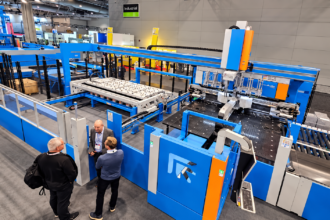
LVD made a strong impression at EuroBLECH 2026, showcasing its new AI-powered RBS 40 Vision robotic bending system and winning an innovation award for CADMAN Suite 9. The LVD RBS 40 Vision demonstration showed how this approach could make automated bending more adaptable to changing production requirements.
The company demonstrated how artificial intelligence can make sheet metal bending more flexible by recognising parts, locating them and checking their orientation before the robot starts work.
The award went to CADMAN Suite 9 in the Advanced Manufacturing Software & AI category. RBS 40 Vision and LVD’s Ricobb cobot bending solution were also finalists in their respective categories. For manufacturers evaluating AI in sheet metal fabrication, the most immediately practical development is the RBS 40 Vision demonstration in Hall 12, Stand F104.
LVD RBS 40 Vision: AI recognises the part before bending
The AI-powered vision system identifies a sheet metal part, finds its position in a stack and checks that it is correctly oriented. This tackles a familiar limitation of automated bending: the robot needs to know where a workpiece is before it can grip and present it to the press brake.
LVD says the vision system allows standard Euro pallets to be used at the input station, removing the need for dedicated inclined pallets and precisely predefined part positions. Parts can be stacked more densely, allowing more material to be supplied before the operator needs to reload the cell.
The LVD RBS 40 Vision can also compensate for certain variations in the way a part is positioned. If a part is too far out of alignment or mirrored, the system raises an alert for operator intervention. The objective is to prevent an incorrect bending operation and avoid unnecessary scrap.
We highlighted this approach in our EuroBLECH 2026 AI exhibitor preview because it addresses a specific shop-floor problem: varying part presentation in high-mix production.
Removing the centre table can shorten cycle times
LVD RBS 40 Vision also removes the need for physical part referencing on a centre table.
The second important change is the removal of physical part referencing on a centre table. Instead of transferring the workpiece to a separate referencing position before bending, RBS 40 Vision uses its vision-guided detection and positioning system to locate the part.
LVD says eliminating this step significantly reduces cycle times. Its 20 October press release does not give a percentage reduction, so the improvement will need to be assessed against a manufacturer’s own parts, handling sequence and production mix.
For fabrication businesses handling a variety of small batches, the combination of flexible pallet loading and fewer positioning steps could make robotic bending easier to operate over longer unattended periods.
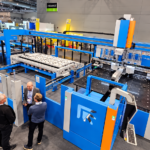
The complete RBS 40 Vision cell shown in Hanover
At EuroBLECH, LVD paired RBS 40 Vision with a ToolCell press brake featuring automatic tool changing and its Easy-Form Laser (EFL) adaptive angle measurement system. The tool changer supports flexible production across different jobs, while EFL supports bend-angle accuracy. These are distinct technologies working alongside the AI vision capability.
The demonstrated configuration handles parts up to 1,600 × 1,200 mm, weighing up to 40 kg, with a maximum profile length of 2,000 mm, according to the supplied press pack.
The broader robotic bending platform also uses CADMAN-SIM software to generate bending and robot programs offline, without on-machine robot teaching. That is particularly relevant in high-mix environments where programming and changeovers can undermine the business case for automation.
CADMAN Suite 9 takes the EuroBLECH Innovation Award
LVD’s award success came from CADMAN Suite 9, winner of the EuroBLECH Innovation Award 2026 in the Advanced Manufacturing Software & AI category. Organisers blechnet and MM MaschinenMarkt confirmed LVD as the winner following public industry voting.
CADMAN Suite 9 brings LVD’s production software modules into a more connected workflow, including CADMAN-B for bending, CADMAN-F for panel bending and CADMAN-SIM for robotic bending simulation. LVD highlights improved programming, optimised tool use, easier operation and greater integration from preparation to production.
The award category includes AI, although LVD’s announcement describes CADMAN Suite 9 primarily in terms of software integration and workflow improvements. The explicit AI function described in the RBS 40 Vision launch is vision-based part identification and orientation verification.
RBS 40 Vision and Ricobb were finalists rather than winners. Their recognition alongside the CADMAN award makes the wider story one of connected production software, robotic vision and more accessible bending automation.
Why it matters for sheet metal manufacturers
Robotic bending cells often depend on predictable workpiece presentation. When a workshop regularly switches between different shapes and batch sizes, keeping parts aligned, programming the next job and maintaining uninterrupted operation becomes more difficult.
AI part recognition tackles one part of that challenge. Standard pallets, less precise stacking and fewer separate referencing steps could reduce operator attention and handling. We have seen a related trend in TCI Cutting’s AI Smart Sorting system, where machine vision helps automate another labour-intensive sheet metal handling task. For high-mix production, LVD RBS 40 Vision could make robotic bending less dependent on precise part positioning and operator intervention.
Manufacturers should still examine how a cell handles near-identical parts, reflective surfaces, different stack heights and rejected orientations. LVD’s press release describes the capabilities, but does not publish recognition accuracy, average operator interventions or independently measured cycle-time savings.
MTN Analysis: AI earns its place on the bending line
For us, LVD RBS 40 Vision is a practical example of industrial AI doing a clearly defined job on the shop floor. When a robot can find a part in a variable stack and check its orientation, the production cell becomes less dependent on fixed presentation rules. That is particularly valuable where product variety makes traditional automation harder to justify.
CADMAN Suite 9’s award adds another dimension. The future of flexible bending will depend on how well part recognition, offline robot programming, automatic tool changes and bend correction work together. AI vision is one component of that larger manufacturing workflow.
The real test for LVD RBS 40 Vision will now be how these advantages translate into measurable results in day-to-day production.
The next useful evidence would be a live customer comparison covering cycle time, scrap, intervention frequency and unattended operating hours. LVD has explained the underlying functions; real production data would help manufacturers make a sound investment decision.
FAQ
What is LVD RBS 40 Vision?
LVD RBS 40 Vision is a robotic sheet metal bending system with AI-powered vision that identifies parts, locates their position and checks orientation before bending.
How does the AI system reduce setup and handling?
It enables standard Euro pallets and more flexible part stacking, and removes the need to reference each part physically on a centre table before bending.
What did LVD win at EuroBLECH 2026?
CADMAN Suite 9 won the EuroBLECH Innovation Award in the Advanced Manufacturing Software & AI category. RBS 40 Vision and Ricobb were finalists in separate categories.
What are the capacity limits of the exhibited RBS 40 Vision?
The EuroBLECH configuration was specified for parts up to 1,600 × 1,200 mm, up to 40 kg, with a maximum profile length of 2,000 mm.
Does LVD provide a measured cycle-time saving?
LVD says that removing centre-table referencing significantly reduces cycle times, but the supplied release does not publish a specific percentage.
Further Reading
Our EuroBLECH 2026 AI exhibitor guide
That’s Sorted: TCI Cutting’s AI Smart Sorting Revolution
AI in Sheet Metal Automation: Smart Bending and Laser Cutting
Official LVD RBS 40 Vision product information