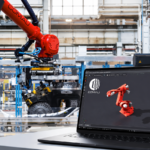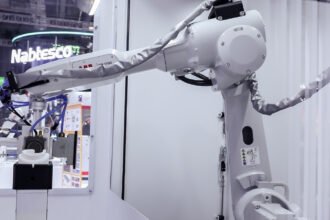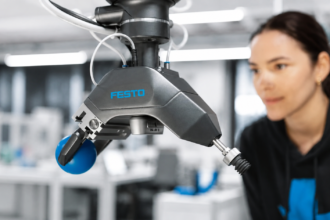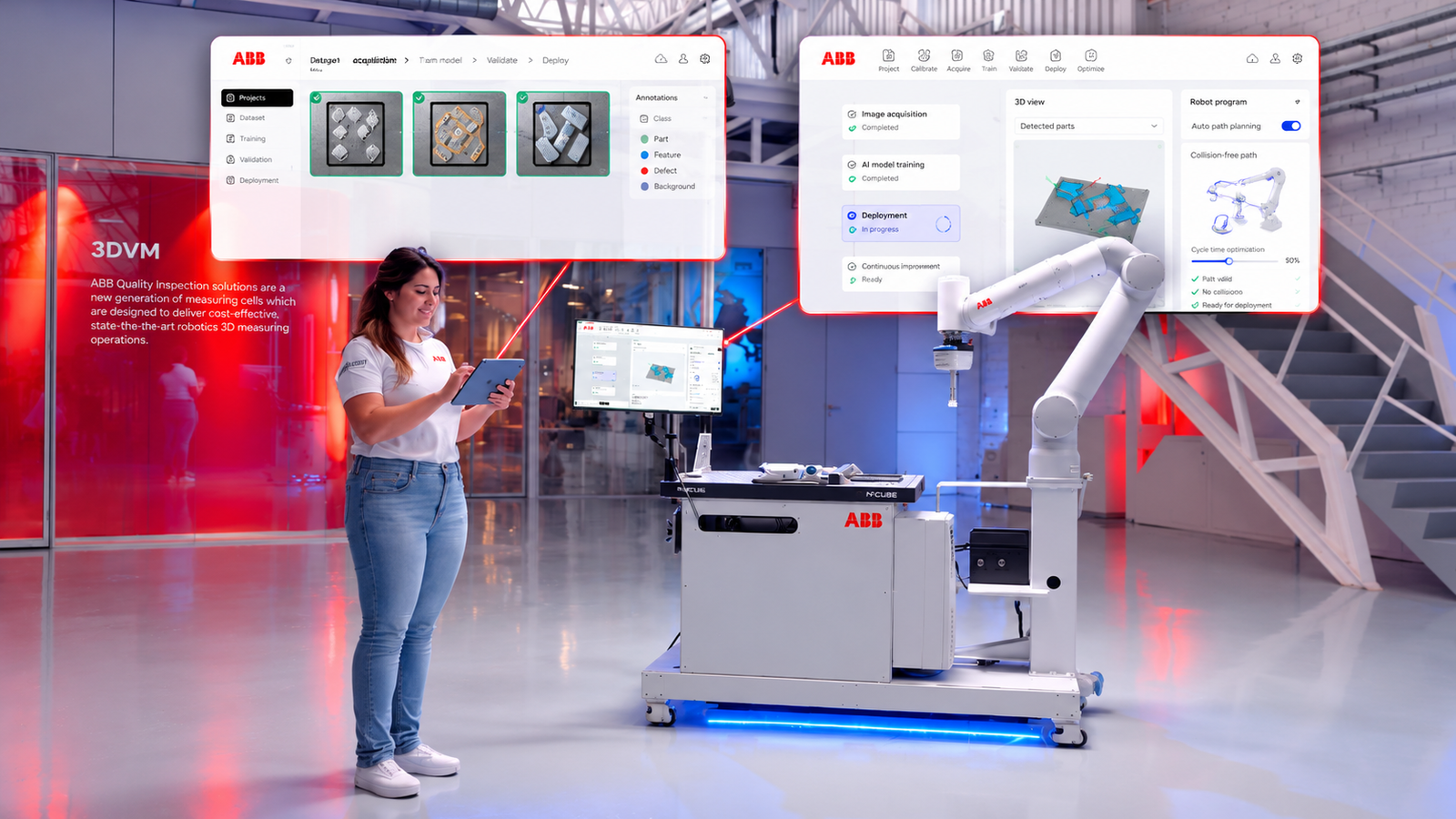
ABB AI Robot Trainer is joining the company’s OmniCore™ EyeMotion platform, giving system integrators a simpler way to train, deploy and continuously improve AI-powered robot vision applications.
ABB says the integrated solution can reduce commissioning time by up to 90%. When combined with automatic collision-free path planning, cycle times can also be cut by up to 50%.
The new workflow connects image acquisition, AI model training, deployment and ongoing improvement, with the aim of reducing the specialist AI knowledge needed to get vision-based robotic applications running on the factory floor.
ABB AI Robot Trainer Brings Vision Training Into One Workflow
AI Robot Trainer works alongside OmniCore EyeMotion in a continuous loop. Images from the shop floor are collected and used to train AI models, which can then be deployed and improved as the application runs.
For system integrators and automation partners working across different production lines or customer sites, ABB is aiming to make that process easier to repeat and scale.
A guided workflow and AI chatbot take users through the different stages. This includes adapting applications when SKUs, lighting conditions, layouts or object variations change.
The system combines real-world and synthetic image data with ABB Robotics’ industrial knowledge. It is also compatible with any brand of camera and sensor, giving integrators more flexibility when working with existing equipment.
Connecting AI Vision Directly to Robot Motion
The workflow goes beyond training the vision model.
OmniCore EyeMotion converts perception into robot motion using automatic collision-free path planning. This connects what the vision system identifies with how the robot responds.
“Physical AI fundamentally changes what robots can do, where they can operate and the value they can create,” said Marc Segura, President, ABB Robotics.
Segura describes robotic AI vision as the bridge between robot perception and physical action, allowing robots to see, understand and act in real time.
ABB’s approach is to keep those stages connected. Data generation, AI model training, deployment and optimization all feed into the same process rather than operating as separate parts of the automation project.
ABB AI Robot Trainer Targets Up to 90% Faster Commissioning
ABB puts some significant numbers behind the new workflow.
The company says AI Robot Trainer and OmniCore EyeMotion can reduce commissioning time by up to 90%. When combined with automatic collision-free path planning, the solution can reduce cycle times by up to 50%.
Part of the focus is on applications that need to adapt when production conditions change.
Different products, lighting, layouts and object variations can all affect a vision application. ABB’s guided workflow is designed to help integrators make those adjustments without requiring an AI specialist at every stage.
That could be particularly relevant for automation companies with strong robotics expertise that want to deploy AI vision without building every model and workflow from scratch.
From 2D Pick and Place to 3D Bin Picking
ABB is targeting a broad range of robot vision applications with the combination of AI Robot Trainer and OmniCore EyeMotion.
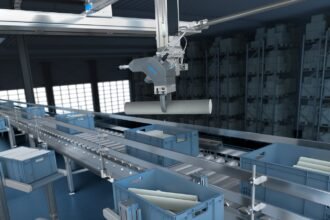
These range from relatively straightforward 2D pick-and-place applications through to more complex 3D bin picking.
ABB also lists quality inspection, sorting and assembly among the potential applications.
For integrators working across several sites or production lines, the emphasis is on being able to train, deploy and adapt those applications through the same workflow.
MTN Analysis: ABB Focuses on the Practical Side of Physical AI
The headline figure is the claimed 90% reduction in commissioning time, but there is another interesting part of ABB’s announcement: how much of the AI vision process it is trying to bring together.
Training a vision model is only one part of putting AI into an industrial robot application.
Images need to be collected, the model needs to be trained and deployed, production changes need to be handled and, ultimately, the robot needs to turn what it sees into a useful physical action.
ABB AI Robot Trainer and OmniCore EyeMotion bring those stages into one workflow.
The guided process and AI chatbot are particularly interesting for system integrators. Reducing the amount of specialist AI knowledge needed to configure and adapt an application could make AI vision easier to use across a wider range of automation projects.
Camera and sensor compatibility also deserves attention. Integrators often work across different customer environments, so the ability to use the workflow without being tied to one vision hardware brand gives them more flexibility.
There is also a wider Physical AI story developing here.
ABB is connecting perception directly with robot motion. Elsewhere in industrial robotics, companies such as Comau are using NVIDIA simulation and AI technologies to train and validate robotic applications before they reach the factory floor.
The approaches are different, but both point towards the same direction: making AI part of the complete robotics workflow rather than treating it as a separate layer added to an existing automation system.
The next question is how ABB’s claimed commissioning and cycle-time improvements translate across different applications and real production environments. But the focus on reducing the specialist work between collecting an image and getting a robot to act on it addresses a very practical barrier to wider AI adoption in industrial robotics.
Further Reading
For more on Physical AI, AI vision and industrial robotics:
- Comau and NVIDIA Advance Physical AI for Industrial Robotics
https://machinetoolnews.ai/comau-nvidia-physical-ai-industrial-robotics/ - 3D Machine Vision Brings ±0.2 mm Accuracy to Aerospace Sealing
https://machinetoolnews.ai/3d-machine-vision-aerospace/ - MVTec AI Vision Solver Brings AI Agents Into Machine Vision Development
https://machinetoolnews.ai/mvtec-ai-vision-solver-ai-agents-machine-vision/