Following our recent coverage of Festo GripperAI, which examined how artificial intelligence can help robots identify unfamiliar objects, select suitable gripping points and handle highly varied product mixes, MachineToolNews.ai wanted to explore the wider strategy behind the technology.
GripperAI is one part of a much broader shift within Festo. The automation specialist is also applying AI to predictive maintenance, energy management, quality monitoring, engineering tools and increasingly intelligent automation components.
In this follow-on Q&A, Andreas Schoch, Product Management GSS, Global System Solutions, and Eberhard Klotz, Global Sales Director Industry 4.0/Digitalisation at Festo, explain how the company is moving AI from individual applications into its wider automation portfolio.
They also discuss how GripperAI understands unknown objects, the commercial scaling of the Würth logistics project, the role of Festo AX Motion Insights and Smartenance, and why intelligence will increasingly be embedded directly into valves, drives, grippers and other automation products.
Festo has moved beyond talking about AI as a research topic and is now applying it to gripping, predictive maintenance, quality and energy management. How central will AI become to Festo’s overall automation strategy over the next few years?
Andreas Schoch and Eberhard Klotz: AI will become a very central part of Festo’s automation strategy. We are moving from AI being regarded as an exotic or unknown topic to it becoming a normal part of our lives, businesses, engineering processes and automation products.
For Festo, this path began much earlier than the current AI discussion. When we introduced valve terminals with internal communication and decentralised intelligence around 30 years ago, known at the time as intelligent pneumatics, we began creating the foundations for using data in automation.
The decisive step now is combining connected data with domain knowledge. Data alone does not improve a production machine. You need to understand the application, its physical behaviour and the automation technology behind it. That combination will be central to predictive maintenance, quality, energy management and engineering.
AI will influence our products, the services surrounding them and engineering tools such as digital twins, simulation and virtual assistants. These tools are already beginning to support engineers with machine design, sizing, commissioning and optimisation.
Within the next three to five years, we expect most parts of the Festo portfolio to be supported by AI in some form, whether directly within a product, through software, as part of an engineering workflow or through a service surrounding the machine.
GripperAI can identify different objects, select the appropriate gripping tool and handle an extremely varied product mix without conventional teaching. What was the biggest technical breakthrough that made this possible?
Andreas Schoch and Eberhard Klotz: As patent applications are still pending, we cannot discuss every technical detail. The main breakthrough, however, is the way GripperAI understands unknown objects.
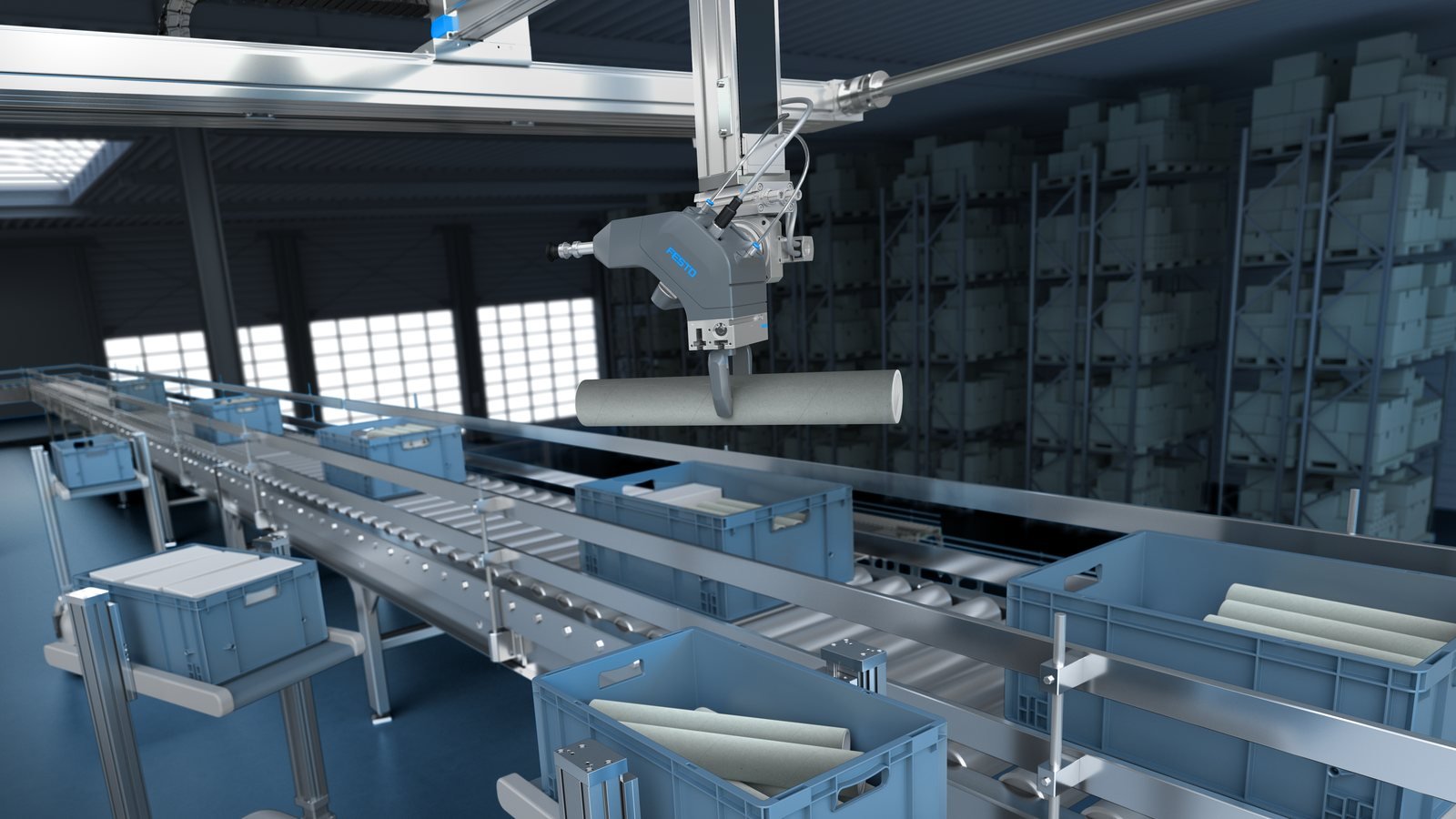
Instead of teaching the system every individual product, the AI is trained using generic basic geometries. The software analyses an object, breaks it down into these basic shapes and calculates one or several possible grasping points. It can then evaluate which gripping point has the highest probability of success.
Another important element is its camera-independent approach. GripperAI can work with high-end 3D camera systems and analyse a depth image of the bin. It transfers the selected gripping point to the robot, allowing it to pick parts that have not previously been taught using conventional methods.
The AI software is only one part of the solution. Festo also contributes a large gripper portfolio and extensive application knowledge. This helps answer the practical question of how an object should be handled, whether with a two-finger gripper, one or several suction cups, or a more universal gripping concept.
The combination of AI, 3D image processing, robotics and gripper expertise is what makes GripperAI effective. Multi-gripper solutions such as the Festo HPSX universal adaptive gripper add further flexibility by handling different contours and surfaces with a single tool.
The Würth application demonstrated GripperAI handling products weighing up to 20 kilograms and working with different robot and vision systems. Is Festo now turning that customised project into a scalable commercial solution that other manufacturers can deploy?
Andreas Schoch and Eberhard Klotz: Yes, that is the overall objective. Festo’s AI-based products often begin as pilot projects before developing into scalable solutions for wider use.
With GripperAI, we see strong potential in logistics, warehouse automation and packing stations where large numbers of different products must be picked reliably. The Würth application demonstrates this direction.
We are also using GripperAI in the Festo Customer Solution Center, where a robotic application demonstrates traceability and provides a basis for further internal and global scaling.
The go-to-market approach must also be clearly defined. Festo offers handling systems, particularly Cartesian robot systems, as complete solutions that can include control cabinets and automation technology. These systems can be combined with third-party vision systems and GripperAI.
For applications involving other robot or cobot brands, scaling will often take place through integrators and technology partners. Festo will not act as the system integrator for every robot available on the market.
Our goal is to make GripperAI usable across different robot, camera and gripper environments while scaling the solution through the appropriate partner ecosystem.
GripperAI has initially been demonstrated in intralogistics and bin picking. Where else do you see the strongest opportunities, particularly in machine tending, assembly, packaging and flexible manufacturing?
Andreas Schoch and Eberhard Klotz: The strongest opportunities exist wherever a robot must handle unknown or highly variable objects. That is the main strength of GripperAI.
This makes logistics and intralogistics natural starting points, particularly packing stations, order fulfilment and applications involving a broad product mix.
There may also be opportunities in semi-automated retail environments such as drugstores and supermarkets, where many different objects need to be handled. Flexible manufacturing may offer further applications, although these must be assessed carefully.
Assembly and machine tending are often different. In many of these applications, the parts are already known, CAD data is available and the process requires precise positioning or a strict operating sequence. CAD-based matching or a dedicated automation solution may therefore be more suitable.
When a robot grips an unknown object, the system must also understand how it has been gripped and how it is orientated before placing it precisely. That can require additional information or another handling stage.
For Festo, the broader opportunity is to combine GripperAI with its intralogistics and handling portfolio, including Cartesian handling systems, lifting solutions, palletising technology, grippers and vacuum systems. This can turn GripperAI from a standalone bin-picking function into part of a wider automation solution.
Festo describes AX Motion Insights Pneumatic and AX Motion Insights Electric as AI-based predictive maintenance solutions. What can their AI detect that traditional condition monitoring or fixed maintenance schedules would normally miss?
Andreas Schoch and Eberhard Klotz: Fixed maintenance intervals are always a compromise. A business may replace a component that could have continued operating for years, or it may discover that the component has failed before its next scheduled service.
Traditional condition monitoring is an improvement, but it still has limitations. It frequently operates close to the PLC, can require specialist programming knowledge and may be tied to proprietary automation environments.
It can also be difficult to correlate data from different devices, cylinder sizes, brands and machine conditions. The central question remains the same: when is the right time to initiate maintenance?
Our AI applications take a different approach. They use standardised data interfaces such as MQTT and OPC UA and operate outside the PLC using IT and OT standards, including Docker technology and browser-based dashboards.
The algorithms are trained using data from healthy operating conditions and damaged or worn components. This is combined with Festo’s domain knowledge of mechanics, pneumatics and electric axes.
This allows Festo AX Motion Insights Pneumatic and AX Motion Insights Electric to detect behavioural changes that can be difficult to identify using fixed threshold values. The applications can support component-level predictions and, in many cases, warn maintenance teams approximately two weeks before a critical failure.
After several training cycles within the real machine, the application adapts to the behaviour of the cylinder or electric axis in that specific environment. It learns how the component operates within the actual machine rather than relying solely on a theoretical model.
How do Festo AX Motion Insights and Festo AX Smartenance work together? Is Smartenance primarily used to organise maintenance tasks, or is AI also involved in prioritising actions and recommending when maintenance should take place?
Andreas Schoch and Eberhard Klotz: Festo AX Smartenance is primarily designed to support maintenance teams in their daily work. It helps manage maintenance tasks, incidents, machine logbooks and spare-parts information. In many cases, documentation supplied by the machine builder forms the basis of the maintenance database.
Smartenance itself is not primarily an AI application. It is a digital maintenance management solution, but it can be connected to AI-based applications through its API.
Predictive analytics generated by AX Motion Insights Pneumatic or AX Motion Insights Electric can be transferred into Smartenance and used to trigger a maintenance task or workflow.
This creates practical value for the end user. Motion Insights identifies a potential component-level issue, while Smartenance helps the maintenance team organise its response, assign the task, track its status and document the completed action.
Smartenance has been developed in close cooperation with customer maintenance teams. Their main priorities are transparency and organisation across open tasks, incidents, machine histories and maintenance priorities. Colour coding can help highlight urgent topics.
AI-based prioritisation within Smartenance is not currently the main customer requirement. The AI insight is generated by Motion Insights, while Smartenance converts that information into a structured and manageable maintenance process.
Festo states that AX can reduce downtime by up to 25%, waste by 20% and leakage by as much as 65%. What real-world customer results sit behind those figures, and how quickly can a manufacturer expect to see measurable improvements?
Andreas Schoch and Eberhard Klotz: These figures are based on real customer applications, but they are examples rather than universal guarantees for every machine.
The results depend on the application, the condition of the machine, the available data and the customer’s starting point.
One of our largest use cases involves reducing downtime in welding-gun applications. In these projects, specific failure modes could be identified earlier and addressed more systematically. Some customers achieved approximately 20% less unplanned downtime, based on maintenance records that already documented downtime and failure causes.
We have also seen strong results with feeding systems on older presses. In some cases, customers achieved a reduction in unplanned downtime of around 10% to 15% within the first few months.
This is often where AI can create value quickly. It provides maintenance teams with earlier and more precise information about changes in machine behaviour.
AI can also support quality stability and waste reduction by identifying changes in machine precision before they result in scrap. Where reliable quality data is available, the financial benefits can be significant. In one customer application, this resulted in savings of approximately €200,000 per production line each year.
Leakage and energy consumption represent another important opportunity. Condition monitoring and AI-based analytics can make deviations visible much earlier than traditional inspection methods. Applications such as Festo Energy Insights can also calculate potential savings using energy consumption, carbon impact and local energy prices.
Intelligent pneumatic systems offer additional potential. AI-based functions can use valve terminal data to understand cylinder loads, measure speed and stroke, and optimise motion behaviour. In suitable applications, combined savings of up to 65% are possible while maintaining the required machine speed.
The time required to achieve measurable improvements varies. When good baseline data already exists, customers can often see their first results within weeks or months. Where this data is unavailable, the first stage is creating transparency across the machine and its processes. That visibility becomes the foundation for future improvements.
Looking ahead, will Festo’s AI mainly remain a separate software layer such as Festo AX, or will intelligence increasingly be embedded directly into valves, drives, grippers and other automation components so that machines can optimise themselves in real time?
Andreas Schoch and Eberhard Klotz: We will see both approaches.
Festo AX will remain important as a software and analytics layer, particularly where customers want to analyse data across machines, components and production processes.
At the same time, intelligence will increasingly move directly into automation components such as valves, drives, grippers and vacuum systems.
This development has already begun. Products such as the Motion Terminal VTEM and the energy-efficiency module MSE6 demonstrated how data and intelligent functions could be integrated directly into pneumatic automation.
New automation platforms such as VTUX and VTEP are continuing in this direction. They use data and AI-based analytics to optimise motion behaviour, reduce energy consumption and support more precise pneumatic control, dosing, gripping and vacuum applications.
The longer-term direction is clear. Machines will increasingly use the data they generate to optimise their own behaviour.
Seamless data integration will be essential. AI alone is not enough. The value comes from connecting product data, application knowledge, engineering tools, commissioning workflows and operating data.
This enables Festo to support a connected customer journey covering design, dimensioning and product selection through to commissioning, production and maintenance. In the future, it could also support the reuse or recycling of machines and components.
AI will therefore become part of the complete automation system, appearing in software, smart products, engineering tools and services surrounding the machine.
MTN Analysis
The significance of Festo’s AI strategy is its focus on combining machine data with deep knowledge of automation hardware and physical processes.
GripperAI demonstrates what that combination can achieve in an application where conventional programming becomes difficult. By learning generic geometries and evaluating possible grasping points, the system can handle objects that have not been individually taught. Festo then adds the gripper, vacuum and handling expertise required to turn an AI decision into a reliable physical action.
Festo is also being realistic about where this technology offers the strongest value. GripperAI is particularly suited to unknown or highly variable products. In applications where every part is known, CAD data is available and precise placement is required, conventional or CAD-based automation may remain the stronger solution.
The same practical approach can be seen in predictive maintenance. Motion Insights is responsible for identifying changes in component behaviour, while Smartenance converts those findings into tasks that a maintenance team can assign, monitor and complete.
The wider direction is a hybrid automation architecture. Some intelligence will remain within platforms such as Festo AX, where information from multiple components and machines can be analysed together. Other AI capabilities will move closer to the physical process and become embedded within valves, drives, grippers and vacuum systems.
For machine builders and manufacturers, that could make AI less visible as a standalone technology. It will increasingly become part of how automation systems are designed, commissioned, monitored, maintained and continuously optimised.
FAQ
What is the Festo AI strategy?
The Festo AI strategy combines automation data with Festo’s knowledge of pneumatics, electric motion, robotics and physical processes. AI is being applied across gripping, predictive maintenance, energy management, quality monitoring, engineering tools and increasingly intelligent automation components.
How does Festo GripperAI recognise objects it has not been taught?
GripperAI is trained using generic basic geometries rather than requiring every individual product to be taught. It analyses an object, breaks it down into basic shapes and calculates possible grasping points before evaluating which has the highest probability of success.
Can Festo GripperAI work with different robots and vision systems?
Festo’s objective is to make GripperAI usable across different robot, camera and gripper environments. For applications involving other robot or cobot brands, deployment can take place through integrators and technology partners.
Where does Festo see the strongest applications for GripperAI?
Festo sees the strongest opportunities wherever robots must handle unknown or highly variable objects. Logistics, intralogistics, packing stations and order fulfilment are natural starting points, while other flexible manufacturing applications may also offer opportunities.
What does Festo AX Motion Insights detect?
Festo AX Motion Insights Pneumatic and AX Motion Insights Electric use AI to detect behavioural changes that can be difficult to identify using fixed threshold values. The applications can support component-level predictions and, in many cases, warn maintenance teams approximately two weeks before a critical failure.
How do Festo AX Motion Insights and AX Smartenance work together?
Motion Insights generates predictive information about potential component-level problems. AX Smartenance can then receive that information and convert it into a maintenance task or workflow that teams can assign, track and document.
What results has Festo reported from its AI applications?
Festo says results vary according to the application and starting conditions. Examples discussed in the Q&A include approximately 20% less unplanned downtime in some welding-gun applications, reductions of around 10% to 15% on feeding systems for older presses, and approximately €200,000 in annual savings per production line in one quality-related customer application.
Will Festo embed AI directly into automation components?
Festo expects both central software and embedded intelligence to play a role. Festo AX will continue to provide a software and analytics layer, while intelligence increasingly moves into components including valves, drives, grippers and vacuum systems.
Further Reading
- MachineToolNews.ai: Festo GripperAI Lets Robots Pick the Unknown Without Reprogramming Every SKU
- MachineToolNews.ai: June 2026 AI Manufacturing Releases
- MachineToolNews.ai: What Is Physical AI in Robotics and Automation?
- Festo: GripperAI Pilot Customer Project With Würth
- Festo: AX Motion Insights Pneumatic
- Festo: AX Smartenance