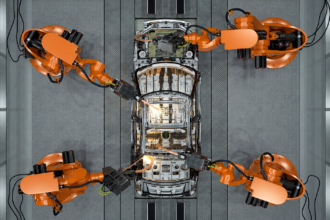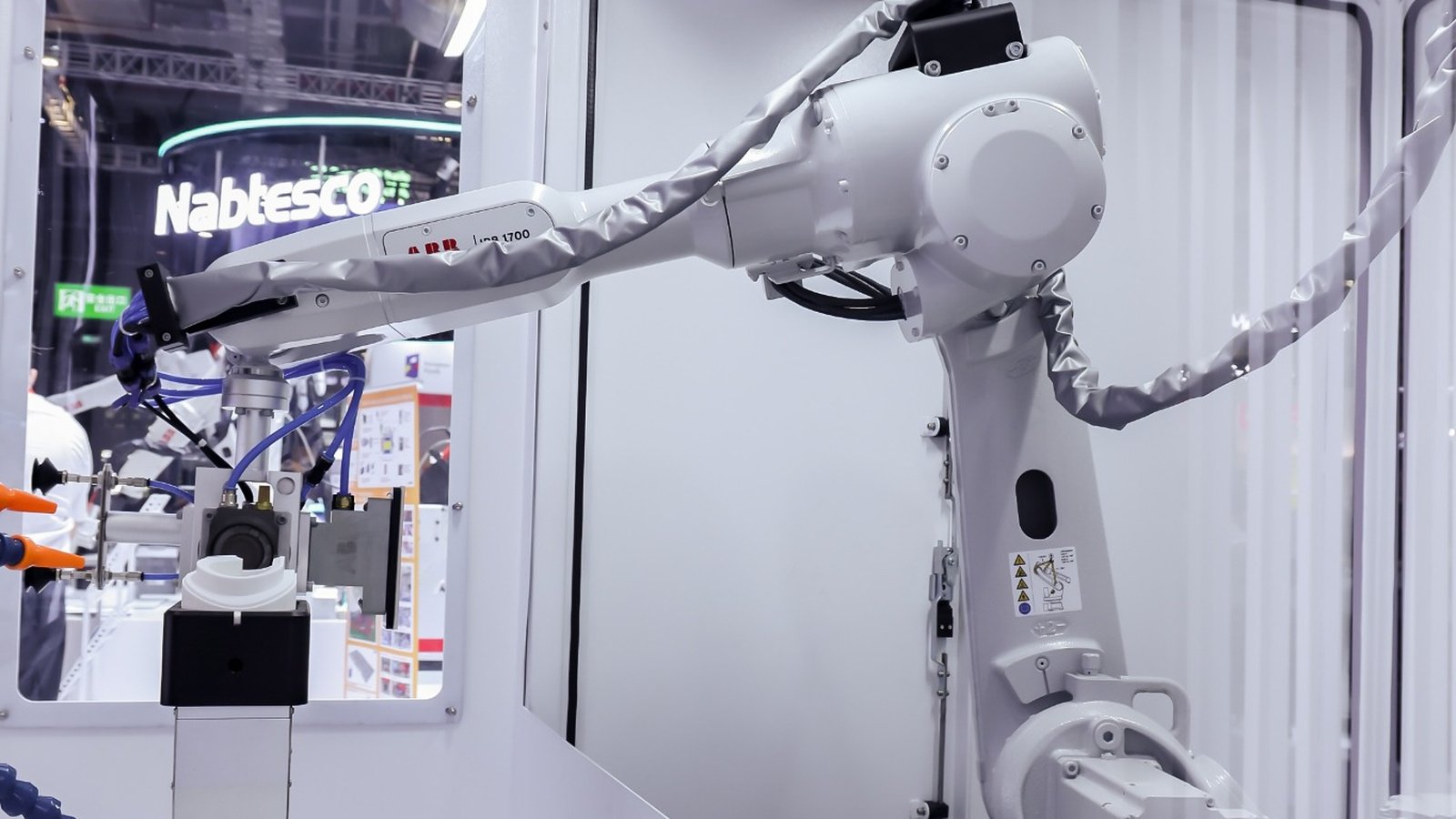
The ABB IRB 1700 and IRB 1700ID are the latest additions to ABB Robotics’ industrial robot portfolio, bringing higher speed, precision and a more compact footprint to manufacturing automation.
Available in five variants with payload capacities ranging from 6 kg to 12 kg, the new robots are designed for applications including machine tending, material handling, arc welding, deburring and sanding. ABB says the range delivers up to 20% shorter cycle times than comparable robots on the market, with lower power consumption and longer service intervals also contributing to reduced operating costs.
“Precision manufacturing across sectors from electronics, automotive, to general industries is facing the pressure to produce more, while maintaining quality and reducing operating costs,” said Craig McDonnell, Managing Director, Business Line Industries, ABB Robotics.
“The IRB 1700 family addresses these challenges with a new level of speed, accuracy, reliability and energy efficiency. It gives manufacturers and system integrators a flexible platform for high-performance automation.”
ABB IRB 1700 Brings Higher Speed and Lower Power Consumption
Powered by ABB’s OmniCore controllers, the IRB 1700 family combines joint speeds of up to 700 degrees per second with path repeatability down to 0.03 mm.
ABB reports cycle times up to 20% shorter than comparable robots on the market. Power consumption can also be up to 15% lower than the previous IRB 1600 when operating with the same payload on OmniCore, while service intervals extend to as much as 20,000 operating hours between oil changes.
These specifications could make the range particularly relevant to high-volume production, where cycle time, energy use and maintenance requirements all contribute to the cost of running automated equipment across multiple shifts.
A 50% Smaller Footprint for Compact Automation Cells
The IRB 1700 has a footprint 50% smaller than its predecessor, giving system integrators more flexibility when designing automation cells. The reduced size could also help manufacturers introduce robots into existing production areas where available floor space limits automation options.
The IRB 1700ID version incorporates ABB Robotics’ Integrated Dressing design, routing cables and hoses inside the robot arm. This reduces external cabling around the robot and simplifies installation across a range of industrial applications.
ABB is also targeting electronics manufacturing, including AI server rack assembly. The company cites research forecasting a compound annual growth rate of 34.46% for the AI server market between 2025 and 2035, creating growing demand for the equipment and components supporting AI computing infrastructure.
ABB Expands the Software Around Its Robot Portfolio
The IRB 1700 family forms part of ABB Robotics’ development of Autonomous Versatile Robotics (AVR), supported by a growing portfolio of programming and AI-powered software.
The robots can be used with RobotStudio, AI Robot Trainer, OmniCore EyeMotion and automatic collision-free path planning, covering areas including simulation, robot programming, vision and automated motion planning.
This software ecosystem gives manufacturers and integrators tools to develop and test robotic applications and adapt systems as production requirements change. ABB has been steadily expanding this side of its robotics business, including its integration of NVIDIA Omniverse libraries into RobotStudio for industrial robot simulation and physical AI development.
MTN Analysis
The IRB 1700 brings together several improvements that address practical issues manufacturers encounter when introducing or expanding robotic automation.
Cycle time has an immediate impact on production capacity, particularly in repetitive applications running across several shifts. ABB’s claimed improvement of up to 20% therefore gives the new range a clear productivity angle. The 15% reduction in power consumption compared with the IRB 1600 and service intervals of up to 20,000 hours add another dimension to the operating economics.
The smaller footprint could be equally useful in established factories. Automation projects often have to work around existing machines, material routes, safety systems and limited floor space. Reducing the robot footprint by 50% gives integrators more room to design compact cells around those constraints.
For machine shops and metal manufacturers, ABB has identified several familiar applications for the range. Machine tending, arc welding, deburring and sanding are processes where robotic automation can increase consistency and free operators from repetitive tasks. The combination of 0.03 mm path repeatability and joint speeds of up to 700 degrees per second is designed to support applications requiring both precision and throughput.
AI server rack assembly extends the potential market into an area experiencing rapid investment. The growth of AI infrastructure requires large volumes of servers, racks, electronics and supporting equipment, creating new opportunities for automated assembly and material handling.
ABB’s expanding software portfolio also plays a growing role in how these robots are deployed. Simulation, vision, AI-assisted training and automatic path planning can help integrators handle more of the engineering process digitally and make robotic cells easier to adapt over their operating life.
For manufacturers assessing the IRB 1700, the overall proposition combines faster production with a smaller installation footprint, lower energy consumption, longer service intervals and access to ABB’s developing robotics software ecosystem.
IRB 1700 Makes Its Debut in Shanghai
The IRB 1700 and IRB 1700ID made their public debut at the China International Industry Fair (CIIF) in Shanghai, held from October 12 to 16, 2026.
ABB demonstrated the robots in a fully functional arc welding and sanding application, showing two production processes with direct relevance to metalworking manufacturers.
With payloads ranging from 6 kg to 12 kg, path repeatability down to 0.03 mm and joint speeds of up to 700 degrees per second, the IRB 1700 family extends ABB’s industrial robot range for compact, high-speed precision applications.
Further Reading
ABB RobotStudio NVIDIA Omniverse Integration Brings Physical AI to Industrial Robotics
ABB Autonomous Forklift Launch Completes AI-Powered Visual SLAM AMR Portfolio
Festo GripperAI Lets Robots Pick the Unknown Without Reprogramming Every SKU