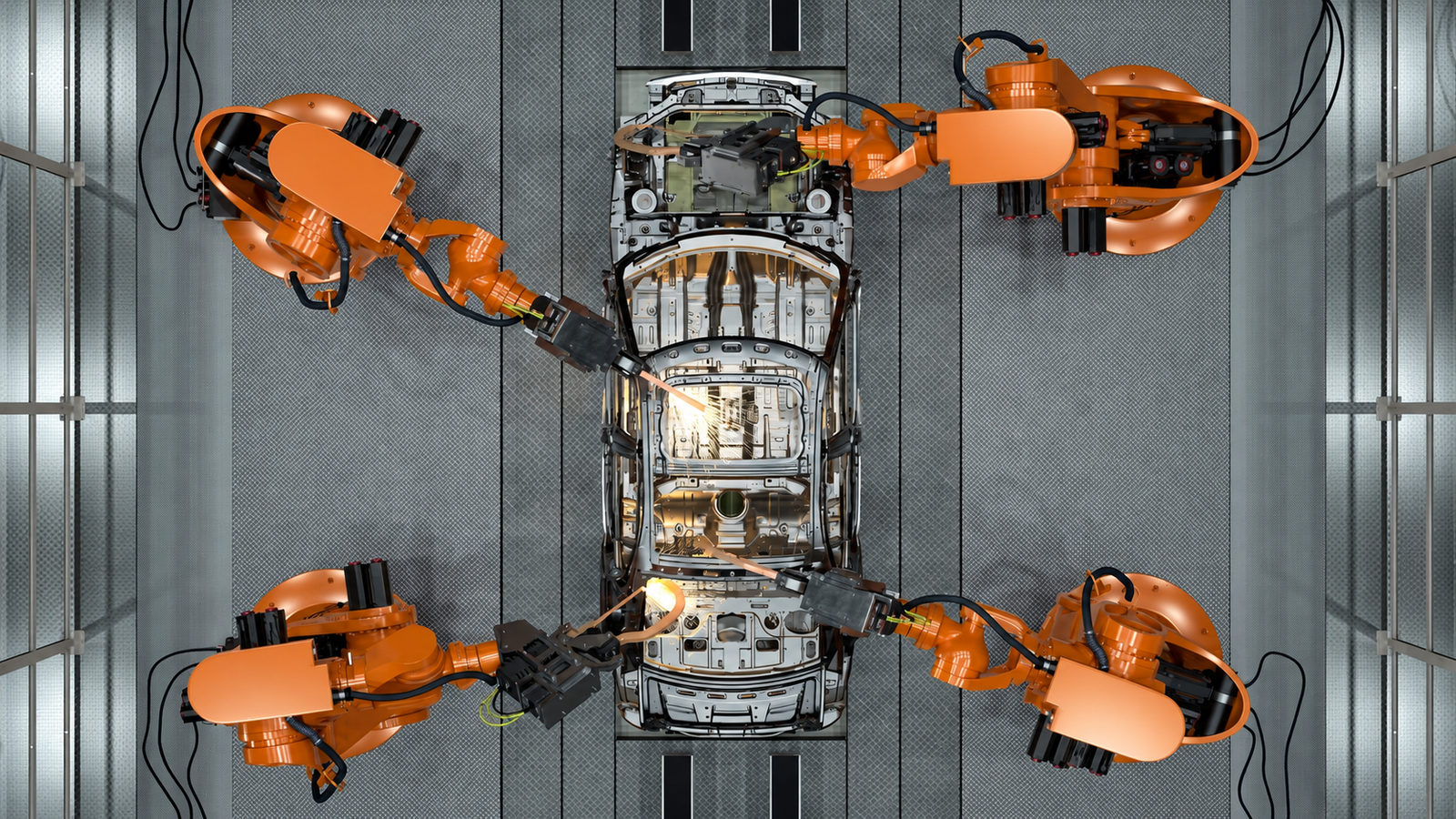
KUKA AMP is now live and delivering production parts inside a major automotive factory in North America, according to a new update from KUKA Group Chief Software & AI Officer Marc Fleischmann.
Fleischmann revealed the production deployment in his July 13 article, The Next Frontier in AI, marking an important step for a platform that KUKA publicly unveiled at NVIDIA GTC earlier this year.
The automotive manufacturer has not been identified. Fleischmann indicated that it is a large vehicle producer whose cars are widely used, suggesting this is a genuine industrial deployment rather than a controlled research project or trade show demonstration.
For manufacturers watching the development of Physical AI, the significance lies in KUKA AMP moving from a platform announcement into an operational factory environment where it is involved in producing real components.
KUKA AMP Moves From the AI Lab to the Factory Floor
KUKA introduced the KUKA Automation Management Platform in March 2026 as a software layer positioned between AI agents and physical automation equipment.
The platform is designed to orchestrate industrial robots, autonomous mobile robots, production cells, digital twins, software services and factory data within a common environment.
Traditional industrial robots perform predefined movements with high levels of repeatability. Changes in products, parts, workflows or factory conditions normally require additional programming, configuration and engineering.
KUKA AMP is intended to give automation systems more contextual understanding, allowing them to interpret an intended production outcome and coordinate the physical actions required to achieve it.
Fleischmann summarised the principle by writing:
“Scaling models makes AI smarter; building the context layer makes AI useful.”
The context layer is designed to give AI systems shared information about the user’s objective, the available equipment, the actions each machine can perform, the condition of the production environment and the outcome of previous tasks.
How KUKA AMP Connects AI With Industrial Automation
KUKA describes KUKA AMP as an open and composable platform built around three main capabilities: semantics, actions and data.
Semantics allow the system to understand the intended outcome of a task. Instead of concentrating entirely on individual robot movements or device instructions, the platform interprets what the production process is expected to achieve.
Actions provide standardised functions that AI agents can use across robots, mobile platforms, work cells and other automation equipment. These actions could include picking a component, moving material, loading a machine or delivering a pallet to a workstation.
Data provides structured information about equipment status, process conditions and previous operations. This allows the platform to evaluate results and use production experience to improve future tasks.
KUKA says the platform operates through a continuous cycle of observing, acting, measuring and predicting. It can connect the physical factory with an embedded digital twin, enabling production workflows to be simulated, monitored and adjusted within the same environment.
The company refers to this development as part of its move from conventional Automation 1.0 towards AI-supported Automation 2.0.
AI Agents Could Orchestrate Complete Factory Workflows
One of the most important elements of KUKA AMP is its emphasis on AI agents as users of industrial automation interfaces.
A conventional application programming interface is normally designed for a software developer. Under the KUKA AMP model, an AI agent could discover available production capabilities and combine them to complete a wider objective.
For example, a production instruction could involve identifying a particular component, collecting it from a storage area, transporting it to a machine, loading the machine, removing the finished component and delivering it to inspection.
Several robots, machines, sensors and material handling systems may be involved. KUKA AMP is intended to provide the shared context and standardised actions needed to coordinate these systems.
This reflects the wider rise of the manufacturing copilot and industrial AI agent, where natural-language instructions and contextual AI are beginning to support programming, simulation, diagnostics and factory operations.
Digital Twins Provide a Testing and Learning Environment
Digital twin technology is central to the KUKA AMP strategy.
A digital twin creates a virtual representation of the production environment, including robots, equipment, physical layouts and production processes. Proposed changes can be tested virtually before they are applied to live equipment.
KUKA says the digital twin within KUKA AMP could also allow manufacturers to replay previous factory operations, investigate production problems and simulate how future changes might affect output.
This could help manufacturers evaluate altered production sequences, new component variants, equipment changes and capacity requirements without immediately disrupting live production.
It also creates an environment where AI-generated actions can be evaluated before they are sent to physical equipment, providing an additional layer of control for autonomous factory systems.
Governance and Safety Are Built Into the Platform
Fleischmann also highlighted the need to place governance and operational guardrails within the automation platform itself.
Physical AI systems can directly influence machines, materials and people. Their decisions therefore need to operate within defined safety, security and compliance requirements.
KUKA’s approach is to codify these requirements at the platform level. AI agents should only be able to discover and execute actions that comply with the approved operational boundaries of the production system.
This could become increasingly important as AI agents gain access to more production equipment and begin coordinating workflows across several machines or factory areas.
Why KUKA AMP Matters to Metal Manufacturers
For metalworking and machine tool companies, the most immediate opportunities could appear in machine tending, robotic welding, material handling, inspection, deburring and internal logistics.
A machine shop could eventually define an intended production outcome while an AI orchestration platform coordinates the machines, robots, fixtures, inspection systems and material movements required to complete it.
KUKA is already involved in efforts to make robotic machine tending more accessible. A recent integration involving Siemens, KUKA and SYIL allows robot functions to be controlled through the CNC interface, as covered in our report on AI machine tool automation for job shops.
KUKA AMP takes the idea further by providing a potential orchestration layer above individual robots and machines.
For high-mix manufacturers, this could reduce the engineering required when switching between components or production schedules. For larger factories, the platform could help coordinate robots, cells and autonomous vehicles across wider production operations.
The wider objective is a factory where automation capabilities can be combined and reconfigured through software rather than every new workflow becoming a separate integration project.
Important Questions Remain About the Deployment
KUKA has not disclosed the identity of the North American automotive manufacturer or published detailed performance figures from the installation.
It is therefore unclear how many robots, work cells or production processes are currently connected to the platform.
KUKA has described AMP as an open, composable API platform that can orchestrate different automation assets. However, the precise level of compatibility with third-party robots, CNC controls and factory systems has not yet been fully detailed publicly.
Manufacturers will also want information about implementation costs, cybersecurity, data ownership, integration requirements and the commercial structure behind KUKA’s proposed robotics-as-a-service model.
The live automotive deployment should begin to provide KUKA with the industrial data and operational experience required to answer some of these questions.
MTN Analysis
The importance of KUKA AMP lies in the shift from adding AI to an individual robot towards building an intelligence layer across the production environment.
Many current industrial AI applications remain isolated. One system supports robot programming, another monitors machine condition and another manages autonomous vehicles. Each system may have limited knowledge of the wider production objective.
KUKA AMP is attempting to connect these capabilities through shared semantics, actions, data and digital twins.
For machine tool manufacturers and metalworking companies, this could eventually enable robots and production equipment to be deployed with less custom engineering and reconfigured more quickly when product requirements change.
The fact that KUKA AMP is reportedly producing automotive parts is therefore an important milestone. Automotive factories demand repeatability, traceability, safety and high equipment availability. A successful deployment in this environment would provide stronger evidence that Physical AI can progress beyond demonstrations and operate within real production constraints.
The next stage will be proving that the technology can deliver measurable improvements in commissioning time, production flexibility, equipment utilisation and operating cost.
FAQs
What is KUKA AMP?
KUKA AMP is the KUKA Automation Management Platform, a software orchestration layer designed to connect AI agents with industrial robots, autonomous mobile robots, production cells, digital twins, data and software services.
Is KUKA AMP being used in a real factory?
Yes. According to KUKA Group Chief Software & AI Officer Marc Fleischmann, KUKA AMP is live and delivering production parts inside a major North American automotive factory. The customer has not been named.
What is Physical AI?
Physical AI describes artificial intelligence systems that can perceive an environment, make decisions and perform actions through physical equipment such as robots, machines and autonomous vehicles.
What does intent-based automation mean?
Intent-based automation allows a user to define the desired outcome of a process. The automation system then determines the actions and equipment required to achieve that outcome based on available data and context.
Can KUKA AMP control non-KUKA robots?
KUKA describes AMP as an open and composable platform capable of coordinating different hardware assets and automation systems. Detailed information about compatibility with individual third-party robot brands and machine controls has not yet been publicly released.
Why is KUKA AMP relevant to machine shops?
KUKA AMP could eventually coordinate CNC machine tending, component handling, inspection, logistics and other automation tasks. This could reduce integration complexity and make robotic automation easier to reconfigure for high-mix production.
Further Reading
AI Machine Tool Automation Becomes Accessible for Job Shops
Is 2026 the Rise of the Manufacturing Copilot?
AI in Machine Tools 2026: 10 Breakthrough Technologies
External Sources
Read Marc Fleischmann’s original KUKA AMP article