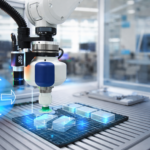
ABB Robotics has announced a new collaboration with NVIDIA that aims to accelerate the deployment of physical AI in industrial robotics. The company is integrating NVIDIA Omniverse libraries into ABB’s RobotStudio® simulation platform, allowing manufacturers to train robotic systems in digital environments and deploy them into real-world production with unprecedented accuracy.
The development is designed to close the long-standing gap between virtual robot training and real-world deployment. According to ABB Robotics, the technology can achieve up to 99 percent accuracy between simulation and real-world performance, allowing companies to design, train, and validate robotic automation systems before they reach the factory floor.
The ABB RobotStudio NVIDIA Omniverse Integration represents a major step forward in how manufacturers design, simulate, and deploy AI-powered robotics systems.
ABB and NVIDIA Bring Physical AI to Industrial Robotics
The collaboration combines ABB Robotics’ software programming, design and simulation suite RobotStudio with the physically accurate simulation capabilities of NVIDIA Omniverse libraries.
This allows developers to build digital twins of robotic systems, generate synthetic data, and train AI models in simulated production environments. Once validated, the trained models can be transferred directly to physical robots operating in real industrial workflows.
Marc Segura, President of ABB Robotics, said the collaboration removes major barriers to deploying industrial AI at scale.
“Today, using NVIDIA accelerated computing and simulation technologies, we have removed the last barriers to making industrial and physical AI a reality at a global scale by closing the sim-to-real gap,” said Marc Segura.
“For more than 50 years, ABB Robotics has led the evolution of intelligent industrial automation, from pioneering the first generation of fully electric industrial robots to advancing digital twin simulation through RobotStudio and shaping a new area of autonomous and versatile mobile robots. Today’s announcement with NVIDIA brings physical AI to industry at scale.”
RobotStudio HyperReality to Transform Production Scaling
A key outcome of the collaboration is a new capability called RobotStudio HyperReality, which ABB plans to release in the second half of 2026.
The technology will allow manufacturers to create highly realistic simulations of robotic production systems and continuously improve them using real-world operational data. These models can then be used to train large fleets of ABB robots anywhere in the world while maintaining the reliability and accuracy required for industrial applications.
Deepu Talla, Vice President of Robotics and Edge AI at NVIDIA, said physically accurate simulation is essential for scaling AI-powered robotics.
“The industrial sector needs physically accurate simulation to bridge the gap between virtual training and the real-world deployment of AI-driven robotics at scale,” said Deepu Talla.
“Integrating NVIDIA Omniverse libraries into RobotStudio brings advanced simulation and accelerated computing to ABB Robotics’ unique virtual controller technology, accelerating how manufacturers of all sizes bring complex products to market.”
With the ABB RobotStudio NVIDIA Omniverse Integration, manufacturers will be able to train robotic systems in highly realistic digital twin environments before deploying them into production.
Closing the Sim-to-Real Gap
One of the biggest challenges in industrial robotics has been the sim-to-real gap, where simulation environments fail to accurately represent real-world factory conditions such as lighting, materials, and physical environments.
By integrating NVIDIA Omniverse libraries into RobotStudio, ABB Robotics will deliver advanced robotics simulation and synthetic data generation capabilities designed to bridge this gap with up to 99 percent accuracy.
ABB is also the only robot manufacturer with a virtual controller running the same firmware as the physical hardware, ensuring near-perfect correlation between simulation and real-world robot behaviour.
Combined with ABB’s Absolute Accuracy technology, which reduces positioning errors from 8–15 millimetres to around 0.5 millimetres, the platform delivers the level of precision required for high-precision industrial applications.
For manufacturers, this innovation allows entire production lines to be designed, tested, and optimized in a virtual environment before deployment. ABB estimates that companies could reduce commissioning times by up to 80 percent, reduce costs by up to 40 percent, and accelerate time to market for complex products by up to 50 percent.
Foxconn Pilots the First Real-World Use Case
A real-world pilot project is already underway with Foxconn, the world’s largest electronics contract manufacturer.
The pilot focuses on automating the assembly of small components used in consumer electronics devices. These processes require extremely precise robotic control because multiple device variants demand different assembly methods and delicate metal structures must be handled carefully.
Using RobotStudio HyperReality, Foxconn trains assembly robots in a virtual environment using synthetic data before transferring them to the production line with up to 99 percent accuracy.
Dr. Zhe Shi, Chief Digital Officer of Foxconn, said the technology opens new possibilities for electronics manufacturing.
“Precision is everything in consumer electronics manufacturing and until now, this level of accuracy and fidelity just wasn’t possible in simulation and digital twins,” said Dr. Zhe Shi.
“We’re incredibly excited by the potential of ABB Robotics and NVIDIA’s collaboration, which enables parallel engineering for better designs, faster production ramp-up and greater product evolution through advanced AI inference and understanding.”
The ABB RobotStudio NVIDIA Omniverse Integration allows companies like Foxconn to test complex assembly processes virtually before running them on real production lines.
WORKR Demonstrates the Technology for Smaller Manufacturers
The technology will also be demonstrated at NVIDIA GTC in San Jose.
Robotic workforce company WORKR will showcase how the platform can deploy AI-powered robotic systems for small and mid-sized manufacturers across the United States.
WORKR combines ABB’s industrial robotics with its proprietary WorkrCore™ AI platform to create robotic workforce systems capable of learning new tasks quickly and operating without requiring advanced programming skills.
Ken Macken, CEO and Founder of WORKR, said the collaboration shows how industrial AI can now be deployed in real manufacturing environments.
“This collaboration is about making industrial AI deployable today,” said Ken Macken.
“Together with ABB and NVIDIA, we’re proving that advanced automation can work for manufacturers of any size.”
MTN Analysis
The ABB RobotStudio NVIDIA Omniverse Integration highlights a major shift in industrial robotics as AI-driven systems move from research environments into real manufacturing operations.
Simulation platforms are becoming essential tools for training industrial robots, allowing engineers to test and optimise automation systems before deployment. As simulation accuracy improves, manufacturers can deploy robotics faster, reduce engineering costs, and adapt production systems more easily.
This shift toward simulated training and real-world deployment also connects with wider advances in AI machine vision in manufacturing, where accuracy and validation are becoming critical for industrial AI systems.
For industries such as electronics manufacturing, automotive production, and logistics automation, platforms that bridge the sim-to-real gap will play an increasingly important role in the next generation of smart factories.
The ABB RobotStudio NVIDIA Omniverse Integration demonstrates how simulation, synthetic data, and AI-driven robotics are converging to reshape industrial automation.
FAQ
What is the ABB RobotStudio NVIDIA Omniverse integration?
The ABB RobotStudio NVIDIA Omniverse integration combines ABB’s RobotStudio robotics simulation platform with NVIDIA Omniverse libraries to allow AI-driven robotic systems to be trained in digital environments and deployed in real factories.
What is RobotStudio HyperReality?
RobotStudio HyperReality is a new simulation technology from ABB that enables highly realistic digital twins of robotic production systems. It allows robots to be trained using synthetic data before deployment to real manufacturing environments.
When will RobotStudio HyperReality be available?
ABB Robotics plans to release RobotStudio HyperReality in the second half of 2026.
What is the sim-to-real gap in robotics?
The sim-to-real gap refers to the difference between simulated robot behaviour and real-world performance. This gap has historically limited the ability to train robots in simulation and deploy them directly into factories.
Which companies are already testing the technology?
Foxconn is currently piloting the first industrial use case in consumer electronics assembly using the RobotStudio HyperReality platform.
How can this technology benefit manufacturers?
ABB estimates the platform can reduce production system costs by up to 40 percent, reduce commissioning time by up to 80 percent, and accelerate time to market by up to 50 percent for complex manufactured products.