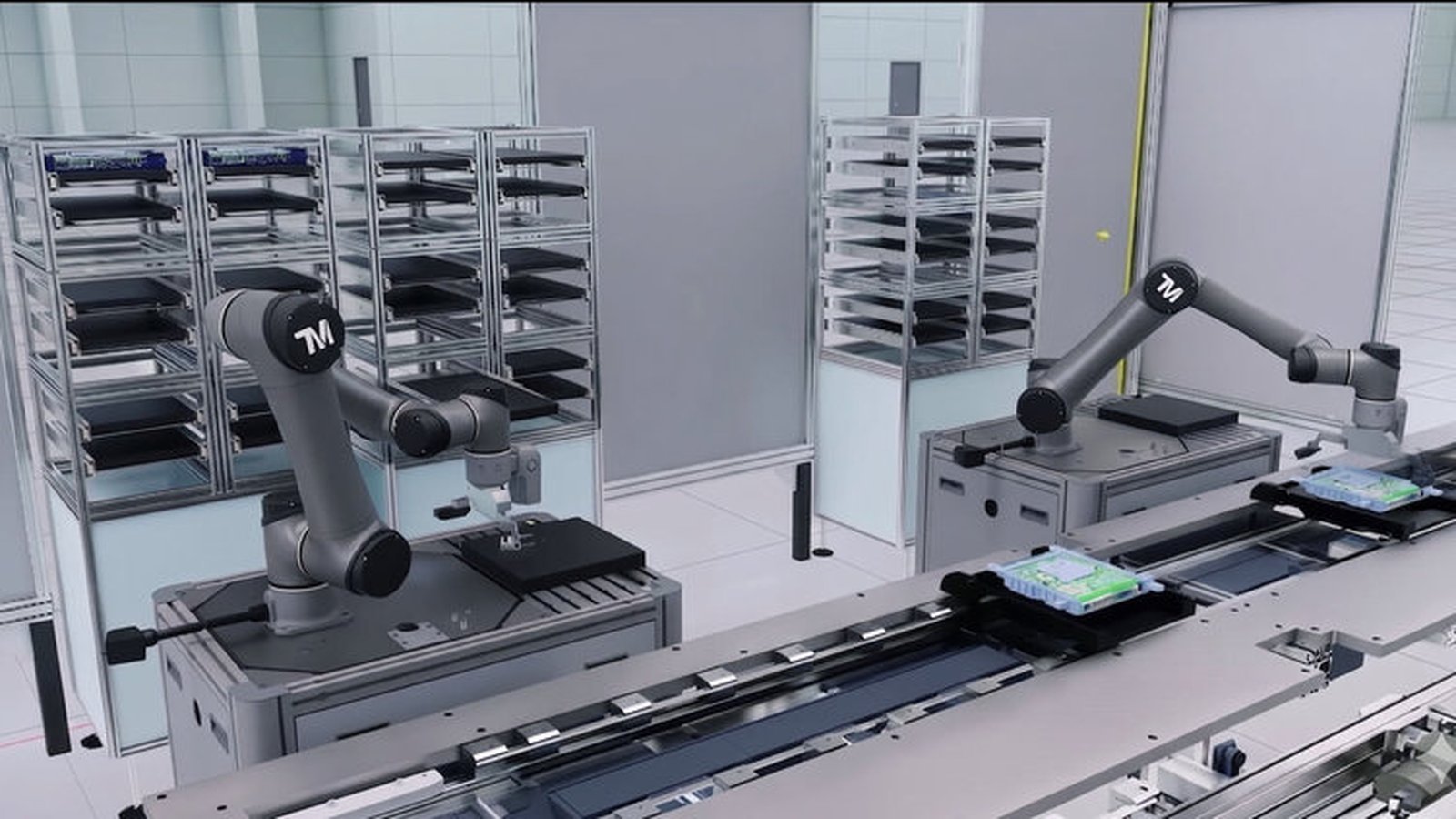
Techman Robot AI cobots have been deployed at Quanta Computer’s automotive electronics manufacturing facility in Germany, giving manufacturers another clear example of how AI-powered robotics is moving from exhibition halls into real production lines.
The project brings together Techman Robot’s collaborative robot arms, built-in AI vision and automated optical inspection capability to support the production of high-density automotive electronics for electric vehicles, advanced driver assistance systems and autonomous driving applications.
According to Techman Robot, the AI cobots are now being used at Quanta’s German automotive computer and electronics manufacturing facility to improve inspection efficiency, production traceability and quality control across complex automotive electronic control unit production.
For manufacturers, the important point is that this is not a lab demo. It is a real production deployment where AI vision, robotic handling and automated inspection are being combined in a factory application where quality, reliability and repeatability matter at automotive scale.
Why Techman Robot AI Cobots Matter For Automotive Manufacturing
Automotive electronics are becoming more complex as electric vehicles, software-defined vehicles, ADAS and autonomous driving platforms demand more computing power inside the car.
Techman Robot said the automotive electronic control units required for ADAS can contain nearly 5,000 components on a single motherboard. That makes manual inspection increasingly difficult and puts more pressure on manufacturers to catch defects before products leave the factory.
This is exactly where AI cobots are starting to become more valuable. A collaborative robot with integrated vision can move around a component, inspect from different positions, read production data and check key assembly features without the same fatigue or inconsistency issues that can affect manual inspection.
In Quanta’s German facility, Techman Robot says its AI cobots are being used for 360-degree inspection, combining precision motion control with AI vision to inspect high-performance automotive circuit boards.
The system is being applied to tasks including QR code scanning, OCR reading of PCBA labels, assembly verification, connector checks, screw-fastening confirmation, inspection of water-cooling pipe rubber sleeves, foreign object detection and missing component detection.
That is a strong manufacturing use case because it places AI directly into the quality gate rather than treating it as a separate analytics tool.
AI Inspection Is Becoming A Factory Floor Requirement
We see this as another signal that AI inspection is becoming a practical requirement for manufacturers making high-value, high-density products.
For metal manufacturers, machine builders and automation suppliers, the lesson is clear. The same direction of travel that is happening in automotive electronics is also relevant to machining, fabrication, welding, assembly, metrology and machine tending.
As parts become more complex and customers demand more documentation, manufacturers need inspection systems that can check quality, capture data and link that data back to production records.
Techman’s AI Vision platform is positioned around functions such as part positioning, barcode reading, dimension measurement and visual inspection. Its TM AI Cobot Series combines a collaborative robot arm with machine vision for applications including automated optical inspection, quality assurance, testing, assembly, packaging and machine tending.
That combination is important because it reduces the gap between robot movement and inspection intelligence. Instead of using a robot simply to move a part from one place to another, the robot becomes part of the quality control process.
The Quanta Link Gives This Deployment Extra Weight
This deployment is also commercially significant because Techman Robot is backed by Quanta Group. Techman describes Quanta Computer as one of the world’s largest notebook manufacturers and a top-tier electronics manufacturing services provider.
That matters because this is not a demonstration with a small test cell. It is an internal manufacturing deployment inside a major electronics manufacturing group, focused on automotive-grade products where reliability and consistency are essential.
Terrisa Chung, VP & GM of Automotive Business at Quanta Computer, said:
“Quanta continues to drive the intelligentization and automation upgrade of our global manufacturing sites, employing rigorous quality management to meet the stringent reliability and consistency requirements of automotive electronics.”
“The introduction of Techman Robot’s AI vision and cobot solutions enhances the efficiency and stability of our inspection processes, reflecting Quanta Group’s ongoing commitment to excellence in smart manufacturing and automotive electronics.”
Scott Huang, Chief Operating Officer of Techman Robot, added:
“We are deeply honored to collaborate closely with Quanta, a global leader in electronics manufacturing.”
“The successful application at the Germany plant not only proves that our solutions can satisfy the most demanding automotive-grade standards, but also demonstrates the collective capability of both companies to drive the future of automotive production automation.”
MTN Analysis
This story matters because it shows the shift from cobots as flexible labour support to cobots as intelligent inspection assets.
For years, collaborative robots have been sold around ease of use, safety and flexibility. Those points still matter, but AI vision is changing the value proposition. Manufacturers are increasingly looking for robots that can see, check, verify and record, not only pick and place.
In Quanta’s case, the challenge is high-density automotive electronics. In a metalworking environment, the same principle could apply to checking machined features, confirming part presence, reading serial numbers, verifying welds, supporting in-process inspection or loading inspection data into a wider production traceability system.
That is why this story is relevant beyond electronics. It shows how AI robotics is becoming tied to quality assurance, production documentation and factory-gate confidence.
As automotive, aerospace, energy and precision engineering customers demand more proof of quality, the pressure on manufacturers to automate inspection will only grow.
Why This Matters For Machine Tool Buyers
For machine tool buyers, the message is that AI automation is increasingly becoming part of the wider production ecosystem.
A CNC machine, press brake, laser cutter or machining cell may still be the centre of production, but the value around that machine is now being shaped by AI inspection, robot loading, process monitoring, traceability and automated quality control.
The Quanta and Techman Robot deployment shows how manufacturers are combining robotics and AI vision to reduce inspection bottlenecks and improve consistency. That same thinking is likely to become more common across metal manufacturing as factories try to increase output without losing control of quality.
AI is already active on the factory floor. The next stage is deeper integration between machines, robots, vision systems and inspection data.
FAQs
What are Techman Robot AI cobots?
Techman Robot AI cobots are collaborative robot systems that combine a robot arm, vision system and AI capability to support tasks such as automated optical inspection, assembly checks, part positioning, barcode reading and machine tending.
Where have Techman Robot AI cobots been deployed?
Techman Robot says its AI cobots have been deployed at Quanta Computer’s automotive computer and electronics manufacturing facility in Germany.
What are the AI cobots inspecting at Quanta’s German facility?
The system is being used to inspect high-density automotive circuit boards and electronic control units, including QR codes, PCBA labels, connectors, screw-fastening status, cooling pipe sleeves, missing parts, foreign objects and surface defects.
Why is this important for automotive manufacturing?
Automotive electronics for ADAS, EVs and autonomous driving are becoming more complex. AI-powered inspection helps manufacturers improve repeatability, traceability and factory-gate quality.
How is this relevant to metal manufacturing?
The same AI vision and robotic inspection approach can support metal manufacturers with part verification, machine tending, quality checks, serial number reading, weld inspection and production traceability.
Further Reading
Techman Robot announces Quanta German facility deployment