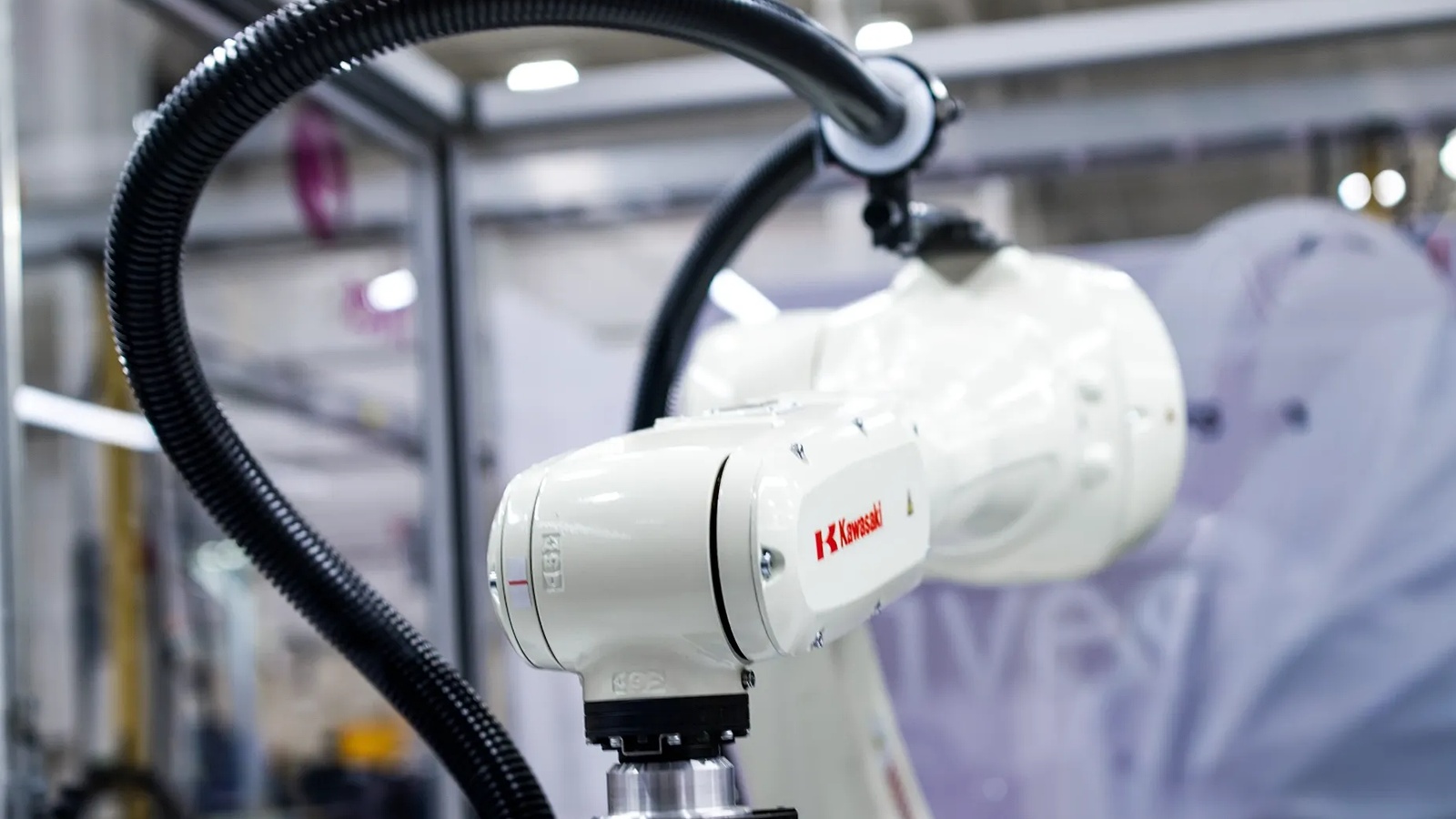
Kawasaki Physical AI Robot 2026 is one of the clearest signs yet that industrial robotics is moving into a more adaptive phase, where robot motion, machine vision, real-time control and AI software are increasingly being designed to work together on the factory floor.
Kawasaki Robotics has unveiled a new 8 Degree of Freedom robot platform, the RL030N, for Physical AI applications at Automate 2026 in Chicago. The company is also presenting its patented Pulseboard inspection technology, the new BA013L arc welding robot and the MXP360L heavy-duty material handling robot.
For manufacturers, the most important point is this: Kawasaki is positioning the RL030N around more flexible, AI-orchestrated robot behaviour. That matters because many factories are now trying to automate tasks that do not fit neatly into old-style fixed robot paths.
We have already seen Physical AI in robotics and automation become one of the strongest themes in industrial automation this year. Kawasaki’s launch gives that trend another important shop-floor signal.
Why Kawasaki’s RL030N Matters for Physical AI
Kawasaki says the RL030N is an 8 Degree of Freedom robot platform designed for Physical AI applications. The additional axis gives the robot more dexterity than a conventional 6-axis industrial robot, helping it move in tighter spaces and handle more complex motion tasks.
That extra movement could be important for applications where a robot needs to adapt to its environment, avoid obstacles, work inside confined areas or follow motion plans generated by external AI software.
The RL030N is powered by Kawasaki Robotics’ open KRNX real-time control API. According to the company, this allows external AI software, ROS environments, machine learning systems, vision platforms and third-party orchestration systems to control the robot in real time.
That is the key shift. The robot is being presented as part of a wider intelligent automation stack, where software outside the robot controller can help shape motion and decision-making.
Kawasaki Robotics President Seiji Amazawa said future automation will involve systems that “seamlessly integrate perception, motion, and decision-making.”
For manufacturers watching the rise of AI in robotics, that phrase is important. The competitive edge is no longer only about repeatability, payload and reach. It is increasingly about how well a robot can connect to perception, AI planning and real-time process feedback.
Pulseboard Brings AI-Linked Inspection Closer to Production Speed
Kawasaki is also demonstrating its patented Tool Tip Displacement Output Function technology, known as Pulseboard. The company is showing the technology in a robotic weld inspection system developed with Fives DyAG.
The demonstration combines a Kawasaki RS013N robot, a laser 3D profile camera and Kawasaki’s high-speed motion synchronization technology. The aim is to inspect complex weld geometries and curved surfaces at higher speed.
The key claim is that Pulseboard can synchronize image acquisition with the robot’s tool-tip displacement in real time. That means the robot does not need to repeatedly stop for image capture in the same way as conventional inspection systems.
Kawasaki says the result can be up to 10 times faster weld inspection, with reduced setup requirements, precise defect localization and high-speed inspection without sacrificing accuracy.
For metal manufacturers, this is highly relevant. Weld inspection is one of the areas where AI vision and machine inspection can quickly connect to measurable production value. Faster inspection can reduce bottlenecks, improve traceability and help manufacturers catch defects earlier.
Fives DyAG CEO Wade Rickard said the Kawasaki partnership helps “accelerate inspections” and identify defects while maintaining quality.
Closed-Loop Dispensing Shows the Same Factory Trend
Kawasaki is also showing a BU015X 7-axis robot in an adhesive dispensing and inspection demonstration developed with Coherix. The system simulates an automotive production environment by applying sealant to a Ford F-150 door skin while measuring and adjusting adhesive bead placement in real time.
According to Kawasaki, the system can make real-time adjustments at speeds of up to 400 times per second. It combines Kawasaki’s hollow-arm robot design with Coherix’s 3D laser-based Adaptive Process Control technology.
This is another example of the same wider trend: robots are moving from fixed motion machines into systems that can sense, measure, adjust and optimize during production.
Scott Childs, Senior Director, Automotive Group at Kawasaki Robotics, described the demonstration as the “next evolution of intelligent manufacturing.”
That is where this launch becomes relevant beyond automotive. Closed-loop process control, robot-mounted inspection and real-time measurement are becoming important across welding, fabrication, machining, dispensing, assembly and quality control.
New BA013L and MXP360L Expand Kawasaki’s Automation Portfolio
Alongside the RL030N and Pulseboard demonstrations, Kawasaki is also introducing the BA013L and MXP360L robots.
The BA013L is a 13 kg arc welding robot being shown inside a compact welding cell. The system includes a Kawasaki PST500-L2 dual-axis positioner, Rollon Glider RTU, Strong Hand welding table and Miller welding power source.
Kawasaki says the BA013L features a redesigned architecture with a 50 mm hollow wrist for internal cable routing. The robot also supports high-current welding torches, reduced cable wear and improved accessibility. Its extended 2,093 mm reach and high-speed axis performance are designed to help improve cycle times while maintaining weld quality.
The MXP360L is aimed at heavy-duty material handling. It has a 360 kg payload capacity, extended reach and advanced vibration-control technology. At Automate 2026, Kawasaki is displaying the robot handling a Kawasaki Z125S motorcycle on a Rollon RTU linear axis.
These launches show that Kawasaki is addressing both ends of the market: highly adaptive Physical AI applications and more traditional industrial automation tasks where payload, reach, speed and reliability still matter.
MTN Analysis: Physical AI Is Becoming a Real Industrial Robot Category
The Kawasaki Physical AI Robot 2026 launch is important because it gives manufacturers a clearer view of where robot development is heading.
Physical AI is not only about humanoid robots or futuristic demonstrations. In factories, it is more likely to appear first through industrial robot arms connected to vision, sensors, real-time control APIs, machine learning systems and adaptive process software.
That is exactly the direction Kawasaki is highlighting with the RL030N, Pulseboard weld inspection and closed-loop dispensing.
For machine shops, fabricators and industrial automation buyers, the practical question is simple: can these systems reduce programming time, improve inspection speed, deal with variation and make automation easier to justify on lower-volume or more complex work?
That is why the Kawasaki announcement matters. The real value of Physical AI will be measured by whether it helps manufacturers automate tasks that were previously too variable, too awkward, too slow to inspect or too expensive to fixture.
We see three immediate takeaways for manufacturers.
First, robot flexibility is becoming more important than robot speed alone. The RL030N’s 8-axis structure points toward robots designed for dynamic motion and confined spaces.
Second, inspection is becoming part of the robot workflow rather than a separate offline process. Pulseboard shows how synchronized robot motion and image capture can support faster weld inspection.
Third, the strongest industrial AI applications are likely to be built around practical shop-floor problems: welding quality, adhesive dispensing, defect detection, material handling, process stability and cycle time.
That makes this launch highly relevant for anyone following robotics and cobots in manufacturing, industrial AI in factories and the wider move toward adaptive automation.
FAQ
What is Kawasaki’s new RL030N robot?
The RL030N is Kawasaki Robotics’ new 8 Degree of Freedom robot platform designed for Physical AI applications. It is built to support more dexterous motion, real-time external orchestration and AI-connected automation tasks.
Why is the RL030N important for manufacturers?
The RL030N matters because it is designed for applications that require adaptive motion, obstacle avoidance, confined-space manipulation and complex motion planning. These are important for factories trying to automate more variable production tasks.
What is Kawasaki Pulseboard technology?
Pulseboard is Kawasaki Robotics’ patented Tool Tip Displacement Output Function technology. It synchronizes image acquisition with robot tool-tip displacement in real time, helping robotic inspection systems capture high-resolution images during motion.
How fast is Kawasaki’s Pulseboard weld inspection system?
Kawasaki says the Pulseboard-based robotic weld inspection system can deliver up to 10 times faster weld inspection while supporting precise defect localization and high-speed inspection.
Where is Kawasaki showing the new robot technology?
Kawasaki Robotics is demonstrating the RL030N, Pulseboard weld inspection system, BA013L welding robot and MXP360L material handling robot at Automate 2026 in Chicago, Booth S-2201.
Further Reading
What Is Physical AI in Robotics and Automation?
FANUC Accelerates Physical AI Through Collaboration With Google
Robotics & Cobots News on MachineToolNews.ai
What Is Industrial AI and How Is It Used in Factories?
AI Machine Vision HALCON MERLIC 2026
External Sources


3 Comments