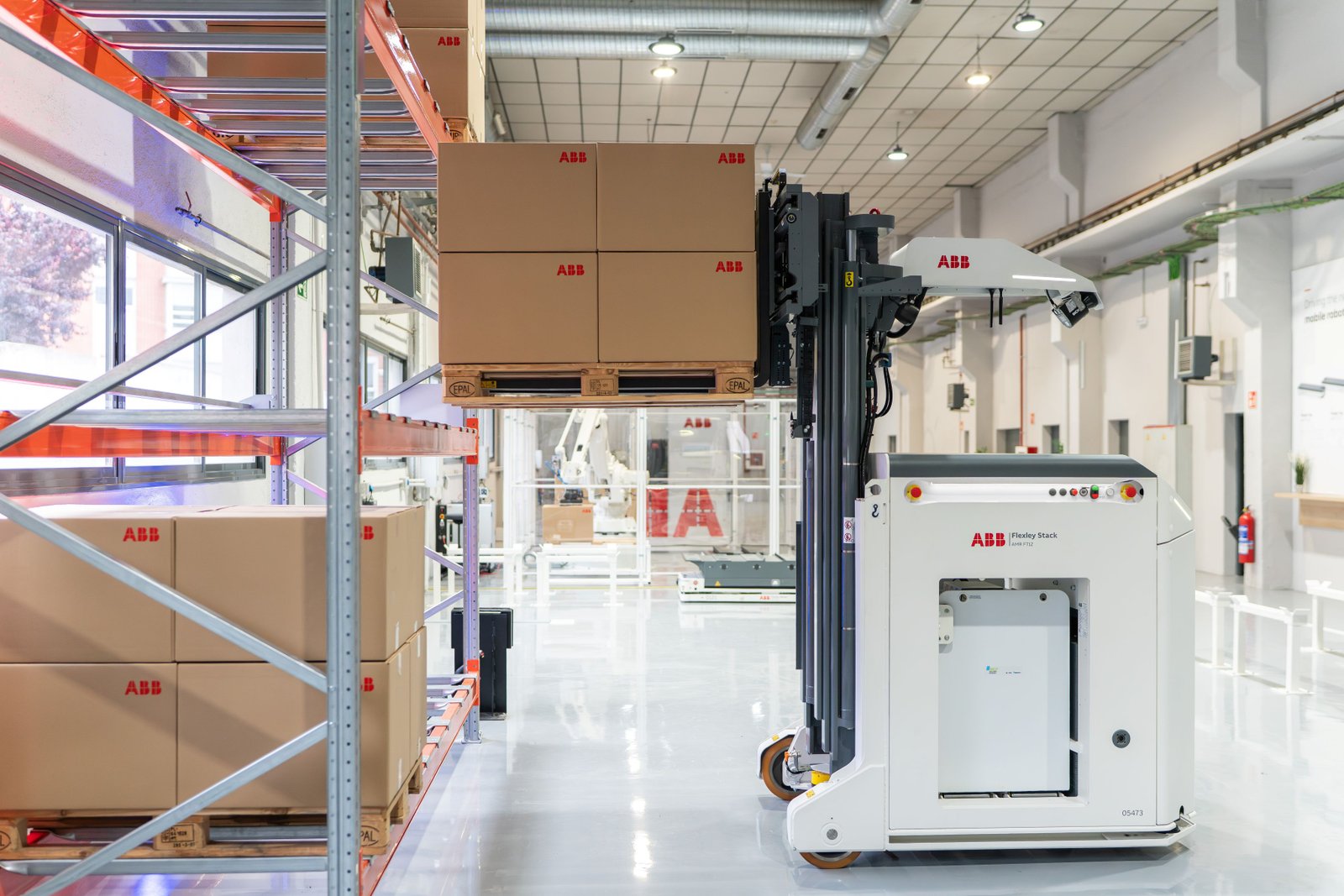
ABB autonomous forklift technology is moving deeper into factory intralogistics with the launch of the new Flexley® Stack F712, an AI-powered autonomous mobile robot designed for pallet transport, warehouse storage and high-density material handling.
ABB Robotics has expanded its Autonomous Mobile Robotics portfolio with the launch of the Flexley® Stack F712, completing what the company describes as a full interoperable ecosystem across all major Visual SLAM AMR types.
The new Flexley Stack F712 brings ABB Robotics’ AI-powered Visual SLAM technology to autonomous forklifts, allowing customers to combine forklifts, tugs and movers on a common navigation, fleet management and software platform.
For manufacturers, this matters because intralogistics is becoming one of the clearest areas where AI, automation and mobile robotics can deliver measurable operational gains. From line supply and end-of-line handling to warehouse storage and retrieval, factories are under pressure to move materials faster, more safely and with fewer manual bottlenecks.
The launch of the ABB autonomous forklift means customers can now deploy mixed fleets of Visual SLAM-powered tugs, movers and forklifts through one unified system. That creates a more scalable route for manufacturers looking to automate material flow without having to manage separate mobile robot platforms.
ABB Flexley Stack F712 Designed For Heavy Industrial Material Handling
The Flexley® Stack F712 has been developed for demanding material handling, end-of-line storage and warehouse operations across sectors including automotive manufacturing.
According to ABB Robotics, the F712 can handle multiple load types and sizes, including open and closed pallets, containers and racks. It can carry loads of up to 2,000 kg and reach lifting heights of up to 8.5 metres.
That gives the ABB autonomous forklift a clear role in factories and warehouses where palletised goods need to be moved between storage areas, production lines, press shops, body shops and light buffer zones.
The F712 joins the existing Flexley® Tug and Flexley® Mover within ABB Robotics’ growing Visual SLAM AMR portfolio. The wider portfolio supports intralogistics tasks such as warehouse storage and retrieval, line supply, end-of-line handling, body-shop and press-shop logistics, drive-in storage and light buffer applications.
“Across intralogistics operations, businesses are being asked to process greater volumes in less time, while working with increasingly limited resources,” said Marc Segura, President, ABB Robotics. “They are under pressure to move goods faster and with greater flexibility, while labour availability is becoming a critical constraint. As part of our journey to more autonomous and versatile robotics (AVR™), we have combined advanced vision, mobility and intelligence in the Flexley® Stack F712 forklift AMR, completing our scalable, AI-powered AMR portfolio.”
AI-Powered Visual SLAM Removes The Need For Fixed Infrastructure
Unlike conventional autonomous forklift systems that may depend on markers, reflectors or fixed navigation infrastructure, the Flexley® Stack F712 uses Visual SLAM to map and navigate its environment.
ABB says the AI-enabled Visual SLAM system supports the autonomous decision-making required for complex and dynamic warehouse operations. The F712 offers market-leading positional accuracy of ±10 mm and can safely operate at speeds of up to 1.7 m/s while loaded.
This is important for manufacturers because factory and warehouse layouts often change. Production cells move, storage areas are adjusted, and logistics routes need to adapt as demand changes.
By using Visual SLAM, ABB Robotics says the F712 can adapt when a warehouse or production floor layout changes, helping reduce the commissioning and reconfiguration burden for customers.
For readers following wider developments in Physical AI in robotics and automation, this is another example of AI moving from software-only environments into machines that make decisions in the physical world.
AMR Studio Supports Faster Commissioning And Mixed Fleet Management
The ABB autonomous forklift is fully integrated with AMR Studio®, ABB Robotics’ no-code software suite for setup, fleet coordination, traffic management and real-time visualisation.
Powered by AMR Studio®, ABB says the portfolio can enable up to 20 percent faster commissioning while supporting interoperability and safe, reliable operation.
The system is also VDA5050 compatible, helping the F712 integrate with ABB Robotics’ Visual SLAM AMRs and existing systems within a unified project.
This allows customers to manage more complex mobile robot deployments where different AMR types need to operate together in the same layout. For example, a manufacturer could use tugs for line supply, movers for component handling and the Flexley® Stack F712 for pallet storage and retrieval, all coordinated through one software environment.
That interoperability is becoming increasingly important as manufacturers move beyond single automation cells and start connecting entire material flow processes.
MachineToolNews.ai has previously covered how ABB is using AI and simulation in industrial robotics through its ABB RobotStudio NVIDIA Omniverse integration. The Flexley® Stack F712 builds on the same broader direction: using software, AI and real-world robotics together to reduce deployment friction and increase manufacturing flexibility.
MTN Analysis
The launch of the ABB autonomous forklift is significant because it shows how AI-powered robotics is moving into the practical logistics layer of manufacturing.
Many discussions around AI in manufacturing focus on machining, inspection, robot programming or digital twins. Those areas are important, but material movement is one of the biggest day-to-day constraints inside factories.
If pallets, parts, containers or racks are not in the right place at the right time, production efficiency suffers. That makes autonomous mobile robots highly relevant to manufacturers that want to reduce waiting time, improve traceability and make labour go further.
ABB’s key move here is not simply launching another forklift AMR. The bigger message is that the F712 completes a broader Visual SLAM-powered AMR portfolio covering tugs, movers and forklifts. That gives customers a more joined-up route into factory intralogistics automation.
For the metal manufacturing and machine tool sector, the relevance is clear. As factories adopt more AI-enabled CNC systems, robotic cells, machine vision and connected software, the next pressure point becomes how materials flow between those assets.
A smarter production cell is only as effective as the material flow around it. The Flexley® Stack F712 is aimed directly at that problem.
Key Takeaways
The ABB autonomous forklift launch extends ABB Robotics’ AI-powered Visual SLAM technology into forklift AMRs.
The Flexley® Stack F712 can handle loads up to 2,000 kg and lift to heights of up to 8.5 metres.
The F712 joins ABB’s Flexley® Tug and Flexley® Mover to create a mixed fleet AMR portfolio on one common platform.
ABB Robotics says AMR Studio® can reduce commissioning time by up to 20 percent.
The system is designed for intralogistics, warehouse storage and retrieval, line supply, end-of-line handling, body-shop and press-shop logistics.
FAQ
What is the ABB autonomous forklift?
The ABB autonomous forklift is the new Flexley® Stack F712, an AI-powered autonomous mobile robot designed for pallet transport, high-density storage, end-of-line handling and warehouse logistics.
What makes the Flexley® Stack F712 different from conventional AMR forklifts?
The Flexley® Stack F712 uses AI-powered Visual SLAM navigation, which means it can map and navigate its environment without needing fixed infrastructure such as markers or reflectors.
How much weight can the ABB Flexley® Stack F712 carry?
The ABB Flexley® Stack F712 can handle loads of up to 2,000 kg and can reach lifting heights of up to 8.5 metres.
What is Visual SLAM in ABB’s AMR portfolio?
Visual SLAM is ABB Robotics’ AI-enabled navigation technology that allows autonomous mobile robots to understand, map and navigate dynamic environments using vision-based perception.
How does AMR Studio® help manufacturers?
AMR Studio® is ABB Robotics’ no-code software suite for AMR setup, fleet coordination, traffic management and real-time visualisation. ABB says it can help reduce commissioning time by up to 20 percent.
Why is the ABB autonomous forklift relevant to manufacturers?
The ABB autonomous forklift is relevant because it helps automate material flow inside factories and warehouses, reducing manual handling pressure and supporting more flexible production logistics.
Further Reading
MTN: ABB RobotStudio NVIDIA Omniverse Integration