3D machine vision aerospace automation is enabling AKEOPLUS to automate a demanding sealing process with positioning accuracy of ±0.2 mm.The French automation specialist has developed a robot cell that uses MVTec HALCON machine vision software and 3D scanning to locate bearings on large metal components and automatically correct the robot’s application path.
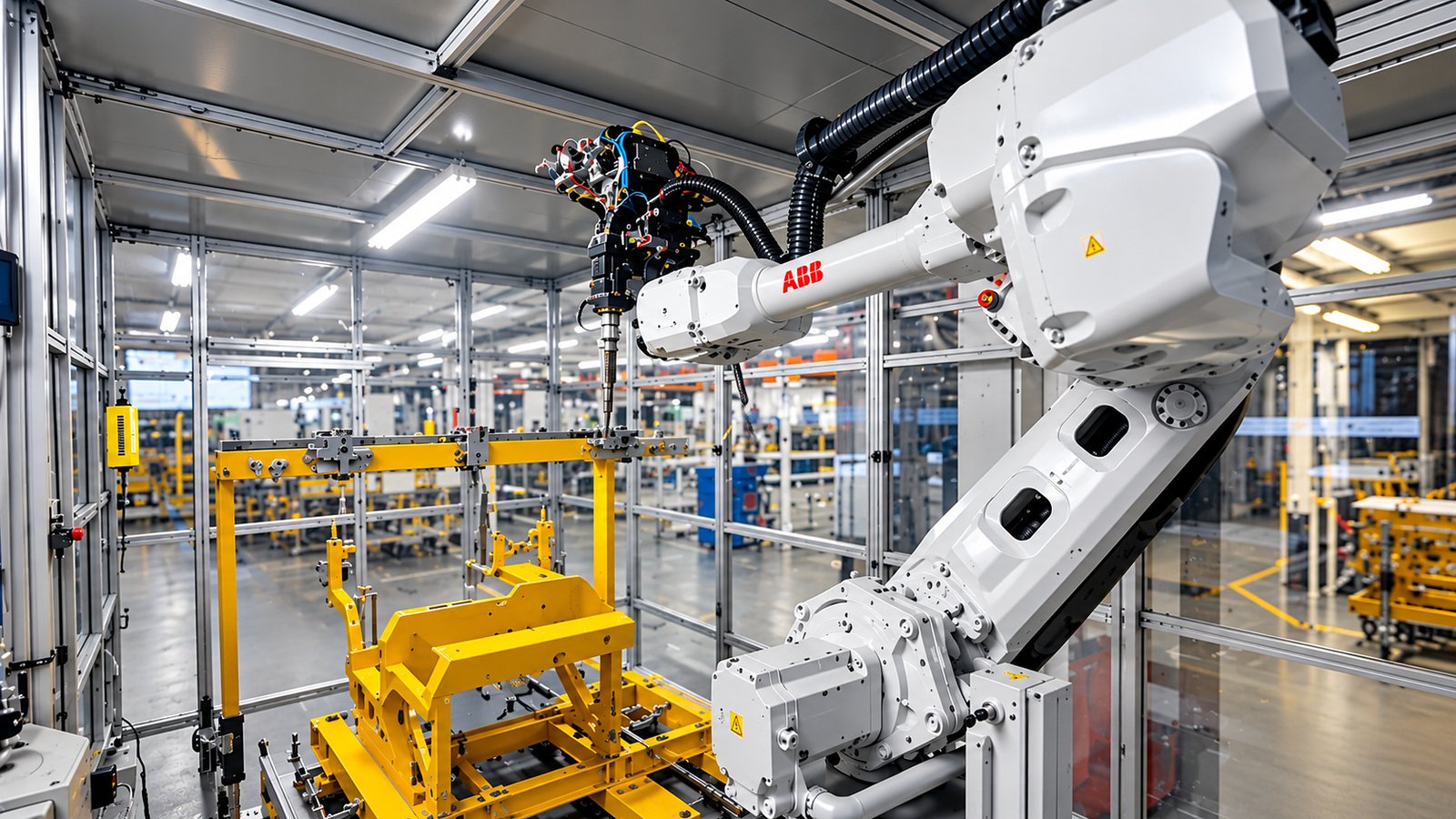
The system is designed for a process that was previously carried out manually, combining component scanning, primer application and two-component sealant dispensing within a working area of approximately 2,000 x 2,000 x 2,000 mm.
For aerospace manufacturers, the project shows how 3D machine vision can help automate processes involving large components, variable positioning and tight application tolerances.

Automating a Difficult Aerospace Sealing Process
Sealant application leaves little room for error in aviation manufacturing. Beads need to be continuous, uniform and positioned accurately around the required geometry. Gaps, uneven application or positional errors can compromise the sealing function.
The application addressed by AKEOPLUS involves applying primer and a two-component sealant around bronze or stainless-steel bearings installed in painted metal parts.
Previously, the process was completed manually.
Operators first prepared a batch of sealant, creating a limited working window of around two hours before the material hardened. An invisible primer also had to be applied manually with a brush before the sealant could be dispensed.
Alongside the quality and time constraints, the process exposed operators to strong-smelling materials and substances that could be harmful to health.
AKEOPLUS was tasked with developing a system capable of automating as much of the process as possible, including fluid preparation, component scanning, primer application and sealant dispensing.
“This application was not simply about having a robot follow a path. We had to automate a process that had previously been strongly shaped by the experience and care of the employees,” said Maxime Motisi, an AKEOPLUS engineer specialising in robot-assisted dispensing applications.
“The robot cell must handle different components and application areas, detect the actual position of the bearings, and apply the sealant reproducibly.”
Why Fixed Positioning Was Not Enough
One of the biggest engineering challenges came from the size and variability of the components.
The robot operates within a workspace of approximately 2,000 x 2,000 x 2,000 mm, while component geometries and bearing configurations can differ considerably.
Parts are also not positioned in exactly the same location each time they enter the cell.
A positioner brings the component within a few centimetres of its intended location, but that level of repeatability is outside the tolerance required for accurate sealant application.
Mechanical probing was considered unsuitable because it would introduce additional handling, physical contact with the component and potentially longer cycle times.
AKEOPLUS therefore turned to 3D machine vision to determine the actual position of each component before the application process begins.
How 3D Machine Aerospace Systems Corrects the Robot Path
Once a component enters the cell, the robot begins a scanning sequence using a 3D profilometer.
It scans predefined areas containing the bearings that require primer and sealant. The resulting 3D data is processed to determine the actual position of each bearing and calculate the corrections required for the programmed robot path.
The robot then changes tools and collects a swab used to apply primer to the designated areas.
After another tool change, it begins dispensing the two-component sealant along the corrected bead paths. Robot speed is adjusted according to the required bead thickness, moving faster for thinner beads and slower where a thicker application is needed.
Once processing is complete, the component can be removed. Between components, the robot moves to a flushing position where sealant is cleared from the mixing system before it can polymerise.
Achieving ±0.2 mm Accuracy
Achieving ±0.2 mm positioning accuracy becomes more difficult when several technologies contribute their own tolerances.
The cell incorporates a six-axis robot, 3D profilometer, laser fork for tool repositioning, primer and two-component sealant dispensing equipment, application tools, component positioner, process monitoring sensors and the associated control system.
Each introduces potential variation.
“The robot, the laser fork, the 3D profilometer, the hand-eye calibration, and the algorithms each introduce their own tolerances into the overall system,” explained Adrien Queyroi of AKEOPLUS.
“One task was therefore to control and combine these influences so that an overall accuracy of ±0.2 mm is ultimately achieved for positioning the sealant bead.”
The machine vision system also has to determine all six degrees of freedom for bearings that vary in shape and dimensions.
Manufacturing and assembly tolerances in both the component and its bearings can exceed the permissible sealant application tolerance, making compensation during the process essential.
“The special challenge was therefore to derive a precise robot path from a variable component,” Motisi said.
“This is exactly where 3D machine vision demonstrates its strength. It compensates for manufacturing, assembly, and operator influences and makes the robot-assisted process possible in the first place.”
MVTec HALCON Processes the 3D Vision Data
MVTec HALCON provides the central machine vision layer within the system.
The software processes data from the 3D profilometer, converts X, Y and Z images into point clouds and allows AKEOPLUS to combine 2D and 3D processing with CAD data and 3D object models.
“MVTec HALCON offers many functions that are crucial for robot-assisted applications using 3D data,” said Jan Gärtner, Product Manager HALCON at MVTec.
“These include robust 3D methods, 3D object models, the combination of 2D and 3D processing, and the ability to efficiently integrate complex machine vision logic into industrial processes.”
AKEOPLUS developed the vision workflows using the HALCON library and MVTec’s HDevelop development environment.
The resulting scripts are called by AKEOPLUS’ AkeoSpine framework through HDevEngine, allowing the vision logic to move into production without requiring a separate engineering stage for deployment.
HALCON is also used to support operator configuration.
When a new bearing or subprogram needs to be taught, operators follow a guided workflow that helps configure the Surface Model and associated parameters. During production, the stored subprogram is called to identify the bearing from the latest 3D scan.
From Manual Work to Repeatable Aerospace Automation
The robot cell has been operating since spring 2026.
According to AKEOPLUS, the resulting sealant beads are uniform, thin and consistent, while the automated process reduces operator involvement in an unpleasant working environment.
The project also has broader implications for aerospace manufacturing.
Processes involving variable parts, complex geometries and tight tolerances have traditionally been difficult to automate because conventional robot programs depend on components arriving in predictable positions.
With 3D machine vision, the system can measure the actual position of the component and adapt the robot path before primer or sealant is applied.
For the end customer, the cell is also serving as a technological showcase for the combination of robotics, dispensing technology and machine vision.
“Many processes that are still close to manual craftsmanship today will be automated in the coming years,” Motisi said.
“The combination of machine vision, AI, and robotics will enable highly adaptive, intelligent, and autonomous systems. The cell developed here demonstrates very concretely what is already possible today.”
MTN Analysis: Where 3D Machine Vision Adds Value
One of the most significant aspects of this project is the tolerance stack.
A robot operates as part of a larger system. Robot repeatability, scanner accuracy, calibration, tooling, component positioning and manufacturing variation all contribute to the final result. Here, those variables have to be controlled closely enough to position the sealant bead within ±0.2 mm.
The 3D machine vision system plays an important role in that positioning strategy by identifying where the component and its bearings actually sit rather than relying solely on predetermined coordinates.
This approach has relevance beyond aerospace sealing. Similar challenges appear wherever manufacturers need robots to work with large or variable components that cannot be located economically using precision fixtures alone.
It is particularly relevant in high-mix production, large-component manufacturing and applications where normal manufacturing tolerances are greater than the tolerance required by the automated process.
The AKEOPLUS application offers a practical example of how machine vision can expand the range of processes suitable for robotics. As vision, robot control and process technologies become more closely integrated, manufacturers can automate applications where component variability has previously limited conventional fixed-path systems.
Further Reading
For more on machine vision, AI and robotics in manufacturing:
- MVTec MERLIC AI Machine Vision Moves From Endress+Hauser Pilot to Global Assembly Rollout
- VISION 2026 Preview: AI Inspection, Robotic Vision and the Technologies Manufacturers Should See
- MVTec Interview: Dr. Maximilian Lueckenhaus on HALCON, MERLIC, and the Next Phase of AI Machine Vision
- Comau AI Robotics 2026: How AI Is Changing Robot Monitoring, Vision And Flexible Automation
- What Is Physical AI in Robotics and Automation? The Technology Powering the Next Generation of Smart Machines