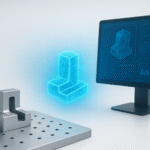
AI sheet metal nesting helps fabricators assess how parts can be arranged on sheet stock within production constraints. The commercial question is straightforward: can the proposed software produce the same accepted parts with less purchased material and manageable programming, cutting and sorting time?
This guide explains the workflow, gives a worked savings example and sets out a trial checklist. Savings depend on the starting nest, part mix, material and operating rules. The calculation below is illustrative, not a supplier performance claim.
What AI sheet metal nesting does
Nesting arranges part profiles for cutting. The software must respect thickness, material grade, grain direction, permissible rotation, spacing, cutting rules and delivery priorities. A denser layout can create extra work elsewhere if it makes parts difficult to release or sort.
Advanced nesting can use search and optimisation methods without learning from production data. Where a supplier describes an AI capability, ask which decision uses AI, what inputs it needs and how its output is checked. Establish whether learning occurs within your installation or through supplier updates.
Documented software examples
Lantek’s nesting documentation describes production-aware optimisation and identifies KAI AI algorithms as part of its approach. Lantek Expert connects nesting with cutting processes; the wider suite connects with manufacturing and business information. Confirm the exact functions in the quoted version.
SigmaNEST documents modular nesting capabilities for material use and manufacturing workflows. It provides a useful comparison when testing alternative layouts and processes. The presence of an advanced optimiser alone does not establish which functions use machine learning.
These are examples for a purchasing discussion, not results from an MTN head-to-head test. Read our Lantek manufacturing software feature for the broader production context.
Choosing nesting software
Which AI nesting software should a sheet metal shop compare?
Lantek and SigmaNEST are two documented options to include in a nesting trial. Lantek explicitly describes KAI AI algorithms in its nesting technology. SigmaNEST documents CAD import, material optimisation and machine programming; confirm the specific AI function in the proposed package. We have not independently benchmarked these products or established a universal winner.
Lantek: its nesting documentation covers sheet cutting, reusable remnants and connections with production systems. Ask which Expert modules, KAI capabilities and postprocessors are included for your machines.
SigmaNEST: its product documentation describes modular CAD/CAM features, importing parts, grouping work by material and machine, and generating cutting programs. Ask for a demonstration of the exact configuration being quoted.
What should a nesting software demonstration prove?
Give each supplier the same DXF files and representative CAD data, quantities, sheet stock and deadlines. Include a part with grain-direction restrictions, a usable remnant and a geometry that normally needs manual repair. Record which file formats and versions import successfully and what preparation is required.
Check whether rotation limits, part spacing, remnant reuse and order identity survive from import to the cutting program. Verify the postprocessor for your machine model and controller. Ask the supplier to show how material availability and job status pass to your ERP or MES, including any extra modules or integration charges. These are acceptance checks, not a claim that every package includes every capability.
Can AI nesting improve profitability without buying a new laser?
Potentially, if the proposed software supports the existing machine and improves the complete job cost. Keep the machine constant during the comparison and measure accepted parts, purchased stock, programming effort and cutting and sorting time. Include software, postprocessor, integration, training and support costs before calculating payback.
Buyer guidance updated 25 October 2026. Product capabilities are based on linked supplier documentation; availability should be confirmed for the quoted version.
Worked example: from utilisation to purchasing savings
Assume a repeat workload needs 8,000 kg of accepted parts each month. At 80% material utilisation, it requires 10,000 kg of input stock. If a controlled trial raises utilisation to 84%, the same output needs approximately 9,524 kg: 8,000 ÷ 0.84.
That saves approximately 476 kg of input stock, or 4.76% of the original purchase quantity. The utilisation improvement is four percentage points. These are different measures and should be labelled separately.
At an assumed purchase price of £2/kg, the gross monthly purchasing reduction is about £952. If the avoided scrap would have returned £0.20/kg, subtract roughly £95 of lost scrap income. The net material benefit is then approximately £857 per month, before software, implementation and operating costs.
This simplified mass balance assumes constant accepted output, comparable stock and no change in usable remnant inventory. In practice, sheet sizes, minimum purchase quantities, quality losses and remnant reuse affect the result. Reconcile the estimate with actual stock issues and purchases.
A trial checklist for fabricators
Freeze the comparison: use identical part quantities, due dates, sheet sizes, material grades and thicknesses. Give both systems the same rotation, grain and spacing restrictions.
Use normal jobs: include small batches, awkward shapes, repeat parts and urgent orders. Set the same calculation-time allowance and record operator changes.
Measure the complete process: record sheets consumed, accepted output, programming time, cutting time, pierces, interruptions and sorting labour. Track usable remnants separately from scrap.
Check the machine output: validate postprocessors and cutting rules. Examine part stability, heat effects and safe release during a production trial with the responsible personnel.
Price the implementation: include licences, stock-data preparation, ERP or MES links, training and support. Compare recurring benefits with recurring costs and account for the initial project cost.
Scrap and carbon: use the right boundary
Less purchased material can reduce the emissions associated with that material. A carbon estimate needs the relevant material factor and a clear accounting boundary. Track changes in energy, rejects and remnant stock; a utilisation percentage alone does not establish a carbon saving. Our guide to measuring nesting, scrap and carbon explains the measurement questions.
MTN Analysis
The practical opportunity is to improve a recurring production decision with data the fabricator can audit. We would start with a representative month of work and compare accepted output, stock consumption and total processing effort. A nest that looks impressive on screen has to work at the machine and at the sorting table.
Explore our AI in Sheet Metal hub for cutting, bending and handling coverage, and our manufacturing software hub for the systems connecting those operations.
Frequently asked questions
How much material can AI nesting save?
There is no reliable universal percentage. Measure the difference against your current process using the same workload and constraints. Report both utilisation percentage points and the reduction in material purchased.
Can it work with an existing laser cutter?
Compatibility depends on the software, postprocessor and machine configuration. Confirm support with the supplier and validate output before production.
Should remnants count as waste?
Record reusable remnants as stock with a defined reuse policy. Counting every offcut as waste can distort the result; carrying unusable remnants as valuable stock can distort it in the other direction.
Further Reading
AI in Sheet Metal: applications and news
TCI Cutting Smart Sorting
Measuring nesting, scrap and carbon