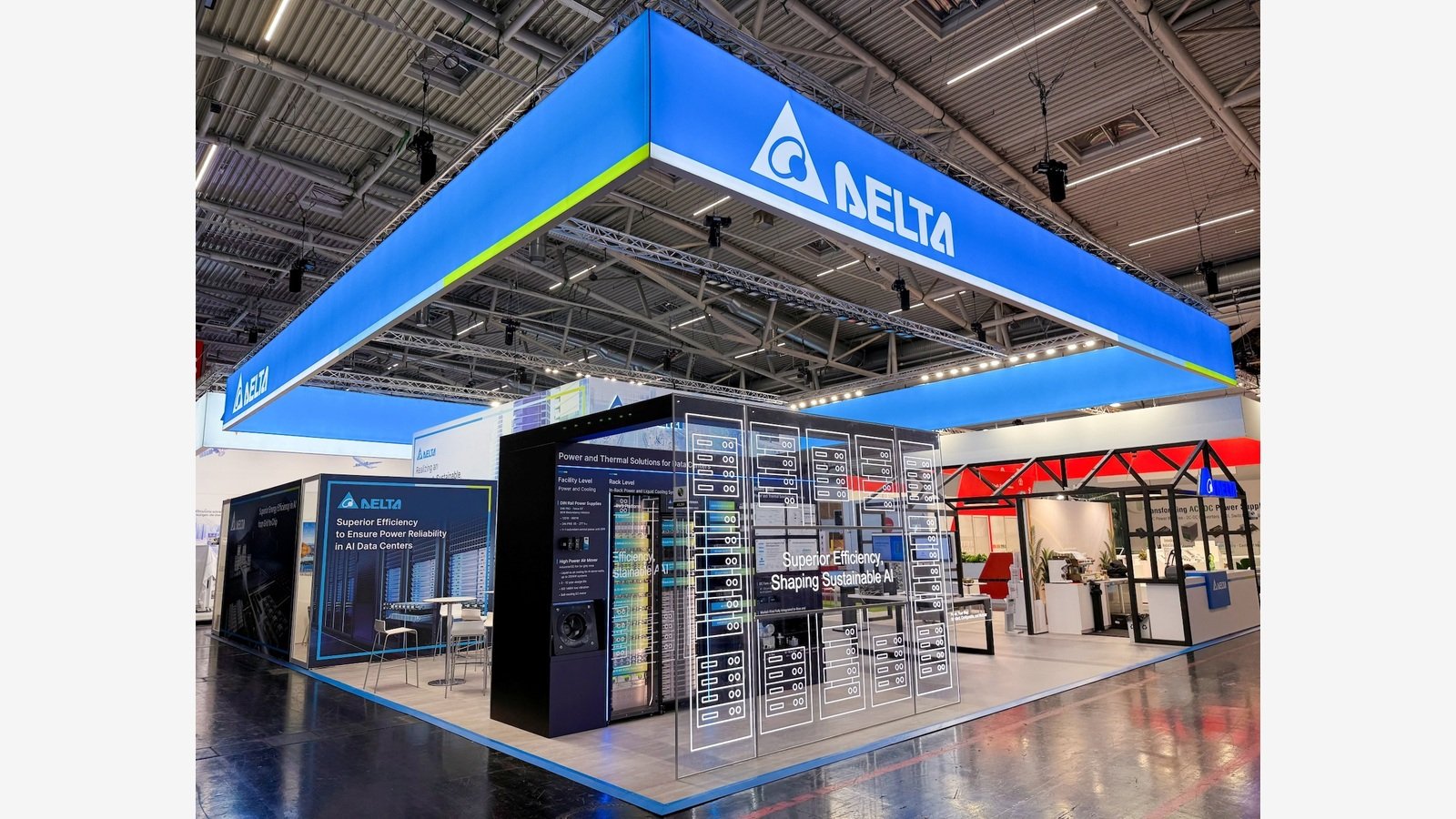
AI data centre technology is beginning to influence how industrial equipment is designed. Delta Electronics identifies three opportunities for OEMs, from supplying AI infrastructure to developing smarter machines and preparing for new European regulations. But what does this mean for manufacturers investing in their next generation of equipment?
The growing influence of AI data centre technology is creating new engineering considerations for industrial OEMs, particularly around power efficiency, thermal management and the integration of advanced computing hardware.
AI data centre technology is creating opportunities beyond the computing industry, according to Delta Electronics. The company’s latest assessment highlights how higher power density, advanced cooling, silicon carbide power electronics and high-voltage DC architectures could influence industrial automation, machine design and manufacturing equipment.
For industrial OEMs, the opportunity is not necessarily to develop artificial intelligence themselves. It is to apply engineering capabilities already used in industrial machinery, power electronics and automation to emerging applications, while preparing their own products for higher computing and electrical demands.
Delta identifies three areas where this transition could create opportunities for equipment manufacturers.
Can industrial OEMs supply equipment to AI data centres?
AI data centres require more than processors and servers. They also depend on cooling equipment, power distribution, pumps, valves, fans, motor drives and control systems.
Many of these technologies are already familiar to industrial equipment manufacturers.
Delta argues that European OEMs with experience in fluid control, industrial drives and high-reliability electrical equipment could find new customers in AI infrastructure.
Liquid cooling is particularly relevant as high-performance computing systems place greater demands on thermal management.
For manufacturers of pumps, valves and cooling equipment, this creates a potential opportunity to adapt existing products for data centre applications.
However, supplying a data centre is not necessarily the same as supplying a conventional industrial installation.
Equipment manufacturers must consider continuous operation, redundancy, maintenance access, energy efficiency and compatibility with the customer’s cooling architecture.
High-voltage DC power distribution presents another potential market.
Delta highlights the movement towards architectures such as 800 VDC, where experience gained from electric vehicle development could be useful.
Manufacturers already working with high-voltage power conversion, electrical protection and thermal management may therefore have transferable engineering capabilities.
The commercial question is whether those existing products can meet the reliability, certification and integration requirements of data centre operators without extensive redesign.
How AI Data Centre Technology Could Change Industrial Machinery Design?
The second opportunity concerns the equipment manufacturers already produce.
Machine vision, predictive maintenance, edge computing and intelligent control systems are increasing the amount of processing that can take place directly within industrial equipment.
These applications can change the electrical and thermal requirements of a machine.
An industrial system incorporating additional computing hardware may require higher peak power, more sophisticated power conversion or additional cooling capacity.
Delta argues that OEMs should consider these requirements during the initial product design rather than adding them after the mechanical and electrical architecture has been finalised.
For machine builders, several engineering questions become important:
- Can the existing power supply support additional computing hardware and peak electrical loads?
- Will additional processors or power electronics require changes to enclosure ventilation or cooling?
- Can the new equipment operate reliably alongside existing drives, controllers and industrial networks?
- How will the additional hardware affect electrical safety, electromagnetic compatibility and maintenance?
These questions are particularly relevant to machine vision systems, robotic equipment and machines incorporating local AI processing.
However, not every AI application requires a completely new power architecture. The requirements depend on the computing hardware, operating conditions and machine configuration.
Delta’s announcement does not provide a specific industrial machine installation demonstrating quantified improvements from these design changes.
Why should machine builders prepare for the EU Machinery Regulation in 2027?
The third opportunity identified by Delta concerns regulatory changes.
The European Union’s Machinery Regulation (EU) 2023/1230 becomes generally applicable on 20 January 2027, replacing the existing Machinery Directive 2006/42/EC.
The regulation addresses several areas relevant to manufacturers introducing connected and intelligent machinery, including safety-related software, cybersecurity risks affecting safety and machinery incorporating AI-based safety functions. Internal Market & SMEs+1
For OEMs planning new machinery platforms, this creates an opportunity to review safety, electrical architecture and digital functionality together.
For example, a manufacturer introducing AI-based inspection or automated decision-making should establish whether those functions are safety-related and how they interact with the machine’s existing safety systems.
The new regulation does not mean that every machine must incorporate AI or adopt high-voltage DC technology.
Instead, manufacturers should assess which requirements apply to their particular equipment and document how compliance will be achieved.
Delta’s position is that manufacturers already redesigning products for higher performance can use this process to improve energy efficiency, maintainability and future compatibility.
Why It Matters: Power and cooling are becoming machine design decisions
The practical significance of Delta’s assessment is that AI adoption involves more than selecting software or adding processing hardware.
For machine builders, electrical and thermal requirements can determine how easily new technologies can be integrated into existing platforms.
Higher power density can reduce the physical space needed for electrical equipment, but it can also increase the importance of heat dissipation.
Liquid cooling may offer advantages in applications with demanding thermal loads, although it introduces additional components, maintenance considerations and potential failure points.
Silicon carbide power devices can support efficient high-frequency power conversion, but their suitability depends on the application, cost, electromagnetic compatibility and overall system design.
These technologies should therefore be evaluated against measurable engineering requirements rather than adopted simply because they are associated with AI infrastructure.
Delta Electronics at electronica 2026
Delta is presenting its perspective on this technology transition at electronica 2026 in Munich, taking place from 10 to 13 November.
At Booth A5.202, the company is showcasing power solutions for industrial automation, medical equipment and other OEM applications.
One relevant example is Delta’s DIN PRO series of industrial power supplies. According to the company’s exhibition information, the range offers a power boost of up to 150% for five seconds to accommodate temporary loads such as motor start-up and inrush currents.
That is a more immediate industrial application than the wholesale adoption of data centre electrical architectures. It addresses an existing challenge for machine builders: supporting variable electrical loads without unnecessarily oversizing power supplies. psu.deltaww.com+1
Further details are available through Delta’s electronica 2026 exhibition information.
MTN Analysis
Delta’s argument is particularly relevant because it connects two developments often discussed separately: the expansion of AI infrastructure and the changing requirements of industrial equipment.
For manufacturers, however, the opportunities are not equal.
Supplying pumps, cooling equipment or power electronics to AI data centres represents a potential new market for established industrial technologies.
Introducing edge AI into machinery presents a different challenge. Here, the commercial benefit depends on whether the additional computing capability improves inspection, reliability, productivity or another measurable production outcome.
The third opportunity, redesigning equipment around future regulatory and performance requirements, may be the most immediately relevant for OEMs developing new platforms.
We would also distinguish between technologies already available and those that may become more widely adopted.
Liquid cooling and high-voltage DC distribution have established applications, but their use in AI infrastructure does not automatically make them necessary or economical for conventional industrial machinery.
Before committing to a new architecture, buyers should ask suppliers for application-specific efficiency data, thermal performance, safety documentation, maintenance requirements and lifecycle cost comparisons.
The central question is not whether industrial machinery will become more like an AI data centre. It is which engineering developments genuinely improve the performance and economics of the machine being designed.
FAQ
What is the connection between AI data centres and industrial machinery?
Both use power conversion, cooling, electrical distribution and control technologies. Delta believes developments in AI infrastructure could create new markets for industrial equipment suppliers and influence future machine designs.
Will industrial machines need liquid cooling to support AI?
Not necessarily. Cooling requirements depend on processor power consumption, heat generation, installation conditions and the overall machine architecture. Many industrial edge AI applications can continue to use air cooling.
Can existing industrial OEMs supply AI data centres?
Potentially. Manufacturers of pumps, valves, motor drives, cooling equipment and power distribution systems may have relevant capabilities. However, products must meet the operating, reliability and integration requirements of data centre customers.
Has Delta demonstrated measurable productivity improvements from these technologies in manufacturing?
The supplied announcement does not disclose an independently verified industrial case study showing productivity improvements, energy savings or return on investment from transferring AI data centre technologies into machinery.
When does the new EU Machinery Regulation apply?
Regulation (EU) 2023/1230 becomes generally applicable on 20 January 2027. Machinery manufacturers should review the requirements relevant to their products before placing equipment on the EU market.
Further Reading
For more information about Delta’s power electronics and thermal management technologies, visit the official Delta data centre technology portfolio.
For the original industry assessment, read The Next Wave of AI: Why Tomorrow’s OEM Products Will Be Designed Like Today’s AI Data Centers.
For regulatory requirements, consult the European Commission’s guidance on the Machinery Regulation.
LG CNS Factova: Bryce Barnes on Connecting Factory Equipment and Putting AI to Work
MVTec, Bosch Rexroth and BMG Simplify Machine Vision Integration Wit