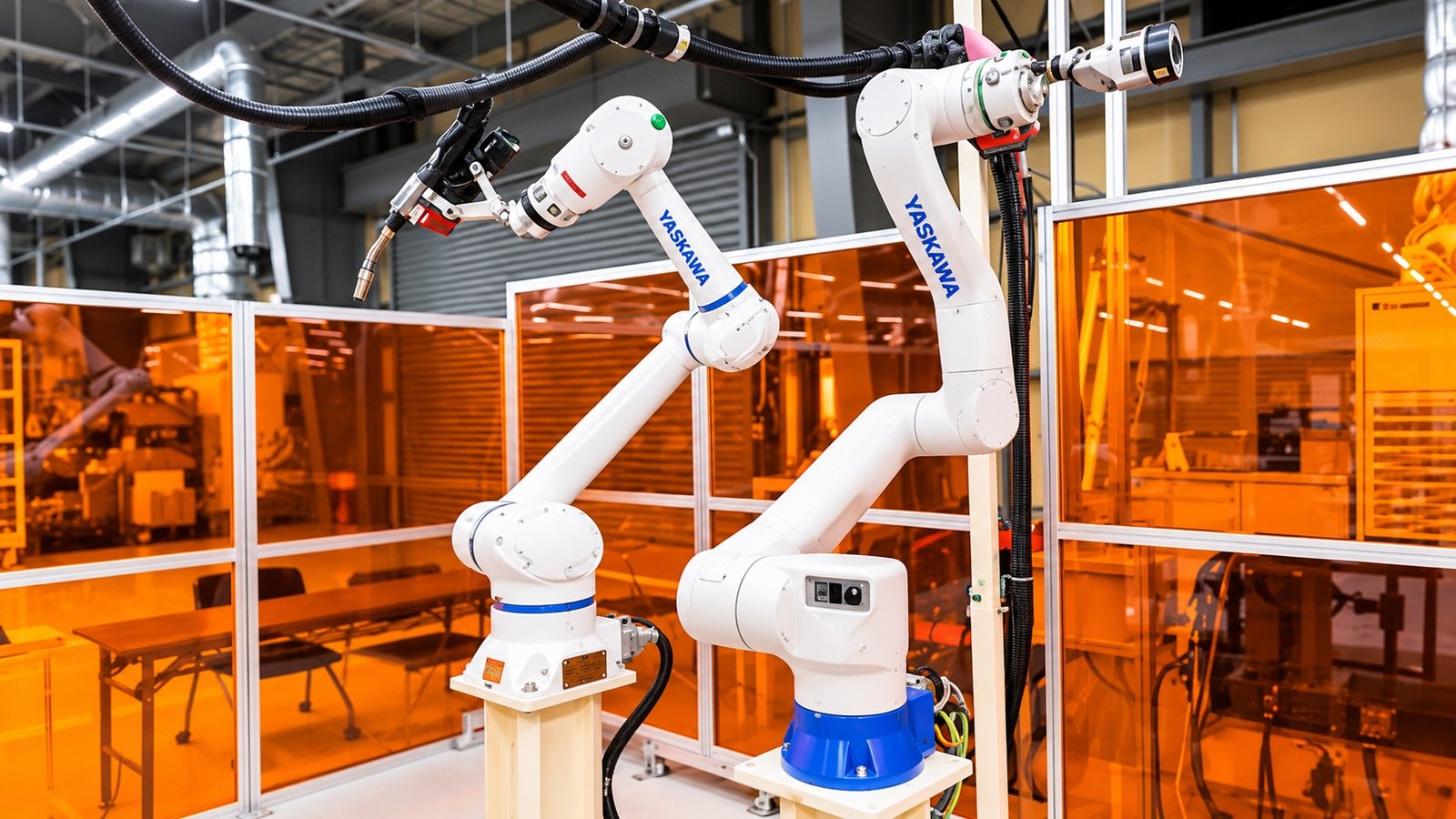
Yaskawa Electric and Toyota GAZOO Racing have introduced autonomous robotic welding into GR Kart frame production in Japan. The MOTOMAN NEXT system adjusts to variations in pipe joints, evaluates weld quality using images, sound and process data, and determines when corrections are required.
Yaskawa’s MOTOMAN NEXT AI welding robot is now being used in production at Toyota GAZOO Racing’s Gamagori GR Kart Workshop in Japan, bringing autonomous decision-making to a welding process that has traditionally depended on skilled operators.
The system does more than follow a programmed welding path. It recognises differences in pipe-frame assembly conditions, assesses joint gaps and temperature, and determines how to carry out the weld. After welding, it analyses inspection images, welding sounds and process data to evaluate quality and perform corrections.
The deployment began in September 2026, with both companies formally announcing the project on 28 October.
For manufacturers, the important development is not simply the introduction of another AI-enabled industrial robot. It is the integration of welding, inspection and corrective action into a single automated production process. Yaskawa Global Site+1
How Does MOTOMAN NEXT AI Welding Handle Joint Variations?
Conventional robotic welding works particularly well when components are accurately positioned and joint conditions remain consistent.
Pipe-frame fabrication can be more challenging. Variations in assembly, joint gaps and temperature can affect the welding conditions required to produce an acceptable result.
Yaskawa and GAZOO Racing have developed a system designed to respond to these differences rather than depend entirely on predetermined conditions.
The MOTOMAN NEXT robot combines onboard GPU-based AI processing with recognition, decision-making and robot control technologies.
According to Yaskawa, the system can recognise the condition of an assembled pipe frame, assess the gaps between joints and select appropriate welding actions for the situation.
Toyota also identifies temperature as one of the conditions considered during welding.
This is particularly relevant for manufacturers producing tubular structures, where maintaining consistent joint preparation and positioning can be difficult.
However, the companies have not published the maximum joint-gap variation the system can accommodate, its dimensional tolerances or the limits within which it can adapt welding parameters. These would be important considerations for any manufacturer evaluating a similar installation.
How Does AI Inspect Weld Quality and Decide Whether Correction Is Needed?
Yaskawa and GAZOO Racing’s autonomous welding project applies robotic inspection and correction to GR Kart frame manufacturing.
One of the more significant aspects of the project is what happens after the robot completes a weld.
Instead of treating welding and inspection as entirely separate operations, the system uses several sources of information to assess the result.
Yaskawa identifies three main inputs:
- Visual inspection images: Used to evaluate the completed weld.
- Welding sounds: Analysed by AI as part of the quality assessment.
- Process data: Provides additional information about welding conditions and results.
MOTOMAN NEXT combines these inputs with its recognition and decision-making capabilities to determine whether corrective action is required.
Yaskawa states that the robot can autonomously perform post-weld inspection and correction, tasks that previously relied on experienced welders.
For production engineers, the distinction is important. A robot that can identify a potential quality issue is useful. A system that can also decide how to respond and carry out a correction has the potential to reduce manual intervention.
There are still important questions about inspection reliability.
Neither company has published defect-detection accuracy, false-rejection rates, the types of defects that can be corrected or the independent inspection methods used to validate the results.
The announcement also does not establish whether the AI-based assessment can replace conventional weld qualification or nondestructive testing requirements for safety-critical components.
From Motorsport Welding to Autonomous GR Kart Production
The collaboration between Yaskawa and GAZOO Racing began before the latest AI welding deployment.
In 2023, Toyota Chairman Akio Toyoda visited the Toyota GAZOO Racing World Rally Team in Finland, where roll-cage fabrication was taking between two and three weeks.
Yaskawa and GAZOO Racing subsequently developed the Sequence Freezing Arc Welding (SFA) process in 2024.
According to the companies, the new process reduced roll-cage production time to three days while improving weld quality and strength and contributing to weight reduction.
The SFA process has also been adopted for vehicles competing in Japan’s Super Taikyu Series.
REPORTED ROLL-CAGE PRODUCTION TIME
Before SFA 2–3 weeks with SFA 3 days
Figures reported by Yaskawa and GAZOO Racing for the earlier roll-cage manufacturing process, not measured cycle-time improvements for the new MOTOMAN NEXT installation.
The latest development builds on that welding expertise but introduces a different capability: autonomous recognition, assessment and correction during GR Kart frame production.
This distinction matters. The earlier SFA project demonstrated a substantial improvement in a specific fabrication process. The new installation is intended to demonstrate how robotic decision-making can manage changing conditions during production.
Is MOTOMAN NEXT Already Operating in Production?
Yes. The technology is being used at the Gamagori GR Kart Workshop in Aichi Prefecture, Japan.
Yaskawa describes the installation as a practical deployment on a customer’s actual production line rather than a laboratory demonstration or evaluation project.
GAZOO Racing also reports that the technology has contributed to reducing GR Kart manufacturing costs.
However, neither company has disclosed the size of those savings.
There are also no published figures for the installation’s welding cycle time, production volume, defect rate, equipment investment or payback period.
For manufacturers considering similar technology, these missing figures are significant.
The deployment establishes that the system has moved into a real manufacturing application. It does not yet provide enough public data to calculate the return on investment for another factory.
What Would Manufacturers Need to Consider Before Adopting the Technology?
The most relevant applications are likely to be welding operations where joint conditions vary and where inspection or rework currently requires substantial operator involvement.
Tubular frames and welded structural assemblies are obvious areas to investigate, although Yaskawa has not confirmed the performance of this particular system across other product categories.
Manufacturers would need to establish how the system performs with their own materials, joint designs, fit-up tolerances and production volumes.
Integration is another consideration.
The announcement does not specify the required welding power source, sensor configuration, software interfaces or compatibility with existing robotic welding cells.
It also does not explain how the system records inspection decisions, manages rejected welds or handles cases where an automatic correction is unsuccessful.
These are not minor details. They determine whether an autonomous welding system can be integrated into a controlled production environment with appropriate quality assurance and traceability.
Yaskawa has indicated that it intends to expand the application of technologies developed through the project to other manufacturing environments. No specific wider deployment schedule or commercial package for this complete welding and inspection solution has been announced.
Why It Matters for Industrial AI and Robotic Welding
Industrial AI becomes more useful when it can respond to real production variation rather than simply analyse information after a process has finished.
The Yaskawa and GAZOO Racing project demonstrates a practical direction for this development.
The robot recognises conditions, selects an action, performs the weld, evaluates the result and can carry out a correction.
This moves beyond conventional automation in which operators must intervene whenever a process falls outside predefined conditions.
It also brings together two activities that manufacturers often manage separately: production and quality inspection.
For factories dealing with welding skills shortages, variable joint conditions or repeated manual rework, that combination deserves attention.
The important question is how reliably it performs across different components, production conditions and defect types.
Those results will ultimately determine how widely the technology can be applied.
MTN Analysis: A Production Deployment, but More Validation Is Needed
We see the most important aspect of this project in the robot’s ability to respond to changing welding conditions and act on its own quality assessment.
Many industrial AI applications concentrate on monitoring equipment, identifying anomalies or recommending actions to an operator.
MOTOMAN NEXT is being used to go further by connecting recognition and decision-making directly to physical production and correction.
The GR Kart installation provides a real manufacturing example of that approach.
However, we would not interpret this deployment as evidence that autonomous welding inspection can already replace established quality assurance procedures across industrial applications.
The manufacturers have confirmed the application and described its capabilities, but detailed independent performance data remains unavailable.
Before investing, we would want to see how the system handles different joint gaps, weld defects, materials and production conditions, alongside the cost of integration and the results of independent weld-quality testing.
The technology is worth watching because it addresses a genuine manufacturing challenge: maintaining welding quality when real components do not always match ideal programmed conditions.
Its broader commercial value will depend on how consistently that capability can be reproduced outside the GR Kart workshop.
FAQ
Can MOTOMAN NEXT automatically correct welding defects?
Yaskawa states that the system can inspect completed welds and perform corrective actions autonomously. The company has not disclosed which defect types can be corrected or the limits of those corrections.
Does the robot use welding sound to inspect quality?
Yes. Yaskawa confirms that AI analyses welding sounds alongside visual inspection images and process data. The specific acoustic analysis methods and detection accuracy have not been published.
Is the system already being used in a factory?
Yes. The technology entered use in September 2026 at the Gamagori GR Kart Workshop in Japan, where it is applied to kart-frame manufacturing.
Can manufacturers buy the complete autonomous welding system?
MOTOMAN NEXT is an established Yaskawa robot platform, introduced in 2023. However, the companies have not confirmed commercial availability, pricing or a standard configuration for the complete GR Kart welding, inspection and correction solution.
Has Toyota confirmed measurable cost savings?
GAZOO Racing reports that the installation has reduced GR Kart production costs, but no percentage saving, investment figure or payback period has been published.
Further Reading
For the original announcements and technical background, see Yaskawa Electric’s official release and GAZOO Racing’s announcement, both published on 28 October 2026.
Related MTN coverage:
- IMTS 2026 Post-Show Review: Powerful AI Trends Shaping Manufacturing – Includes Yaskawa Motoman’s adaptive robotics developments.
- AI at EuroBLECH 2026: 7 Powerful Trends Shaping Sheet Metal – Examines adaptive robotic welding from Valk Welding and TRUMPF.
- Real Time Weld Defect Detection: Inside Sonibel’s New AI Technology – Explores acoustic sensing for welding quality monitoring.
- Kawasaki Physical AI Robot 2026: 8-Axis RL030N Launch – Covers robotic intelligence and high-speed weld inspection.