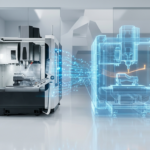
As manufacturers push for greater efficiency, consistency, and control in CNC programming, the conversation around AI has become louder and often more confusing. With claims coming from every direction, the real question is where AI actually delivers value in manufacturing. As part of that shift, we sat down with Ken Baldwin of OPEN MIND Technologies to break down what hyperMILL INTELLIGENCE really means in practice, and how manufacturers should be thinking about automation, data, and AI as we move toward MACH 2026.
MTN: hyperMILL INTELLIGENCE is positioned as a major step forward in CAM automation. How would you describe its role in helping manufacturers move towards more intelligent and data-driven machining processes?
hyperMILL INTELLIGENCE is not a product or a single feature. It is our approach to combining smart automation with AI. It brings these two worlds together on one consistent technology platform. We are talking about making CAD/CAM programming more reliable and consistent, not just more “automated”. We’ve spent over 30 years building real manufacturing knowledge into the software – feature-based machining, tool selection, proven strategies. That’s the foundation. What we’re doing now is building on that with a mix of rule-based automation and AI, but only where it actually adds value. The focus isn’t AI as a buzzword. It’s about reducing programming time, improving consistency, and making sure what you program actually works on the machine.
MTN: There is a lot of discussion around AI in manufacturing right now. Where does hyperMILL INTELLIGENCE sit within that landscape, and how should manufacturers think about rule-based intelligence versus full AI systems?
hyperMILL INTELLIGENCE uses proven automation as a stable foundation and complements it with AI where it provides real, measurable benefits. AI is not a replacement for engineering expertise. It only delivers value when it builds on a strong technological base. If the fundamentals aren’t right, AI just makes bad decisions faster. AI is getting a lot of attention, but in CAM it’s often misunderstood. Core processes like toolpaths, collision avoidance, and machine control need to be predictable and exact. That’s not where AI fits – that’s where rule-based engineering is critical. Where AI does help is in handling data, recognising patterns, and supporting decisions. Giving an example, a rules-based process gives consistent results. Real AI should learn and you can get variable results in quality which is not what you want in this context. Our approach is to combine both. Use proven automation as the backbone, and apply AI where it genuinely improves the process.
MTN: Does the rule-based approach of hyperMILL INTELLIGENCE directly improve machine tool productivity, or is its impact elsewhere in the process?
Our hyperMILL automation technology doesn’t make the machine physically faster on its own, but it does improve how effectively the machine is used. Through the Virtual Machine and digital twin, toolpaths can be optimized for the specific machine and control. That means better use of the machine’s capabilities, smoother motion, and more efficient programs. At the same time, programming is faster and more consistent, and programs are far more likely to run correctly first time. The overall result is improved machine productivity – not by pushing the machine harder, but by removing inefficiencies, reducing rework, and making better use of the machine.
MTN: One of the biggest challenges in CNC programming is consistency between programmers. How does hyperMILL help standardise processes and reduce variability across teams?
Consistency is one of the biggest challenges within manufacturing processes. hyperMILL helps by letting you define proven processes once and reuse them, so everyone is programming in the same way rather than doing their own thing. You define how the process should be done, based on your machines, tools, and experience, not how the software thinks it should be done. Feature-based machining and automation remove a lot of the variation, so results don’t depend on who is sat at the CAM system. The result is more consistent output, less rework and no unexpected behaviour on the machine.
MTN: At MACH 2026, what specific capabilities or live demonstrations will visitors be able to see on your stand related to hyperMILL INTELLIGENCE?
At MACH 2026, visitors will see how our automation works in the real world, not just in theory. We’ll demonstrate how feature-based machining, tool and machine optimisation, and process automation combine to produce consistent and reliable results. The focus is on practical use – defining processes once, reusing them, and reducing programming time while avoiding issues on the machine. We’ll also be showing hyperMILL DATA Center, which captures and reuses customer data to improve consistency and efficiency. We’ll also highlight where data-driven technologies and AI add value, but always in a controlled and predictable way.
MTN: Is AI in manufacturing the biggest revolution since digital programming?
AI will shape the future of manufacturing, but it’s not a silver bullet. It’s still just a tool, and if it’s used in the wrong way, it can create more problems than it solves. In areas like CNC programming, you still need predictable, proven processes. That doesn’t change. Where AI helps is in supporting decisions and working with data, not replacing engineering. So yes, it’s important, but its value depends entirely on how it’s applied.
MTN Analysis
This interview lands exactly where the industry is heading, away from hype and toward controlled, usable intelligence.
The key takeaway is that hyperMILL INTELLIGENCE is not trying to replace engineering judgement. It is reinforcing it. That matters because most CAM failures do not come from lack of automation, they come from inconsistency, poor decisions, and lack of process control.
OPEN MIND’s position is clear:
- Rule based automation remains the backbone of CNC programming
- AI sits on top as a support layer, not the decision maker
- Consistency and reliability are more valuable than experimental optimisation
This aligns with what high performing shops are actually prioritising in 2026:
- First time right machining
- Reduced rework and scrap
- Standardised programming across teams
- Better utilisation of existing machines rather than chasing marginal speed gains
The mention of digital twin and Virtual Machine is also critical. This is where real gains are happening. Not in theoretical AI optimisation, but in ensuring that what is programmed runs exactly as expected on the shop floor.
Looking ahead to MACH 2026, the emphasis on live, practical demonstrations is important. Buyers are becoming far more sceptical of AI claims. They want to see:
- Real parts
- Real programming workflows
- Real time savings
No slides, no theory.
The most important line in this entire discussion is simple. If the fundamentals are not right, AI makes bad decisions faster.
That is the dividing line in CAM right now.
Vendors who understand this are building structured, layered intelligence. Vendors who do not are pushing features that look impressive but fail under real production pressure.
OPEN MIND is clearly positioning itself in the first category.
FAQs: hyperMILL INTELLIGENCE interview 2026
What is hyperMILL INTELLIGENCE?
hyperMILL INTELLIGENCE is the overarching approach of OPEN MIND to more intelligent and reliable CAD/CAM programming built on decades of machining knowledge. It connects automation, optimization, and Artificial Intelligence on one consistent technology platform. And it standardises how CAD/CAM programming is done by embedding proven processes, strategies, and decision logic into the system. It is not a product or a feature or an AI system in itself.
Is hyperMILL INTELLIGENCE an AI solution?
No. hyperMILL INTELLIGENCE is not AI. It is the structured, rule-based foundation that ensures machining processes are predictable and consistent. AI can be layered on top of this, but only after the fundamentals are defined and controlled.
Why is rule-based automation more important than AI in CAM?
Core CAM processes such as toolpaths, collision avoidance, and machine behaviour require absolute precision and repeatability. Rule-based systems guarantee consistent results, while AI introduces variability. That makes rule-based automation essential as the foundation.
Where does AI fit if hyperMILL INTELLIGENCE is not AI?
AI sits on top of the rule-based framework. It can support decision-making, analyse data, and recognise patterns, but it should not control critical machining processes. The rule-based system ensures stability, while AI adds selective optimisation.
How does hyperMILL improve consistency in CNC programming?
It allows manufacturers to define machining processes once and reuse them across teams. This removes variation between programmers and ensures that output is consistent regardless of who is creating the program.
Does hyperMILL make machines faster?
No. It improves how machines are used. By optimising programs for specific machines and controls, it reduces inefficiencies, improves reliability, and increases the likelihood of first-time-right machining.
Why is this approach important for manufacturers in 2026?
As manufacturers adopt more digital tools, consistency and reliability are becoming more valuable than experimental optimisation. A strong rule-based foundation ensures stable production, which is critical before introducing any AI-driven elements.
For more information, you can visit www.openmind-tech.com or pop over to meet Ken and his team at their stand at MACH in Hall 17 stand 230.
Read more about Open Mind