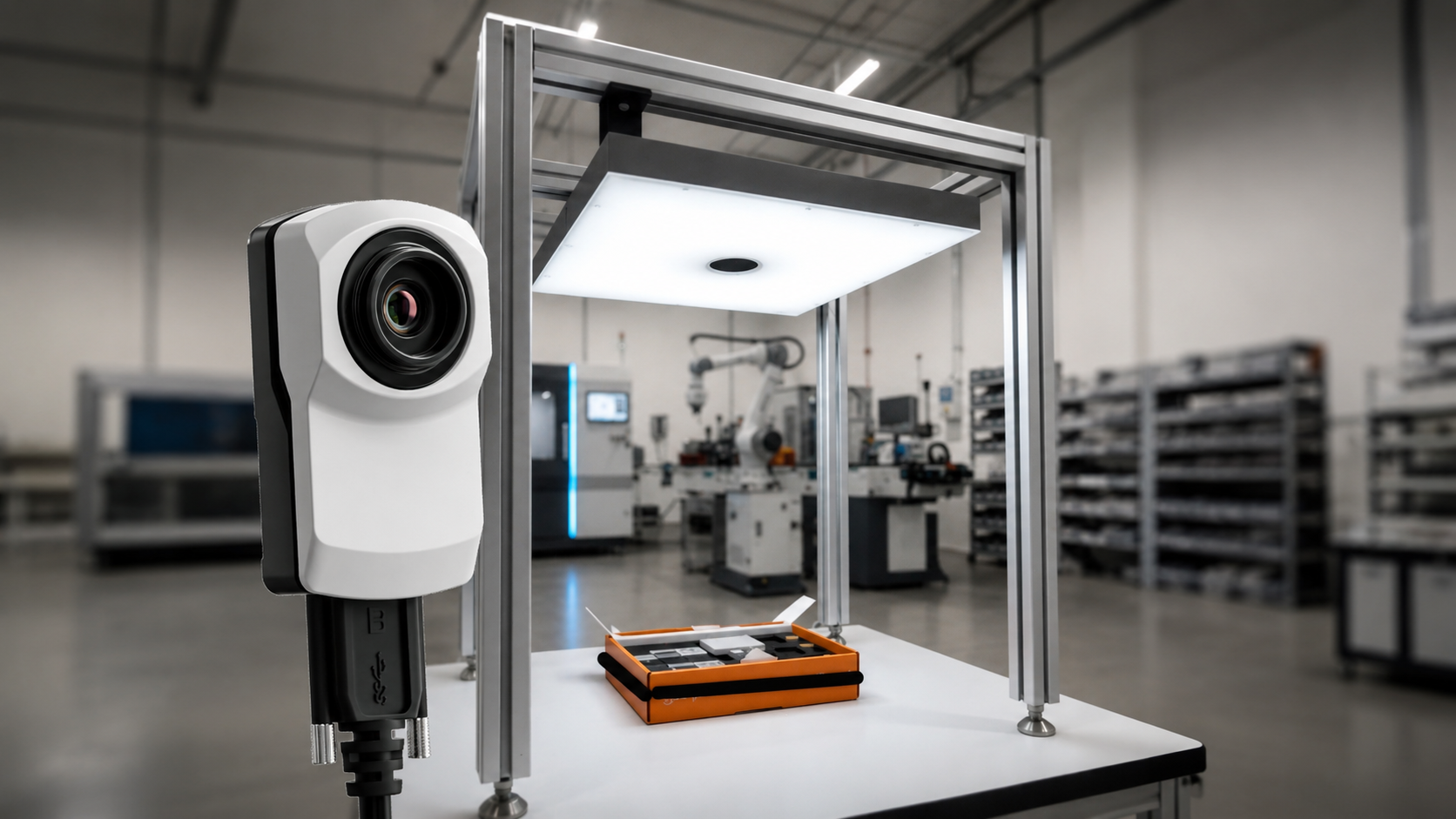
IDS AI visual inspection 2026 is becoming a strong example of how AI-supported quality control is moving closer to everyday production environments.
I have been looking at a new case study from IDS Imaging Development Systems, which explains how its uEye XC autofocus camera is being used within preML’s modular inspection solution. The system combines AI software, edge computing, lighting and IDS camera technology to help manufacturers carry out visual quality inspection without needing specialist image processing knowledge.
That matters because quality control is under growing pressure across sectors such as automotive, mechanical engineering and electronics manufacturing. Manufacturers are having to inspect a wider range of components, often under changing conditions, while keeping integration time and operating complexity under control.
The preML system has been developed to address that challenge. According to IDS, the solution is supplied as a complete modular kit, including camera, lighting, edge computing and pre-installed software. This allows it to be used as a plug-and-play inspection system for industrial quality control.
At the centre of the system is the IDS uEye XC industrial camera. The camera uses a 13-megapixel sensor and autofocus to capture detailed images, with consistent sharpness even when component heights, working distances or surfaces change. That makes it relevant for inspection tasks where the parts being checked are not always identical or positioned in exactly the same way.
For wider context on how this fits into the market, I would also link this story internally to our Metrology & Vision coverage and our recent article on MVTec and ZEISS advancing AI inspection.
IDS AI visual inspection 2026 and no-code inspection models
One of the clearest aspects of the case study is the focus on usability.
The preML Vision Lab software allows users to create, manage and evaluate AI-supported inspection models directly on the device. In one example, the system captures a plastic dowel and automatically checks it for deviations. Test models can then be managed and evaluated in real time.
The system is also being used in electronics manufacturing. IDS highlights TOP. Thomas Preuhs GmbH as a practical example, where the inspection system is used to check manually assembled printed circuit boards.
That is a useful application area because PCB inspection can involve different variants, changing surfaces and varying lighting conditions. In that environment, the ability to adapt inspection models without complex programming can be important.
David Fehrenbach, founder of preML GmbH, says the solution is intended to fill a gap in the market by allowing skilled personnel without knowledge of image processing or AI to independently teach, manage and perform visual quality inspections on the device itself.
For me, that is the strongest part of the story. The value is not simply that AI is being added to inspection. The value is that AI-supported inspection is being packaged in a way that production staff can use more directly.
This also connects well with the wider shift toward factory-level AI, which we have covered in our explainer on what industrial AI is and how it is used in factories.
Why the IDS uEye XC camera matters
The IDS uEye XC is positioned as a camera that combines the ease of use of a webcam with the reliability of an industrial camera.
A single cable connection is used for installation and commissioning, which is useful in production environments where systems may be converted, expanded or reconfigured. Inside the camera is a 13 MP AR1335 sensor from onsemi, which provides high-resolution images for fault detection.
The autofocus function is also central to the application. It automatically adjusts focus and helps maintain image quality when object distances change. IDS says the sensor delivers 20 frames per second at full resolution and, thanks to BSI technology, can cope with changing lighting conditions.
Jürgen Hejna, Product Manager 2D Machine Vision at IDS, describes the uEye XC as being designed for users who need reliable image quality without significant integration effort.
The case study also notes that a quick-change macro attachment lens extends use at close range. This allows small structures to be detected more precisely, including conductor tracks, material defects and geometric deviations. Additional camera functions such as digital zoom, auto white balance and colour correction support detailed inspection work.
The exact model used in the case study is the IDS U3-36L0XC, which IDS lists as part of the uEye XC camera family.
Depending on the inspection requirement, preML says up to four uEye XC cameras can be used per system. That allows the inspection setup to cover multi-sided processes, complex geometries or combined surface and detail checks.
For readers following wider developments in AI inspection, this also sits alongside other factory quality applications such as our InspecVision GAV AI system review and MVTec HALCON 26.05 machine vision coverage.
Edge computing keeps the system self-sufficient
Another important detail is that the inspection system runs on a compact edge computing unit.
The system operates independently and does not require an internet connection. That makes it suitable for isolated production environments where cloud connectivity may not be desired or available.
The preML Vision Lab software runs as a web application directly on the device. It is described as a no-code solution, allowing inspection models to be trained and executed without programming knowledge.
IDS says models can be adapted to new products in a few minutes. That is particularly relevant for production environments with many variants, where inspection systems need to be reconfigured quickly rather than rebuilt around every product change.
This is also why the story fits into the wider move toward edge AI in manufacturing, where more intelligence is being processed directly on or near production equipment.
Use at TOP: manual assembly and 100 per cent inspection
The case study gives a practical example from TOP GmbH & Co. KG, which uses the system to inspect manually assembled printed circuit boards.
Emil Kurowski, Managing Director of TOP, explains that the company has been assembling components and end devices for more than two decades, from prototypes through to small and large series. The company works according to lean production principles, with many assemblies produced by hand and followed by inductive soldering.
Because TOP requires 100 per cent inspection of manufactured parts, the company uses the preML system as part of its quality control process.
This is where the application becomes especially relevant for manufacturers. Manual assembly remains important in many production environments, particularly where product variation is high. A flexible inspection system that can be adapted without programming knowledge can support quality control without forcing every inspection change through an external specialist or integrator.
MTN Analysis: why this matters for manufacturing
My view is that this case study shows where AI inspection is becoming more practical for everyday production.
Many manufacturers understand the value of machine vision and AI-supported quality control, but the barrier has often been implementation. Traditional inspection projects can require specialist image processing knowledge, integration work and time-consuming setup.
The IDS and preML approach points towards a more accessible model. The hardware, software, lighting and edge computing are brought together as a modular system. The inspection models can be created on the device. The system can run without an internet connection. The camera can handle changing distances and lighting conditions. Up to four cameras can be used where more complex inspections are needed.
Manufacturers still need to define what they are inspecting, what counts as a defect and how results should be handled. This case study shows how AI-supported inspection can move closer to the shop floor, with tools that production teams can manage more directly.
For sectors such as electronics manufacturing, plastics, mechanical engineering and automotive supply chains, that could make flexible inspection easier to adopt across more production tasks.
Key Takeaways
IDS AI visual inspection 2026 is being shown through a practical case study involving preML’s modular inspection system.
The solution combines IDS uEye XC cameras, AI software, edge computing, lighting and pre-installed software.
The system is designed so users without image processing or AI expertise can teach, manage and run inspection models.
The IDS uEye XC camera uses a 13-megapixel sensor, autofocus and single-cable connection for easier deployment.
The exact camera model used in the case study is the IDS U3-36L0XC.
The system can operate independently without an internet connection, making it suitable for isolated production environments.
TOP GmbH & Co. KG is using the system to inspect manually assembled printed circuit boards.
FAQ
What is IDS AI visual inspection 2026?
IDS AI visual inspection 2026 refers to the use of IDS camera technology within preML’s modular AI-supported visual inspection system for industrial quality control.
Which IDS camera is used in the preML inspection system?
The case study identifies the IDS uEye XC industrial camera, with the model used listed as U3-36L0XC.
What does the preML inspection system include?
According to IDS, the system includes camera technology, lighting, edge computing and pre-installed software in a modular plug-and-play setup.
Does the system require image processing expertise?
According to IDS and preML, the system is designed so users without image processing or AI knowledge can create, manage and run inspection models directly on the device.
Does the inspection system need an internet connection?
The system includes a compact edge computing unit and can operate independently without an internet connection.
How many cameras can the preML system use?
Depending on inspection requirements, up to four IDS uEye XC cameras can be used per system to support multi-sided inspection, complex geometries or combined surface and detail checks.
Further Reading on MachineToolNews.ai
Metrology & Vision
MVTec and ZEISS Team Up to Advance AI Inspection
MVTec HALCON 26.05: Faster AI Object Detection and Machine Vision Performance
GAV AI Guidance and Verification Product Review
What Is Industrial AI and How Is It Used in Factories?
Edge AI in Manufacturing 2026: Powerful Real-Time AI Explained





One Comment