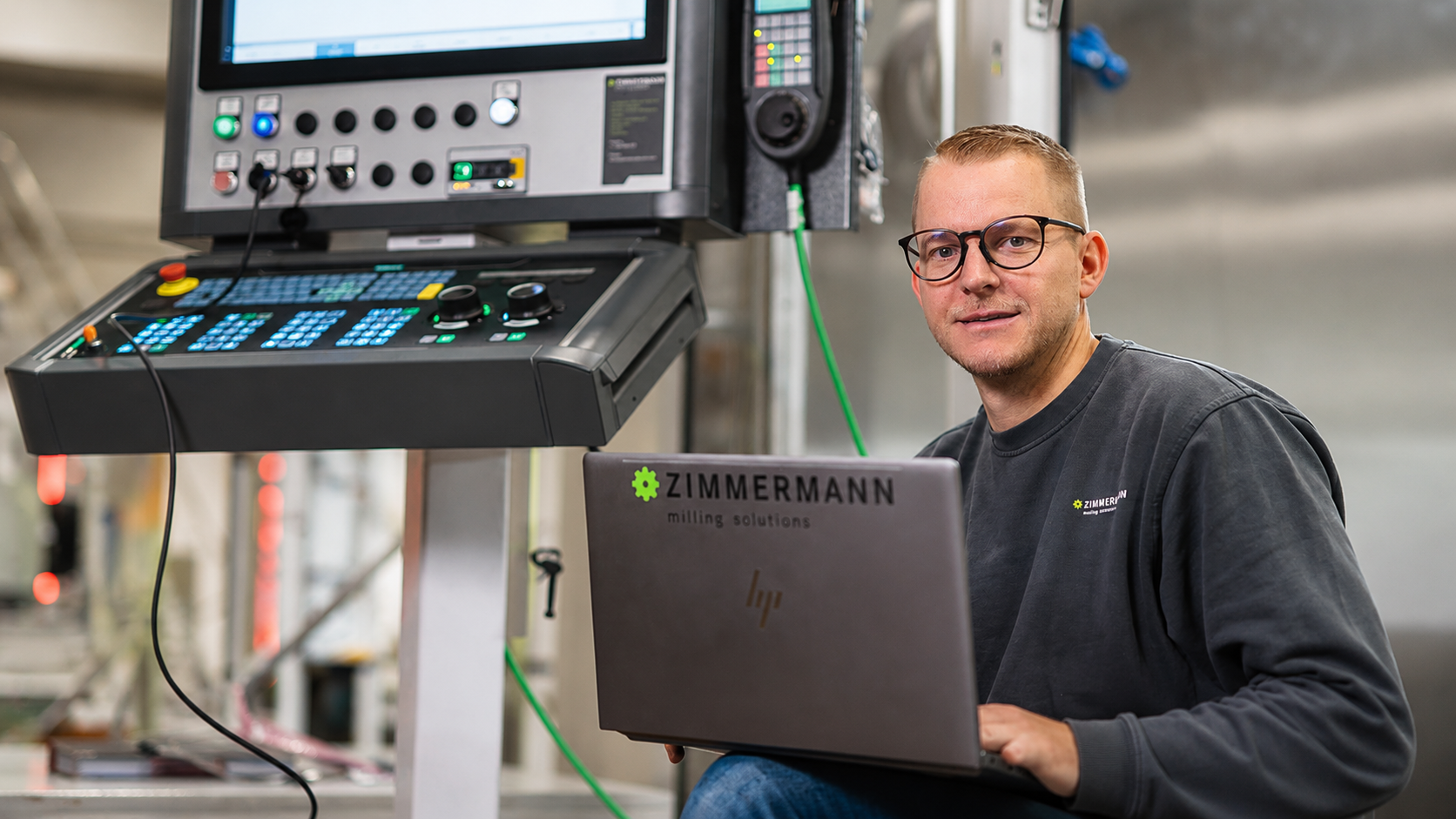
Zimmermann cyber resilience AI developments are placing digital security, simulation and intelligent assistance at the centre of high-precision portal milling machine construction, as the machine tool manufacturer prepares for new European cyber security requirements and increasingly connected manufacturing environments.
The company says modern high-precision portal milling machines are no longer purely mechanical systems. They are complex digital platforms built around CNC control systems, industrial PCs, sensor technology, software, drives and internal networks. As these machines become more connected, cyber resilience is becoming an integral part of machine tool design.
For Zimmermann, the issue is especially important because its machines are used in demanding sectors including aerospace, automotive, mouldmaking, transportation, off-highway and mechanical engineering. In applications where machined components may later be used in safety-relevant areas such as commercial or military aviation, the integrity of data, production parameters and machine performance becomes a critical part of overall precision.
Christian Gaarz, Head of Software Development & Commissioning at Zimmermann, explains that machine safety and cyber security address different risks.
“What distinguishes machine security from cyber security? The former protects the operator from hazards posed by the system. Safety features prevent mechanical or electrical risks and ensure that people are not harmed. Cyber security, on the other hand, affects the entire digital network of a machine,” explains Gaarz. “All networked components with IP addresses must be secured in such a way that no unauthorized access from the outside is possible. Such an intervention could change processes, cause production to fail and have serious consequences go unnoticed, such as data loss or falsified production parameters. This is particularly critical for components that will later be used in safety-relevant applications such as commercial and military aviation.”
Gaarz and his team are responsible for the digital systems that bring Zimmermann’s portal milling machines to life, from drives and sensor technology through to software solutions. The goal is to turn mechanical components into process-reliable complete systems where digital security is considered from the start.
Zimmermann cyber resilience AI strategy becomes a regulatory requirement
Zimmermann is preparing for a changing European regulatory environment. The company points to the Cyber Resilience Act, the Machinery Regulation (EU) 2023/1230 and the NIS 2 Directive as part of a wider legal framework affecting digital products, machine systems and connected industrial equipment.
“For us as a mechanical engineering company, this means that cyber resilience is no longer a voluntary additional service, but a regulatory obligation,” reports Gaarz. “We must meet this binding framework for compliance as early as 2027.”
This changes how machines are developed. Security requirements influence machine design, software architecture, documentation and internal processes at an early stage. Zimmermann describes the key principle as “security by design,” meaning security is built into machine development from the beginning.
The company says it is working in industry specialist groups and collaborating with control manufacturers including Heidenhain and Siemens, as well as external specialists.
“Especially for a medium-sized mechanical engineering company such as Zimmermann, it is crucial to bundle regulatory know-how to develop practical solutions. At the same time, we are adapting internal processes and training our staff in a very targeted manner,” says Gaarz.
How Zimmermann is applying security by design
Zimmermann’s approach begins with analysing which requirements apply to each machine configuration. Network architectures are then reviewed, segmented and supplemented with suitable security mechanisms.
Industrial PCs and the main CNC on the machine are secured, while software vulnerabilities are assessed through defined processes for updates and documentation. The aim is to reduce digital risk without affecting machine performance.
“We want to minimize digital attack surfaces without impairing the dynamics or precision of the machines,” explains Gaarz.
That balance matters because Zimmermann operates in special machine construction, where each system can differ in detail. Although machines are based on existing Zimmermann series, individual configurations may include different milling heads, peripherals, automation systems, axes, drives, safety functions and material handling equipment.
Each machine therefore requires its own electrical plan, topology and parameterisation. Mechanical differences can directly affect control behaviour, which means cyber security must be integrated into existing machine structures without limiting the machine’s precision, dynamics or productivity.
Digital twins support commissioning, service and training
Alongside cyber resilience, Zimmermann is also looking to digital twins as a way to improve efficiency and process reliability.
The company says a virtual machine environment can allow collision checks, parameterisation and software adjustments to be carried out earlier in the development and commissioning process. By testing some elements digitally before work takes place on the factory floor, commissioning time can be reduced, risks can be lowered and processes can be stabilised.
Digital twins can also support operator training before the physical machine is fully deployed. In service situations, a fault status can be reproduced in the digital model so causes can be identified more quickly. For customers, this has the potential to support both machine productivity and process reliability.
AI as an engineering assistant
Artificial intelligence is also being explored as part of Zimmermann’s wider digital strategy. The company is building an internal knowledge database that can be evaluated with AI support.
“In pilot projects with control manufacturers, we are investigating how AI can support us in programming or analyzing error messages more quickly,” says Gaarz. “In the future, recurring tasks can be accelerated and proposed solutions generated.”
Zimmermann is positioning AI as an assistance system rather than as a replacement for engineering responsibility. The company says results must be checked and validated by engineers, with transparency and traceability remaining essential.
AI could also support the faster creation of digital twins, helping make the structural development process of a machine more efficient.
For MachineToolNews.ai, this is where the story becomes especially relevant to the future of AI in machine tools. Zimmermann is showing how AI can sit inside a wider industrial digital framework that includes cyber resilience, control systems, simulation, engineering knowledge and machine performance. In this model, AI is not treated as a standalone feature. It becomes part of the technical infrastructure that supports safer, more reliable and more efficient machine development.
Beyond Precision in a connected industry
Zimmermann describes its guiding principle as “Beyond Precision.” In practice, that means precision is being expanded beyond the mechanical performance of the machine to include cyber safety, digitalisation, simulation and engineering responsibility.
For North American President of Zimmermann, Cornelius Kiesel, “This development is an expression of technical responsibility.”
When components are manufactured for highly sensitive applications, Zimmermann says this broader approach reinforces the need for holistically conceived precision. By integrating cyber resilience, simulation and AI, the machine tool manufacturer is strengthening its role as a technology partner for high-precision, large-scale machining and supporting long-term investment security in an increasingly networked industry.
“We see precision not only as a mechanical quality feature, but also as a holistic claim that combines cyber safety, digitalization and engineering expertise,” Kiesel sums up.
About Zimmermann
Zimmermann is based in Germany and is a global high-tech supplier of portal milling machines. Founded in 1933 by Friedrich Zimmermann, the company now has more than 200 employees worldwide. Its machines are used in sectors including automotive, aerospace, mouldmaking, transportation, off-highway and mechanical engineering.
Zimmermann Inc. has its North American headquarters in Wixom, Michigan, near Detroit, where it operates a full tech centre offering engineering assistance, commissioning, parts and retrofit services, as well as machines for demonstration purposes. Zimmermann Inc. is headed by President Cornelius Kiesel.
Further reading on MachineToolNews.ai
Latest MachineToolNews.ai stories
FAQ:
What is Zimmermann doing with cyber resilience?
Zimmermann is integrating cyber resilience into the development of its high-precision portal milling machines, including CNC systems, industrial PCs, software, internal networks and connected machine components.
Why is cyber resilience important for Zimmermann machines?
Cyber resilience is important because modern Zimmermann machines are connected digital systems. Unauthorized access could affect production processes, machine reliability, data integrity or production parameters.
How is Zimmermann using digital twins?
Zimmermann plans to use digital twins to support collision checks, parameterisation, software adjustments, operator training and service diagnostics.
How is Zimmermann exploring AI?
Zimmermann is exploring AI as an engineering assistance system that may support programming, error message analysis, internal knowledge databases and faster creation of digital twins.
Which sectors use Zimmermann machines?
Zimmermann machines are used in sectors including aerospace, automotive, mouldmaking, transportation, off-highway and mechanical engineering.
This is the safer Rank Math route. The issue is not the article quality. It is that the longer focus keyword is too specific, so Rank Math is treating the article as under-optimised even though the content is relevant.



One Comment