At IMTS 2026, Industrial AI will take centre stage in Chicago this September as manufacturers get their clearest opportunity yet to see how artificial intelligence, automation, digital twins, additive manufacturing and connected production systems are changing the factory floor.
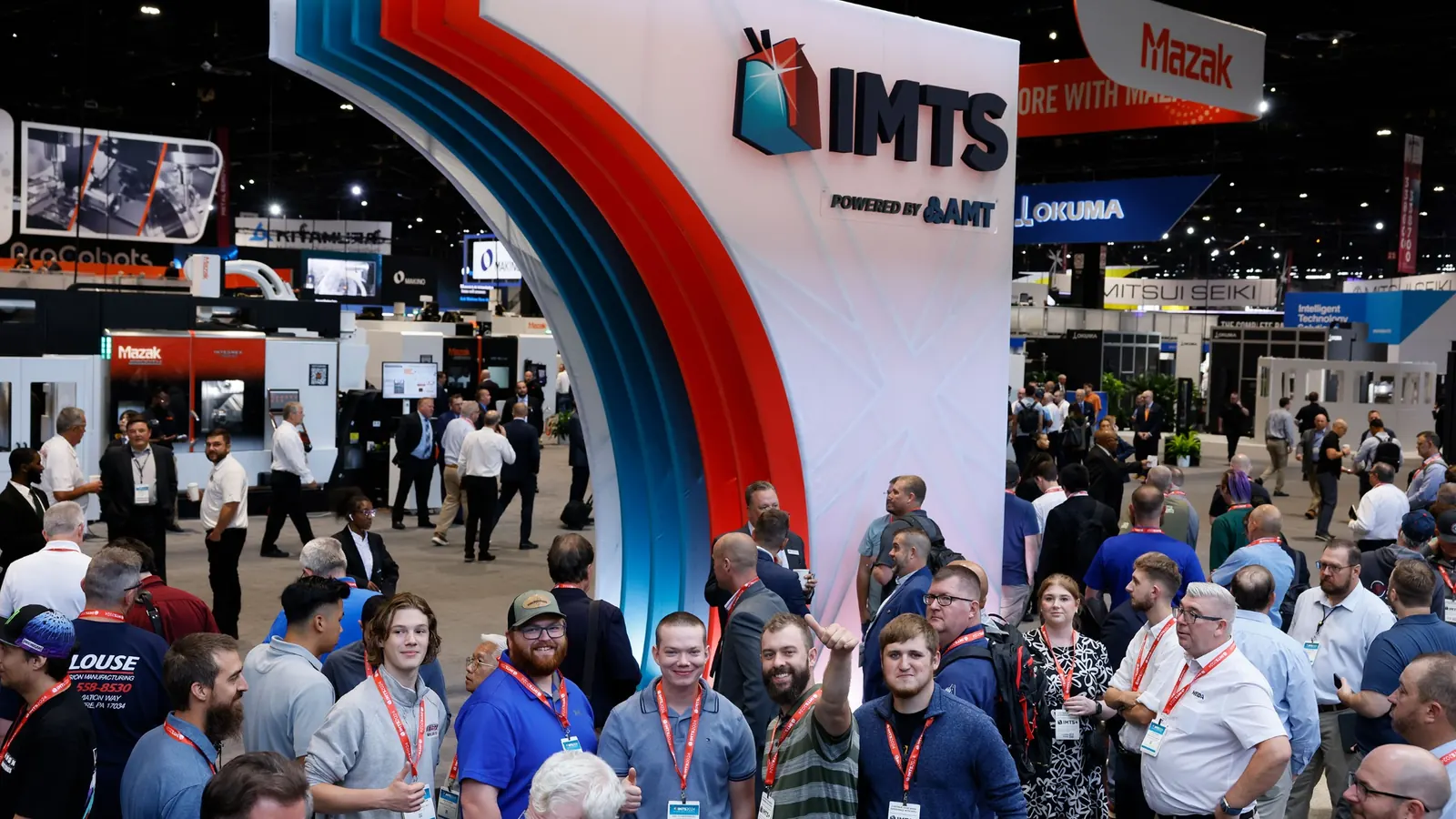
Taking place at McCormick Place from September 14 to 19, 2026, the International Manufacturing Technology Show will bring together more than 1,800 exhibitors across 1.2 million square feet of exhibition space.
However, the biggest reason manufacturers should pay attention this year is the scale at which AI will appear across the entire manufacturing process.
Visitors will see industrial AI integrated into CNC machining, CAM programming, robotics, machine vision, inspection, additive manufacturing, predictive maintenance, production planning and digital factory platforms.
For manufacturers asking where AI can deliver genuine operational value, IMTS 2026 could be the most important manufacturing technology event of the year.
Read the official IMTS 2026 announcement
IMTS 2026 Industrial AI Arrives at a Critical Moment
The latest figures published by AMT, the organisation that owns and produces IMTS, suggest that investment in American manufacturing technology is accelerating.
Manufacturing technology orders reached $2.19 billion during the first four months of 2026, representing a 28.9% increase compared with the same period in 2025.
The ISM Manufacturing PMI reached 53.3% in June, while manufacturing labour productivity increased by 3.2% during the first quarter of 2026. Manufacturing output rose by 3.3% without an increase in hours worked.
These figures point towards manufacturers gaining more output from their existing workforces through improved machinery, automation, software and digital production technology.
“Production demands and workforce constraints are pushing manufacturers to take a closer look at technologies like AI, digital twins, additive, and advanced automation, all of which are woven through the manufacturing ecosystem at IMTS,” said Mike Cicco, president and CEO of FANUC America and chairman of the AMT board.
The commercial question facing manufacturers is increasingly straightforward: how can existing people, machines and production data be used more effectively?
AI will form a major part of the answer presented at IMTS 2026.
Industrial AI Moves Across the Full Manufacturing Stack
Previous manufacturing AI events have often concentrated on individual technologies such as predictive maintenance, automated inspection or generative design.
IMTS 2026 will show how these capabilities connect across the manufacturing technology stack.
Visitors will be able to explore AI within:
- CNC machines and controls
- CAD and CAM software
- Industrial robots and cobots
- Machine vision and quality inspection
- Additive manufacturing
- Digital twins and simulation
- Quoting and production planning
- Predictive maintenance
- Tooling and process optimisation
- Cloud and edge computing
- Connected factory platforms
This connected approach is important because manufacturers rarely operate technology in isolation.
A machining company may need to connect quoting software with CAM, tooling data, CNC controls, robot loading, inspection results and its wider production management systems.
AI becomes far more valuable when it supports decisions across this complete workflow.
MachineToolNews.ai previously examined this shift in our guide to industrial AI in factories and our earlier preview of AI for job shops at IMTS 2026.
The New IMTS Industrial AI Arena
One of the biggest additions to the show will be the new IMTS Industrial AI Arena.
The dedicated area will bring together 32 industrial AI exhibitors, alongside Sandia National Laboratories, to demonstrate production-focused AI applications.
The arena will cover practical manufacturing challenges including:
- Quality and inspection
- Process optimisation
- Downtime reduction
- Cybersecurity
- Operator ergonomics
- Workplace safety
- Demand forecasting
- Production planning
The exhibitor list includes a mixture of established industrial technology companies and AI-native manufacturing businesses.
Atomic Industries is applying software and AI across the injection moulding process, covering mould design, tooling and finished-part production.
Ignizia is developing an industrial AI platform intended to help manufacturers identify applications with measurable return on investment and move projects from pilot stage into production.
C-Infinity’s AutoAssembler AI uses CAD and PLM information to generate production-ready assembly instructions.
Purchaser.ai applies artificial intelligence to manufacturing RFQs, extracting information from PDFs, spreadsheets and email submissions before converting it into a consistent format for assessment.
These companies represent a significant development within industrial AI. Manufacturing-specific platforms are emerging to solve problems that general-purpose AI systems were never designed to understand.
The First IMTS Industrial AI Conference
IMTS will also hold its first dedicated Industrial AI Conference on Wednesday, September 16.
The full-day conference will run from 10 a.m. to 4 p.m. at McCormick Place.
Sessions will focus on areas including:
- Predictive maintenance
- AI quality applications
- Edge AI compared with cloud deployment
- Manufacturing data readiness
- AI implementation planning
- Moving AI projects into production
- Identifying commercially valuable applications
This practical focus is essential.
Many manufacturers understand that AI could improve their operations but remain uncertain about where to begin, what data is required and how to assess likely returns.
The conference is intended to help manufacturers build an implementation roadmap rather than leaving Chicago with another collection of disconnected AI demonstrations.
Google, Microsoft and AWS Move Deeper Into Manufacturing
The presence of Amazon Web Services, Google Cloud and Microsoft demonstrates how rapidly major technology companies are moving into industrial production.
These companies provide the cloud infrastructure, AI models, data platforms and development tools that can connect engineering, operational technology and enterprise IT systems.
Google Cloud will demonstrate how Gemini Enterprise can support specialised AI agents that interpret information from manufacturing systems.
“The real magic happens at the intersection of data from engineering technology, operational technology, and IT software,” said Praveen Rao, global director and manufacturing industry lead at Google Cloud.
According to Rao, specialised agents could interpret live visual and sensor information, help prevent downtime and address manufacturing productivity gaps.
MachineToolNews.ai has previously examined the increasing influence of technology companies in Big Tech Has Found the Factory Floor.
For machine shops, the important development is the connection between these cloud platforms and the equipment already operating on the factory floor.
The cloud can support fleet-wide learning, longer-term analysis and enterprise planning, while edge AI in manufacturing can make immediate decisions close to CNC machines, robots and inspection systems.
AI-Enhanced CAM Will Be a Major IMTS 2026 Theme
CAM programming is becoming one of the clearest areas where industrial AI can deliver measurable value.
Autodesk Fusion integrates AI across design and manufacturing workflows to support generative design, workflow automation, data analysis and production decision-making.
Hexagon Manufacturing Intelligence will demonstrate AI capabilities within ESPRIT EDGE.
Its ProPlanAI technology analyses historical machining jobs and recommends processes for new parts. The objective is to reduce programming time while retaining knowledge developed by experienced manufacturing engineers.
This could become especially valuable as manufacturers attempt to protect production knowledge when experienced programmers retire or move between companies.
MachineToolNews.ai explored this subject directly with Hexagon in AI in machining: the real value starts before the first cut.
The strongest AI-enhanced CAM systems at IMTS will be judged on several practical questions:
How much programming time can they remove?
Can they work with the company’s existing machines and tools?
How do they validate recommended strategies?
Can an experienced programmer review and adjust the result?
Does the system learn from completed production jobs?
The companies that provide convincing answers will attract serious interest from job shops and contract manufacturers.
AI Moves Inside CNC Machines and Controls
AI is also moving closer to the actual cutting process.
IMTS says machine tool and CNC control manufacturers will demonstrate technology designed to reduce programming and setup time, shorten cycles, stabilise machining accuracy and diagnose machine conditions.
This is where AI can begin supporting decisions involving:
- Cutting stability
- Tool condition
- Machine health
- Thermal behaviour
- Surface quality
- Cycle optimisation
- Operator support
- Production scheduling
Heidenhain’s TNC7 control will feature interactive programming and automation tools, alongside an AI chatbot designed to provide task-oriented support.
FANUC, Siemens and Okuma and other major industrial technology companies will also demonstrate how automation, controls and machine data are becoming more closely connected.
For manufacturers, the most valuable developments will be those that turn machine data into clear actions for operators, programmers and maintenance teams.
Our guide to industrial AI in CNC machining explains how these systems can improve uptime, tool management, quality and machine utilisation.
CloudNC Brings AI CNC Programming to IMTS 2026
CloudNC will also be one of the most relevant companies for machine shops exploring practical AI-assisted CAM programming at IMTS 2026.
Its CAM Assist platform integrates with existing CAM software and uses AI to generate machining strategies and toolpaths for 3-axis and 3+2-axis CNC components. CloudNC says the software can complete up to 80% of a CAM programme in minutes, leaving programmers to review, refine and approve the machining strategy before sending it back into their CAM system.
CAM Assist currently supports platforms including Autodesk Fusion, Mastercam, Siemens NX, GibbsCAM and SolidCAM. The system also provides machinability feedback, cycle-time estimation, cutting parameter recommendations and automated soft-jaw design.
CloudNC says CAM Assist is now used by more than 1,000 machine shops worldwide. Its CAM Assist 2.0 upgrade gives programmers greater visibility into the AI’s decisions, allowing them to inspect and adjust strategies, tooling and feeds and speeds before any toolpath is committed.
This human-in-the-loop approach will be particularly important for manufacturers assessing AI at IMTS. Programming speed matters, but machine shops also need confidence that experienced machinists remain in control of tooling, strategy and production standards.
CloudNC is currently listed in the IMTS Software sector in the East Building, Level 3, at booths 133259 and 133028.
MachineToolNews.ai previously examined the platform in our feature on CloudNC CAM Assist 2.0 and AI CNC programming and our CloudNC interview on control and confidence in AI-assisted CAM.
Robots Become Easier to Programme and Deploy
Industrial automation providers including FANUC, Standard Bots and Universal Robots will demonstrate how AI can simplify robot programming and improve machine vision, object recognition and motion control.
This development could significantly increase the number of smaller manufacturers able to adopt robotics.
Traditional industrial robot integration can require specialist programming, carefully controlled environments and significant engineering work.
AI-assisted systems can help robots understand variation, recognise objects and learn tasks through simpler interfaces.
For machine shops, this could support applications including:
- CNC machine tending
- Bin picking
- Part handling
- Pallet loading
- Inspection
- Packaging
- Assembly
- Welding
The combination of AI, machine vision and simpler robot programming is turning automation into a more flexible production tool.
MachineToolNews.ai has examined this wider shift through our coverage of FANUC and Google’s Physical AI collaboration and our analysis of the biggest AI breakthroughs in machine tools.
AI Is Transforming Industrial Additive Manufacturing
Additive manufacturing will also have a significant presence at IMTS 2026.
EOS will introduce the EOS M4 Onyx to the North American market, a laser powder bed fusion platform designed for industrial-scale production.
AI is increasingly being used across the additive workflow.
Before production, intelligent software can help orient components, create support structures, prepare builds and simulate the likelihood of distortion or failure.
During production, monitoring platforms analyse meltpool behaviour, machine conditions and sensor data to detect potential anomalies.
After production, machine learning can analyse completed build data and help improve future parameters.
This creates a continuous learning cycle covering preparation, production, inspection and qualification.
The result could be faster build preparation, fewer failed parts, reduced material waste and shorter qualification cycles.
Our coverage of AI in powder bed fusion examines how software intelligence is becoming a central differentiator within metal additive manufacturing.
Digital Twins Support More Reliable Production
Digital twin technology will form another important part of the show.
IMTS highlights manufacturers already using digitally connected shops, multitasking equipment, automated loading and virtual machine models to increase unattended production.
A digital twin allows manufacturers to test processes, verify machine movements, identify collisions and optimise production before making changes to the physical equipment.
When connected to real machine and sensor data, digital twins can also help manufacturers understand production performance and identify emerging problems.
This is particularly important for complex CNC cells where machines, robots, tools, fixtures and inspection systems need to work together without interruption.
Our plain-English guide to digital twins in manufacturing explains how the technology connects simulation with live production data.
Machine Vision and Quality Become Sources of Production Intelligence
Machine vision and metrology will be another major area to watch.
Keyence will demonstrate vision systems that can learn differences between product types, while High QA will show AI-powered software for ballooning drawings, inspection reporting and model-based collaboration.
AI can help manufacturers detect visual defects, analyse dimensional results and identify patterns that may indicate a process is beginning to drift.
Inspection data can then become an active source of production intelligence.
Instead of identifying a problem after multiple rejected components have been produced, manufacturers can use quality information to support earlier interventions.
This matters particularly in aerospace, medical, semiconductor, automotive and defence manufacturing, where traceability and process control are essential.
MachineToolNews.ai has covered practical examples through our report on AI-supported visual inspection using IDS camera technology and the IDS Vision AI Label Reader.
MTN Analysis
IMTS 2026 industrial AI could mark the point where artificial intelligence becomes impossible for manufacturers to ignore.
The most important development is the way AI is spreading across connected production workflows.
An AI system may help quote a component, recommend a machining process, generate a CAM programme, support robot setup, monitor the cutting operation and analyse the final inspection results.
Each individual capability can save time. The greater opportunity appears when these systems begin sharing reliable production information.
That is the direction manufacturers should examine at IMTS.
Visitors should look beyond demonstrations that appear impressive for several minutes and ask how the technology performs during an entire production week.
Manufacturers need to understand:
- What problem does the system solve?
- What data does it require?
- How does it connect with existing machines?
- How long does deployment take?
- What training will operators need?
- How is the result checked and approved?
- What measurable improvement should be expected?
- How quickly could the investment pay back?
The strongest exhibitors will demonstrate clear gains in programming time, setup reduction, machine utilisation, inspection throughput, production quality and delivery performance.
IMTS 2026 will give manufacturers a rare opportunity to compare these technologies across one enormous exhibition.
For businesses planning investments in CNC machinery, industrial robots, CAM, metrology, additive manufacturing or factory software, Chicago should be firmly on the calendar.
When and Where Is IMTS 2026?
Event: IMTS 2026, The International Manufacturing Technology Show
Dates: September 14 to 19, 2026
Location: McCormick Place, Chicago, Illinois, USA
Expected attendance: More than 89,000 visitors
Exhibitors: Approximately 1,800
Exhibition space: Around 1.2 million square feet
Technology sectors: 10, including the new Industrial AI Arena
Key Takeaways
- IMTS 2026 industrial AI will appear across machining, CAM, robotics, metrology, additive and production software.
- The new Industrial AI Arena will feature 32 AI-focused exhibitors and Sandia National Laboratories.
- IMTS will hold its first dedicated Industrial AI Conference on September 16.
- Google Cloud, Microsoft and AWS will demonstrate cloud, data and agentic AI technologies.
- AI-enhanced CAM platforms will focus on reducing programming time and preserving manufacturing knowledge.
- CloudNC will demonstrate how AI-assisted CAM can generate machining strategies, toolpaths and cycle-time estimates while keeping CNC programmers in control.
- Machine tools and controls are gaining AI-based programming, monitoring and diagnostic capabilities.
- AI is helping robots become easier to programme and more adaptable.
- Additive manufacturing systems are using AI across build preparation, monitoring and qualification.
- Manufacturers should assess AI through measurable productivity, quality and return-on-investment improvements.
FAQ:
When is IMTS 2026 taking place?
IMTS 2026 will take place from September 14 to 19, 2026, at McCormick Place in Chicago.
What is the IMTS Industrial AI Arena?
The Industrial AI Arena is a new dedicated exhibition area featuring companies developing practical AI applications for manufacturing, including quality inspection, process optimisation, maintenance, cybersecurity and production planning.
When is the IMTS Industrial AI Conference?
The Industrial AI Conference will take place on Wednesday, September 16, 2026, from 10 a.m. to 4 p.m.
Which technologies will be shown at IMTS 2026?
Visitors will see CNC machine tools, industrial robots, CAM software, machine vision, metrology, additive manufacturing, digital twins, connected production systems and AI platforms.
Is IMTS 2026 relevant to small machine shops?
Yes. Many technologies at IMTS 2026 are intended to help smaller and mid-sized manufacturers reduce programming time, introduce automation, improve inspection and increase machine utilisation.
How should manufacturers evaluate AI at IMTS 2026?
Manufacturers should ask what operational problem the technology solves, what data it requires, how it connects with existing systems and what measurable improvement can realistically be achieved.
Will there be AI-enhanced CAM software at IMTS 2026?
Yes. Autodesk, Hexagon and other CAM providers will demonstrate AI-assisted programming, process planning, automation and manufacturing workflow tools.
Will CloudNC exhibit at IMTS 2026?
Yes. CloudNC is listed in the IMTS Software sector and will present CAM Assist, its AI-assisted CNC programming platform for generating machining strategies and toolpaths.
Will AI be built directly into machines and controls?
Yes. Machine tool, robot and control manufacturers will demonstrate AI capabilities designed to support programming, setup, monitoring, diagnostics and process optimisation.
How can manufacturers attend IMTS 2026?
Manufacturers can obtain show information and register through the official IMTS website.
Further Reading
- IMTS 2026 Industrial AI for Job Shops, CAM and Quality Control
- Big Tech Has Found the Factory Floor
- What Is Industrial AI and How Is It Used in Factories?
- What Is Edge AI in Manufacturing?
- Digital Twins in Manufacturing: A Plain-English Guide
- AI in Machining: The Real Value Starts Before the First Cut
- Industrial AI in CNC Machining
- AI in Machine Tools: 10 Breakthrough Technologies