Big Tech in metal manufacturing 2026 is no longer a future trend. It is already changing how factories use robotics, machine data, predictive maintenance, digital twins, quality control and production intelligence.
For decades, metal manufacturing was often seen from the outside as an old-economy market. CNC machining, sheet metal, welding, grinding, inspection and fabrication were viewed as heavy industrial sectors dominated by machine builders, automation suppliers and specialist engineering companies.
That view now looks outdated.
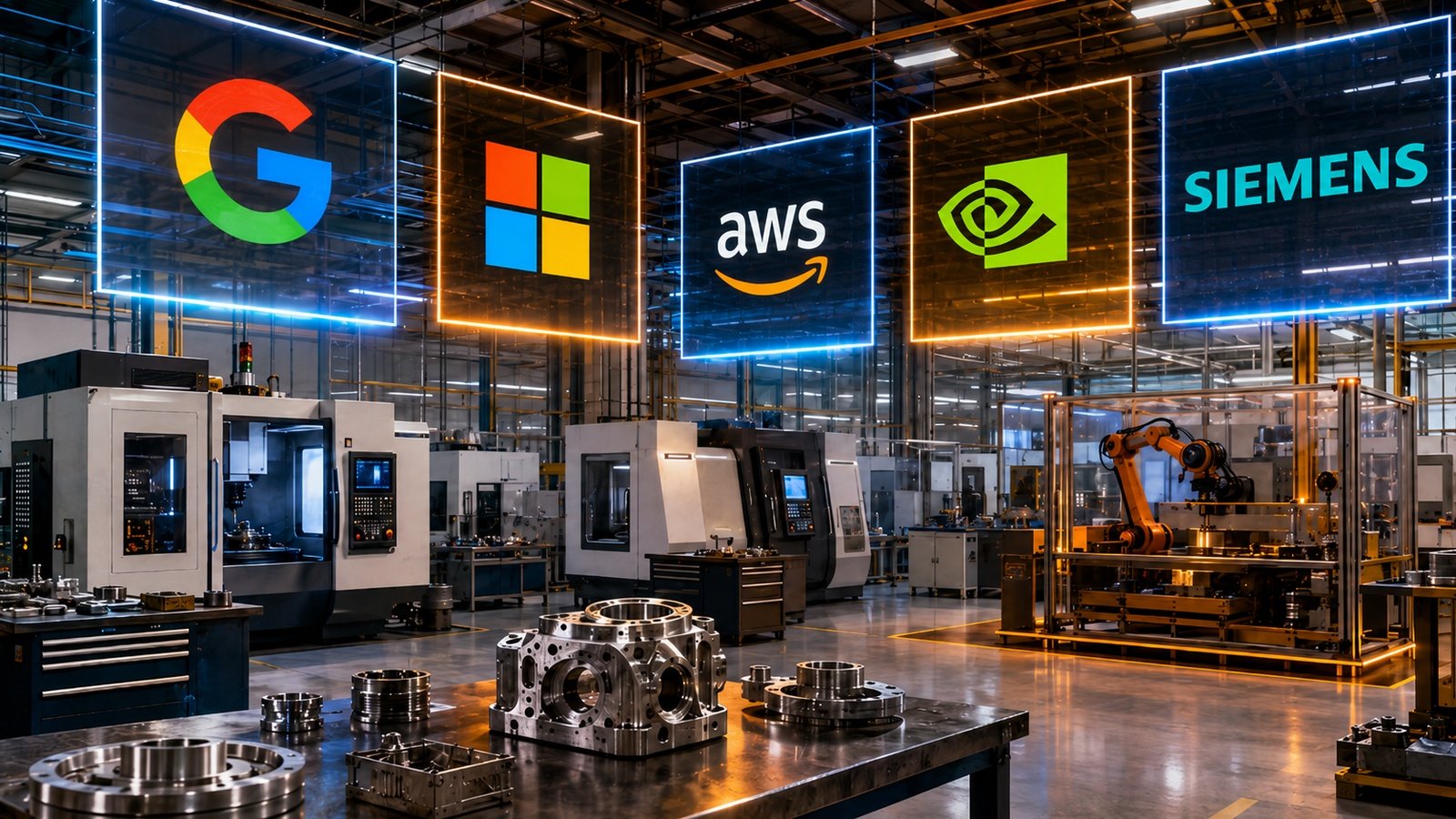
Google, Microsoft, Amazon and NVIDIA are moving closer to the factory floor because metal manufacturing has something every AI company needs: real-world operational data. Machine tools, robots, sensors, cameras, quality systems, maintenance platforms and factory software all generate valuable information. The companies that can connect that data, understand it and turn it into useful factory decisions will have a powerful role in the next phase of industrial AI.
At MachineToolNews.ai, we see this as one of the most important shifts in manufacturing. Big Tech is not replacing traditional machine tool companies. It is becoming the intelligence layer around them.
Why Big Tech Now Cares About Metal Manufacturing
Metal manufacturing is becoming attractive to Big Tech because the factory floor is one of the hardest environments for AI to master.
Unlike office software, manufacturing involves physical machines, live production constraints, safety risks, material variation, downtime, scrap, tool wear, part tolerances and skilled human decision-making. That makes it difficult, but also valuable.
The prize is huge. If AI can help a manufacturer reduce downtime, improve machine utilisation, detect defects earlier, train robots faster or shorten production planning time, the commercial impact is immediate.
That is why Big Tech is now targeting areas such as robotics and physical AI, factory data platforms, machine monitoring, predictive maintenance, digital twins, visual inspection, AI copilots for operators and engineers, production planning and troubleshooting.
This is where the evidence becomes important. The clearest proof is not in vague AI claims. It is in named partnerships, live industrial use cases and factory-floor systems that are already being tested or deployed.
Google: Physical AI Moves Into Industrial Robotics
One of the strongest recent proof points is the collaboration between FANUC and Google.
In May 2026, FANUC announced a collaboration with Google to accelerate physical AI for industrial robots. Intrinsic, Google’s robotics software company, also said it was working with FANUC to bring high-performance support for FANUC robots, including the CRX collaborative robot range, to the Intrinsic platform.
That matters for metal manufacturing because FANUC robots are already widely used across automated production, machine tending, handling, assembly and industrial robot cells. Google is not entering the market by building a CNC machine or a press brake. It is entering through the software and intelligence layer that could help robots become easier to program, more flexible and more useful in real production environments.
This is a major shift. Traditional industrial robots are extremely powerful, but they are often limited by programming time, fixture setup, repeatability requirements and the need for specialist integration. Physical AI aims to make robots better at understanding tasks, objects, environments and instructions.
For metal manufacturers, the potential effect is clear: easier robot deployment, faster automation projects and more flexible use of robots around CNC machines, inspection stations, welding cells and material handling systems.
The credible evidence here is not that every robot is suddenly autonomous. The evidence is that one of the world’s largest robot manufacturers is working with Google’s AI and robotics ecosystem to bring physical AI closer to industrial use.
Microsoft: Factory Data Becomes a Troubleshooting Tool
Microsoft’s role in manufacturing is already visible through factory data and AI agents.
A strong example is Schaeffler, the global motion technology and precision components manufacturer. In a Microsoft customer story on Schaeffler, Microsoft says Schaeffler is using Microsoft Fabric and Azure AI to modernise factory data insights and connect information across manufacturing operations. In the same case study, Schaeffler says workers can use the AI agent to search for the reason behind downtime and the best way to solve it.
That is one of the most important effects Big Tech is having on the factory floor. The impact is not only about automation hardware. It is about helping engineers, maintenance teams and production managers understand what is happening across complex factories.
A factory problem can sit across several systems at once. A quality issue might involve machine parameters, material batches, shift data, inspection results, tool condition and maintenance history. In a traditional setup, investigating that problem can mean manually searching through different systems.
Microsoft’s manufacturing AI push is aimed at connecting that information and making it easier to query. Wired also reported on Microsoft’s Factory Operations Agent being used in a Schaeffler factory environment to help analyse defects, downtime and production data across multiple systems.
For metal manufacturers, this is highly relevant. If an AI system can help identify why a grinding process is drifting, why a bearing line is producing defects, why a CNC cell is losing uptime or why energy use is rising, it moves AI from theory into daily operations.
That is a real factory-floor effect.
Amazon AWS: Predictive Maintenance and Industrial Sensor Data
Amazon’s role is different. AWS is moving into manufacturing through cloud infrastructure, machine learning, industrial data services and predictive maintenance.
One of the clearest examples is Amazon Lookout for Equipment, an AWS machine learning service designed to monitor industrial equipment. AWS says the service analyses sensor data to detect abnormal machine behaviour, diagnose issues and help manufacturers act before unplanned downtime occurs.
That is directly relevant to metals because downtime is one of the most expensive problems on any shop floor. A failed spindle, pump, motor, compressor, press, laser system, robot cell or extraction system can stop production, delay jobs and damage margins.
Predictive maintenance is not new, but Big Tech changes the scale. AWS brings cloud computing, machine learning models, data infrastructure and deployment tools that can help industrial companies build maintenance intelligence around existing equipment.
For smaller and mid-sized metal manufacturers, the most useful development may come from technology partners building applications on top of AWS. The factory may never think of itself as an AWS customer, but the software it uses for maintenance, monitoring or operations may be powered by AWS infrastructure.
The impact is practical: fewer unexpected failures, better maintenance planning, earlier warnings and improved use of machine sensor data.
NVIDIA: Digital Twins, Robot Training and Simulation
NVIDIA may be the most important Big Tech player in the factory-floor AI race.
Its role goes beyond graphics chips. NVIDIA is now central to industrial AI, robotics simulation, digital twins and physical AI infrastructure. NVIDIA says industrial facility digital twins can be used to test and validate AI models, connect visual AI agents to live cameras and support new workflows from planning to operations.
The evidence is becoming stronger.
In March 2026, Reuters reported that ABB had partnered with NVIDIA to improve factory robot training using NVIDIA Omniverse. The report said the collaboration aims to reduce the gap between virtual simulation and real robot performance by creating more realistic training environments with details such as lighting, shadows and textures. Reuters also reported that Foxconn was already piloting the technology for tasks affected by poor robot visibility.
This matters for metal manufacturing because robotic automation can be expensive, time-consuming and risky to deploy. A robot cell for machine tending, welding, material handling, inspection or assembly must work safely and reliably in a real environment.
If digital twins and high-fidelity simulation can help companies test robot movements, layouts, visibility, safety zones and production sequences before installation, that reduces risk. It also gives smaller manufacturers a better chance of adopting automation without making costly mistakes.
NVIDIA’s impact is therefore not limited to AI servers. It is helping create the virtual factory environment where robots, machines and production systems can be tested before physical changes are made.
Siemens: The Industrial Bridge Between Big Tech and Machine Tools
Siemens is not Big Tech in the same way as Google, Microsoft, Amazon or NVIDIA, but it is essential to this story because it connects industrial reality with AI infrastructure.
In September 2025, Siemens announced a data alliance with leading machine tool manufacturers including GROB, TRUMPF, CHIRON, Renishaw and Heller, along with RWTH Aachen WZL and Voith Group. Siemens said the alliance enables data exchange for AI applications in manufacturing and paves the way for industrial AI solutions.
This is highly significant for the machine tool market.
AI needs high-quality industrial data. Generic internet data does not teach an AI model how a machining process behaves, how NC programs are created, how tool wear affects quality, how a machine alarm develops or how production processes vary across real factories.
That is why machine tool data alliances matter. They show that the industrial sector itself recognises the need to pool manufacturing knowledge, machine data and engineering context in order to build useful AI.
For metal manufacturers, the long-term impact could include better NC programming support, improved predictive maintenance, faster troubleshooting, smarter machine operation and more useful AI copilots for production teams.
What Effects Are Already Visible on the Factory Floor?
The evidence points to five factory-floor effects already taking shape.
1. Faster troubleshooting
Microsoft’s work with Schaeffler shows how AI can help workers investigate downtime and production issues by querying connected factory data. This is valuable because manufacturers often lose time searching through disconnected systems before they find the cause of a problem.
2. Better defect analysis
AI agents can help connect quality data with machine data, process data and production history. In metal manufacturing, that could help teams understand why defects appear in machining, grinding, welding, forming or inspection processes.
3. Predictive maintenance
AWS is targeting industrial equipment monitoring through machine learning services that detect abnormal machine behaviour. For factories, this can support earlier maintenance decisions and reduce the risk of unexpected downtime.
4. Faster robot deployment
Google’s work with FANUC and NVIDIA’s work with ABB both point toward a more flexible robotics future. The goal is to make robots easier to train, easier to simulate and easier to apply in real industrial environments.
5. Better digital twins and production planning
NVIDIA’s Omniverse strategy gives manufacturers a way to test factory environments, AI models and robot workflows virtually. That matters because physical trial and error on a live production floor is expensive and disruptive.
Why This Matters for Machine Shops and Metal Manufacturers
The biggest mistake would be to see Big Tech’s move into manufacturing as a story only for large automotive factories.
The direction of travel will affect smaller machine shops, fabricators and subcontract manufacturers as well.
Over time, AI tools from Google, Microsoft, Amazon, NVIDIA and their industrial partners are likely to appear inside the software manufacturers already use. That could include CAM systems, machine monitoring platforms, ERP systems, inspection software, maintenance tools, robot programming environments and production dashboards.
The factory of the future will not be defined by one AI system. It will be defined by connected layers:
machine tools and robots producing data
sensors and cameras capturing production behaviour
cloud and edge platforms processing information
AI agents helping people understand what is happening
digital twins testing changes before they reach the shop floor
operators and engineers making faster, better-informed decisions
That is why Big Tech’s arrival matters. It brings scale, computing power and AI capability into a market that has traditionally moved carefully and incrementally.
The Reality Check: Big Tech Still Needs Industrial Expertise
There is a clear warning here. Big Tech cannot succeed in metal manufacturing by treating factories like office software.
Metal manufacturing requires domain knowledge. Tolerances matter. Materials matter. Fixtures matter. Toolpaths matter. Machine dynamics matter. Safety matters. Skilled operators matter.
That is why the strongest examples involve partnerships. Google is working with FANUC. NVIDIA is working with ABB. Microsoft is working with manufacturers such as Schaeffler. Siemens is working with machine tool builders.
The winners will be the companies that combine AI capability with real manufacturing expertise.
MTN Analysis
We see Big Tech in metal manufacturing 2026 as one of the most important industrial AI stories of the year.
The factory floor has become a serious technology market because it contains difficult, valuable and measurable problems. Downtime has a cost. Scrap has a cost. Poor robot deployment has a cost. Slow troubleshooting has a cost. Inefficient energy use has a cost. Bad production planning has a cost.
That makes metal manufacturing a perfect proving ground for AI.
The real opportunity is not hype about replacing workers. The opportunity is to give skilled people better tools. AI can help engineers find faults faster, help operators understand machine behaviour, help maintenance teams act earlier, help robot integrators simulate better cells and help manufacturers use their production data more intelligently.
This is why Google, Microsoft, Amazon and NVIDIA are moving in.
Metal manufacturing is no longer a boring market to Big Tech. It is becoming one of the most important places where AI must prove it can work in the real world.
Key Takeaways
Big Tech in metal manufacturing 2026 is already visible through partnerships involving Google, Microsoft, Amazon AWS and NVIDIA.
Google’s collaboration with FANUC shows how physical AI is moving closer to industrial robotics.
Microsoft’s work with Schaeffler shows how AI agents can support factory troubleshooting, downtime analysis and production insight.
AWS is targeting predictive maintenance and industrial sensor data through machine learning services.
NVIDIA is becoming a major force in digital twins, robot training and industrial simulation.
Siemens and major machine tool builders are showing that industrial AI needs real machine data, not generic AI models.
The biggest impact for manufacturers will be faster troubleshooting, better maintenance, smarter robotics, improved digital twins and more connected production intelligence.
FAQ
Why is Big Tech moving into metal manufacturing?
Big Tech is moving into metal manufacturing because factories generate valuable real-world data from machines, robots, sensors, inspection systems and production software. That data can be used to improve uptime, quality, maintenance, robotics and planning.
Is Google entering metal manufacturing directly?
Google is not building machine tools, but it is moving into the industrial robotics layer through physical AI, Google Cloud, Gemini and Intrinsic. Its collaboration with FANUC is a clear example of this shift.
How is Microsoft affecting the factory floor?
Microsoft is affecting the factory floor through cloud manufacturing platforms, Microsoft Fabric, Azure AI and factory AI agents. Its work with Schaeffler shows how AI can help workers investigate downtime and production issues faster.
What role does Amazon AWS play in manufacturing AI?
Amazon AWS provides cloud and machine learning infrastructure for industrial data, including predictive maintenance. Services such as Amazon Lookout for Equipment are designed to detect abnormal machine behaviour and help reduce unplanned downtime.
Why is NVIDIA important for metal manufacturing?
NVIDIA is important because its Omniverse and AI platforms support digital twins, robot training and industrial simulation. These tools can help manufacturers test layouts, robot cells and AI models before making physical changes on the shop floor.
Will Big Tech replace traditional machine tool companies?
Big Tech is more likely to become the intelligence and data layer around traditional machine tool companies. Machine builders still provide the machines, process knowledge and industrial expertise, while Big Tech brings AI infrastructure, cloud platforms and simulation tools.
AI CAM Software 2026 Comparison
Digital Twin in Manufacturing 2026
hyperMILL Intelligence AI CAM 2026
AI at Hannover Messe 2026 Exhibitors
Trademark note: Google, Microsoft, Amazon, AWS and NVIDIA names and logos are trademarks of their respective owners. They are used here for editorial identification only. No endorsement, sponsorship or partnership is implied.