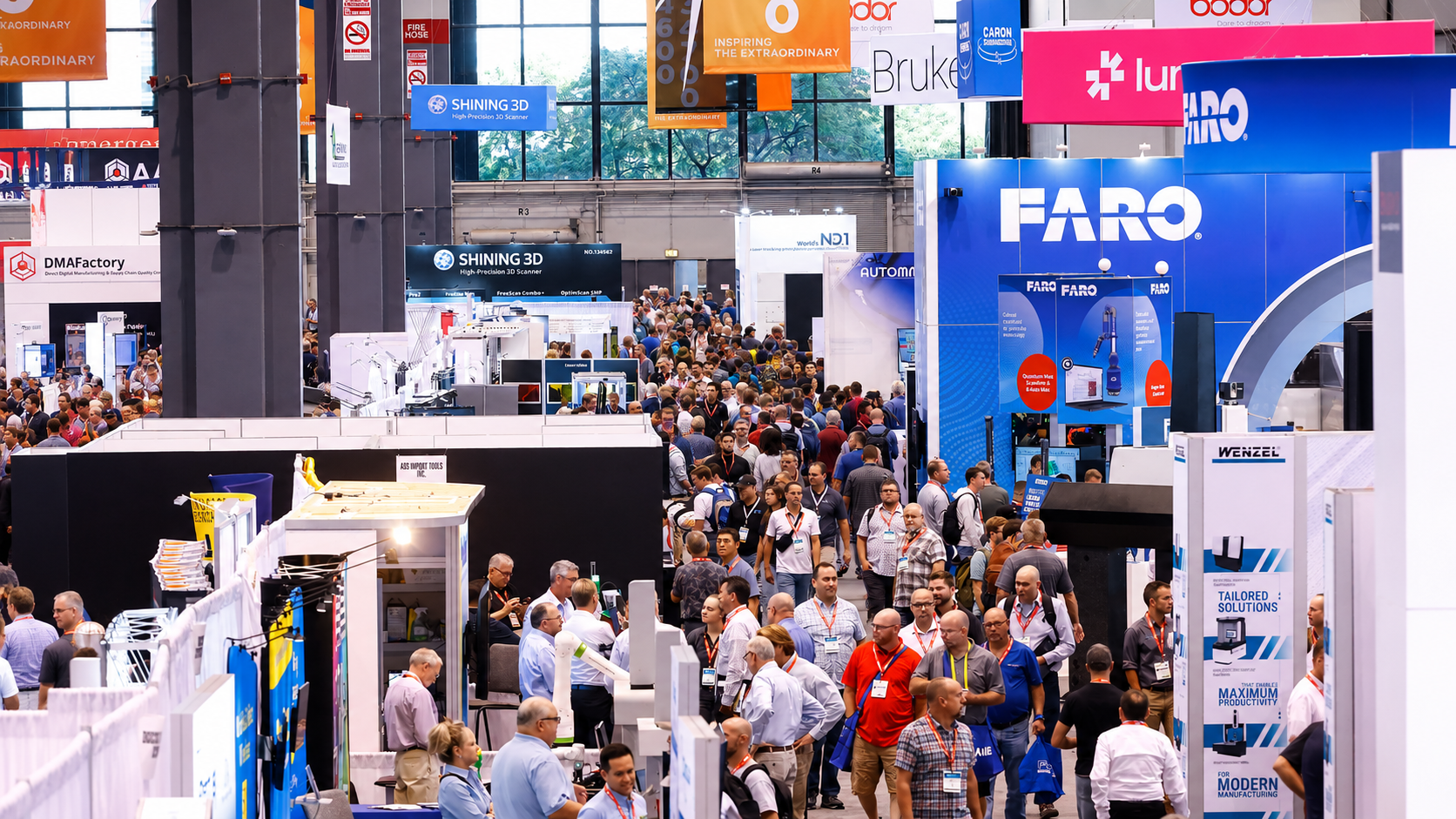
IMTS 2026 industrial AI is shaping up to be one of the strongest themes at this year’s International Manufacturing Technology Show, with AI now appearing across quoting, CAM programming, cobot control, CNC optimisation, tool management and quality assurance. This is also one of the reasons as to why we as Machine Tool News.ai are an official media partner.
The latest IMTS 2026 press release makes the direction clear. The show is being positioned around productivity, automation and digitally connected manufacturing, but the most important signal for job shops is the growing role of AI-enhanced software and shop-floor decision support.
For manufacturers, this matters because AI is now moving into the practical areas where time is lost every day: estimating jobs, checking whether a part can be made, generating toolpaths, adjusting feeds and speeds, supporting unattended production and reducing inspection workload.
IMTS 2026 takes place from Sept. 14 to 19, 2026, at McCormick Place in Chicago. According to IMTS, the event will bring together more than 86,000 registrants, 1,800 exhibitors and 10 Technology Sectors across 1.2 million square feet of exhibit space.
For readers following AI in CNC, AI CAM software and industrial automation, the message is straightforward: IMTS 2026 is becoming a major shop-floor AI showcase.
Why AI Is Becoming A Job Shop Productivity Tool
The strongest part of the IMTS announcement is not the broad promise of digital transformation. It is the practical use of AI to help smaller and mid-sized manufacturers do more with the people, machines and skills they already have.
IMTS highlights persistent labour constraints, rising demand and the need for manufacturers to increase output without adding unnecessary complexity. That is exactly where industrial AI is beginning to prove its value.
We see three areas standing out.
First, AI is helping manufacturers reduce the time between receiving an RFQ and making a confident production decision. Second, AI-enhanced CAM is beginning to compress programming time. Third, AI and automation are helping shops move closer to longer unattended operation, especially where operators are under pressure.
This is the important point for job shops: industrial AI is becoming less about experimental projects and more about removing everyday bottlenecks.
AI-Enhanced CAM And Quoting Will Be A Key IMTS 2026 Theme
One of the clearest examples in the IMTS release is Toolpath, which offers AI-powered estimating and CAM software. The system is described as being able to determine whether a shop has the tooling and capability to machine a part, assess cost and profitability, and generate the toolpath in seconds or minutes.
That is exactly the type of AI application that makes sense for contract manufacturers.
Many job shops lose time before a machine starts cutting. They need to assess drawings, estimate costs, check tooling, understand fixturing, decide whether the work fits their capability and produce a quote that makes commercial sense. AI tools that speed up that front-end decision process can affect both productivity and profitability.
IMTS also points to Mastercam Copilot, which brings AI automation into programming tasks. According to the release, machinists will be able to adjust feed rates and spindle speeds across multiple operations using voice or text commands, with confirmation prompts for safety.
That is significant because it places AI inside the normal CAM and machining workflow. It is not replacing the machinist. It is acting as a productivity layer for skilled people who already understand the process.
This fits the wider pattern we have been tracking in AI CAM software and digital twin manufacturing: the biggest early gains are coming from AI that supports programming, simulation, quoting, inspection and process optimisation.
Cobots And AI Are Making Automation Easier To Adopt
The IMTS release also highlights easier automation, especially for job shops that have historically avoided robots because of cost, complexity or lack of internal programming expertise.
Universal Robots, Formic Technologies, Standard Bots, Hirebotics and Gimbel Automation are among the automation names referenced in the announcement.
Standard Bots is especially relevant to the industrial AI story because its approach is based on robots being taught rather than traditionally programmed. IMTS says visitors will be able to demonstrate a task to the robot, which then performs it autonomously in a learning mode and self-adapts to variations in the environment.
That points toward a future where robot adoption becomes more accessible for job shops that do not have dedicated automation engineers.
Gimbel Automation is also relevant because it focuses on in-machine CNC automation, including spindle grippers, part-flipping modules and pallet automation systems. Its pitch is that automation can be integrated into the CNC environment without demanding deep robotics expertise.
For MTN readers following Robotics & Cobots, this is the shift to watch. AI and simpler automation interfaces are making robotics less intimidating for smaller manufacturers.
Industrial AI Is Also Moving Into CNC Controls
AI at IMTS 2026 will not only appear in software and robots. It is also increasingly connected to CNC controls and machine visibility.
The IMTS release references new CNC controller capabilities such as Mitsubishi Electric Automation’s M8V Series, which is positioned around shorter cycle times, better surface finish, faster setup and clearer visibility into the machining process.
That matters because the CNC control is becoming a richer decision point. The next stage of productivity improvement will depend on how well machine data, operator input, CAM software, tool data and inspection results can work together.
This is why MTN continues to treat edge AI in manufacturing as one of the most important themes for the next phase of factory intelligence. AI becomes far more useful when it is close to the process, connected to live production data and able to support decisions at machine level.
Tool Management And Quality Assurance Are Becoming AI-Ready
The IMTS release also highlights tooling, workholding and quality assurance as major productivity areas.
Tool management exhibitors including Zoller, WinTool USA, TDM Systems and Big Daishowa, through its Speroni brand, are expected to showcase centralised platforms that connect tool data across CAD/CAM, ERP and shop-floor systems.
This matters because AI cannot deliver strong manufacturing outcomes without reliable data. Tool data, machine data, process data and inspection data all need to be organised before manufacturers can gain the full benefit of AI-enhanced decision-making.
Quality assurance is another major area. IMTS says exhibitors including Hexagon, Lumafield, Nikon Metrology and Zeiss will feature systems that unify metrology data, images, analytics and data management into connected platforms.
That is where Metrology & Vision becomes part of the AI story. Inspection is no longer only about confirming tolerance after machining. It is becoming a source of production intelligence.
For aerospace, medical, defence and high-precision subcontractors, the ability to capture, interpret and document quality data is now directly linked to competitiveness.
The IMTS Job Shops Workshop Puts AI On The Agenda
The IMTS 2026 Job Shops Workshop will take place on Tuesday, Sept. 15, and includes sessions on automation, AI and the future of manufacturing.
The workshop includes a panel titled “How is AI Changing the Future of Tomorrow’s Job Shop?” with Al Whatmough, CEO of Toolpath, and James Marzilli, founder and CEO of Warpcore Ai and Native Ai Machine Shop.
That is an important signal. AI is not being treated only as an enterprise technology for major OEMs. It is being presented directly to job shops as a productivity and competitiveness tool.
IMTS has also announced a wider conference lineup, including the Industrial AI Conference on Sept. 16. That full-day event is aimed at manufacturers seeking implementable outcomes for the production floor.
For MTN, this confirms a wider editorial trend: industrial AI is now moving from general discussion into event programming, product demonstrations and practical job shop education.
MTN View: IMTS 2026 Could Be A Defining AI Manufacturing Show
Our view is that IMTS 2026 could become one of the most important manufacturing AI events of the year, especially for CNC job shops and contract manufacturers.
The reason is not that every machine will suddenly become autonomous. The reason is that AI is appearing across the full workflow: quoting, CAM, robot teaching, machine setup, tooling, inspection and production visibility.
That is where the real value sits.
For job shops, the question is no longer whether AI belongs in manufacturing. It already does. The more useful question is where AI can remove the next bottleneck.
Can it reduce estimating time? Can it help a programmer produce reliable toolpaths faster? Can it make cobot deployment easier? Can it support unattended machining? Can it connect inspection data back into production decisions? Can it help a smaller shop compete with a larger one?
Those are the questions manufacturers should take to IMTS 2026.
For companies selling AI-enabled CNC, CAM, robotics, metrology, tool management or smart factory systems, the show will also be a major opportunity to explain use cases in plain language. Manufacturers do not need vague AI claims. They need measurable improvements in setup time, quoting speed, machine utilisation, inspection throughput, labour productivity and margin.
What Manufacturers Should Look For At IMTS 2026
Manufacturers visiting IMTS 2026 should look for AI that solves a clear operational problem.
That means asking suppliers practical questions:
How much time does this save in quoting or programming?
Does it work with our existing machines, controls and CAM systems?
Can operators use it without becoming AI specialists?
What data does the system need before it performs well?
How does it handle safety, confirmation and human approval?
Can it support unattended or lights-out production?
How quickly can it pay back?
The best industrial AI systems at IMTS 2026 will be the ones that make the answer obvious.
AI Is Becoming Part Of The Manufacturing Productivity Stack
IMTS 2026 industrial AI will be one of the key stories to watch in Chicago. The latest IMTS release shows that AI is becoming part of the manufacturing productivity stack, sitting alongside automation, CAM, CNC controls, tooling, metrology and connected factory software.
For job shops, this is not about chasing hype. It is about finding practical technologies that help skilled teams produce more, quote faster, programme faster, inspect better and operate machines for longer periods.
That is why the AI focus at IMTS 2026 matters.
For MTN readers, we will be watching the show closely across AI in CNC, Software / CAM / IIoT, Robotics & Cobots and Metrology & Vision. The companies that can prove real productivity gains, rather than broad AI claims, will be the ones manufacturers remember.
FAQ
What is the main AI theme at IMTS 2026?
The main AI theme at IMTS 2026 is practical productivity. AI is being applied to estimating, CAM programming, cobot operation, CNC control, tool management and quality assurance.
Why does IMTS 2026 matter for job shops?
IMTS 2026 matters for job shops because it will show technologies designed to increase output, reduce labour pressure, improve machine utilisation and make automation easier to adopt.
Which AI CAM technologies are highlighted in the IMTS release?
The IMTS release highlights Toolpath’s AI-powered estimating and CAM software, along with Mastercam Copilot, which uses AI automation for everyday programming tasks such as adjusting feeds and speeds through voice or text commands.
Is industrial AI only for large manufacturers?
No. The IMTS 2026 Job Shops Workshop shows that AI is being positioned directly for smaller and mid-sized manufacturers, including contract manufacturers and job shops.
How can manufacturers judge whether AI is worth adopting?
Manufacturers should judge AI by measurable outcomes such as faster quoting, shorter programming time, higher machine utilisation, better inspection throughput, reduced setup time and clearer production visibility.
What should job shops ask AI suppliers at IMTS 2026?
Job shops should ask how the AI system works with existing machines, what data it needs, how long implementation takes, what tasks it automates, how safety is handled and what return on investment can realistically be expected.
Further Reading
AI in CNC
https://www.machinetoolnews.ai/category/ai-in-cnc/
Software / CAM / IIoT
https://www.machinetoolnews.ai/category/software/
Robotics & Cobots
https://www.machinetoolnews.ai/category/robotics-cobots/
Metrology & Vision
https://www.machinetoolnews.ai/category/metrology-vision/
AI CAM Software 2026 Comparison
https://www.machinetoolnews.ai/ai-cam-software-2026-comparison/
Digital Twin in Manufacturing 2026
https://www.machinetoolnews.ai/digital-twin-in-manufacturing-2026/
Edge AI in Manufacturing 2026
https://www.machinetoolnews.ai/edge-ai-in-manufacturing-2026/
External Sources
IMTS 2026 press release
https://www.imts.com/read/article-details/IMTS-2026-Reveals-How-Manufacturers-Can-Redefine-Productivity-and-Transform-Possibilities/2301/type/Press-Release/5?page=1
IMTS 2026
https://www.imts.com/
IMTS 2026 Job Shops Workshop
https://www.imts.com/show/education/JobShop26.cfm
IMTS 2026 conferences
https://www.imts.com/read/article-details/IMTS-Announces-2026-Conferences-Lineup/2341/type/Press-Release/5?page=1





One Comment