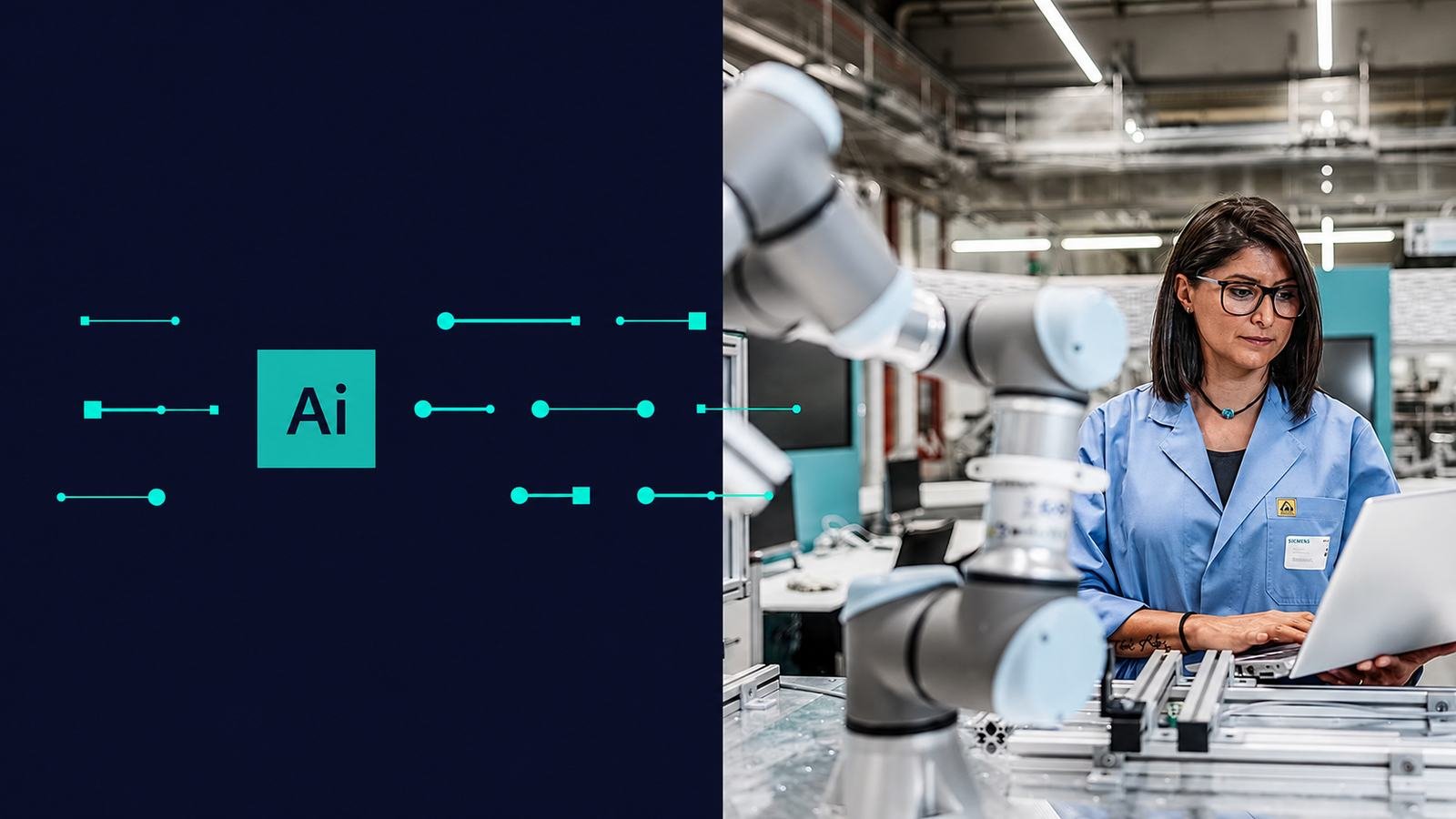
Siemens and IFS have announced a major new Industrial AI partnership that could have significant upsides for metal manufacturers, machine shops, fabrication companies and industrial production sites.
According to the official Siemens and IFS announcement, the partnership is designed to connect design, production and asset performance in one continuous loop. In plain English, Siemens and IFS want to help manufacturers close the gap between how a factory is planned and how it actually performs on the shop floor.
For metal manufacturers, this matters because factory performance is rarely held back by one single problem. Downtime, maintenance delays, disconnected production data, machine performance, supply chain pressure and engineering changes all affect output.
The Siemens and IFS partnership is aimed at joining those areas together using Industrial AI.
Siemens brings industrial software, automation, manufacturing execution, engineering data and digital twin technology. IFS brings enterprise asset management, field service, asset lifecycle data and Industrial AI for complex operations.
The result could be a more practical version of the smart factory, where production planning, maintenance, service history and engineering data are no longer trapped in separate systems.
Why Siemens and IFS Matter to the Metals Industry
Siemens and IFS matter to the metals industry because metal manufacturing is an asset-heavy business.
A machining company depends on expensive CNC equipment. A sheet metal company depends on laser cutting machines, press brakes, automation systems and material handling. A welding operation depends on robots, fixtures, inspection systems and skilled operators. A metal forming business depends on presses, tooling, process control and reliable maintenance.
When those assets stop, production stops.
The challenge is that many metal manufacturers still manage production, maintenance and engineering data through separate systems. A maintenance team may know a machine is showing problems. A production planner may know the same machine is needed for an urgent job. An engineering team may understand how the process was designed. But if those teams are not working from connected data, decisions are slower and less accurate.
This is where the Siemens and IFS partnership becomes relevant.
The aim is to connect engineering intent with real operational performance. That means comparing what should happen in production with what is actually happening on the factory floor.
For metal manufacturers, that could help answer practical questions such as:
Which machines are most likely to cause downtime?
Which maintenance jobs should be prioritised because they protect production?
Which assets are not performing as designed?
Which production problems are linked to maintenance history?
Which design or process changes are causing issues later in manufacturing?
That is the real value of Industrial AI. It is not about adding another dashboard. It is about making better operational decisions from connected factory data.
Industrial AI Needs Real Factory Data
One of the strongest points in the Siemens and IFS announcement is that Industrial AI needs industrial context.
Tony Hemmelgarn, president and chief executive officer at Siemens Digital Industries Software, said: “Industrial AI only delivers value when it is grounded in both engineering intent and real-world performance.”
That is exactly the issue for metal manufacturers. A general AI system can produce answers, but a factory needs answers that understand machines, processes, production schedules, maintenance history, quality requirements, safety and compliance.
A wrong recommendation in a metalworking environment can create scrap, downtime, delivery delays or safety risks. This is why Industrial AI needs trusted data, clear governance and a strong connection to real production systems.
Siemens and IFS are positioning this partnership around that problem. Siemens provides the engineering, simulation and manufacturing context. IFS provides the service history, asset behaviour and operational lifecycle data.
For metal manufacturers, that combination is important because the best decisions often sit between departments.
A maintenance decision is also a production decision. A production delay may also be an asset performance issue. A quality problem may also be linked to machine behaviour. A design change may also affect manufacturability.
Industrial AI becomes much more useful when it can see those connections.
The Digital Twin Becomes More Useful for Metal Manufacturers
Digital twins have been discussed in manufacturing for years, but the Siemens and IFS partnership points to a more practical use case for the metals industry.
A digital twin in manufacturing is a virtual model of a machine, production line, process or factory. It can help manufacturers test changes, simulate performance and understand what should happen before action is taken in the real world.
The missing link has often been live operational feedback.
That is where the Siemens and IFS partnership becomes interesting. Siemens’ digital twin technology can show how a machine, process or factory should work. IFS’ asset management data can show how it actually behaves over time.
For a metal manufacturer, that could mean comparing the expected performance of a CNC machining cell, robotic welding line, laser cutting system or press shop with actual production data, maintenance records and service history.
That matters because the factory floor always reveals things that engineering models alone cannot show.
Tools wear. Machines drift. Operators change methods. Jobs vary. Materials behave differently. Maintenance windows get missed. Urgent production jobs disrupt planned schedules.
A closed-loop digital twin could help manufacturers understand those differences faster and act with more confidence.
Why Asset Performance Is Now Part of the AI Conversation
IFS’ role in the Siemens and IFS partnership is especially important because asset performance is a major issue for metal manufacturers.
In machining, fabrication, welding, forming and automated production, the equipment is often expensive, specialised and central to delivery performance. Losing one key machine can affect an entire production schedule.
IFS says its EAM software uses Industrial AI to turn condition data and work history into insights that help reduce unplanned downtime and optimise maintenance windows.
That is the kind of outcome metal manufacturers need.
The opportunity is not only predictive maintenance. It is better decision-making around the whole production system.
For example, AI could help a manufacturer understand whether a maintenance job should be brought forward because a machine is critical to upcoming work. It could help identify whether a recurring stoppage is linked to a specific asset, part, process or work order history. It could also help connect maintenance risk with customer delivery risk.
That is much more useful than treating maintenance as a separate back-office function.
Agentic AI and the Factory Floor
IFS chief executive officer Mark Moffat called agentic AI “the critical frontier.”
For metal manufacturers, agentic AI could become important because it moves AI beyond passive reporting. Instead of only displaying information, AI agents could help recommend actions, support planning decisions, generate maintenance tasks or guide service teams.
But this has to be handled carefully.
Metal manufacturers cannot afford AI that guesses. They need AI that is grounded in real operational data, explains its recommendations and works inside controlled industrial systems.
This also connects with AI regulation. As we covered in our article on the EU AI Act for manufacturing, manufacturers will increasingly need to know where AI is being used, what data supports it and who owns the outcome.
That makes the Siemens and IFS focus on secure, governed and auditable Industrial AI especially relevant.
What Metal Manufacturers Should Watch Next
The big question is how quickly Siemens and IFS turn this partnership into usable factory tools.
Metal manufacturers should watch for integrations that connect Siemens engineering, simulation, automation and manufacturing execution systems with IFS asset management, maintenance and field service workflows.
The most valuable developments would include better links between production schedules and maintenance planning, digital twins that reflect real machine performance, AI recommendations that explain why action is needed, and closed-loop feedback from production back into engineering.
This fits a much wider shift we are already seeing across the industry. As we covered in Big Tech Has Found the Factory Floor, AI is moving deeper into metal manufacturing because factories generate valuable real-world data.
The Siemens and IFS partnership reinforces that trend from an industrial software and asset performance angle.
For manufacturers in machining, sheet metal fabrication, welding, forming, casting, inspection and automated assembly, the message is clear. The next phase of factory AI will not be built around isolated tools. It will be built around connected operational intelligence.
Key Takeaway
Siemens and IFS have announced a partnership that could make Industrial AI more useful for metal manufacturers by connecting design, production, maintenance and asset performance data.
For the metals industry, the value is straightforward. If manufacturers can connect what was designed, what was planned, what was maintained and what actually happened on the shop floor, they can make better decisions.
That means less downtime, better use of existing machines, smarter maintenance planning and stronger factory performance.
For metal manufacturers, this is why the Siemens and IFS partnership is worth watching.
FAQ
What have Siemens and IFS announced?
Siemens and IFS have announced a strategic Industrial AI partnership focused on connecting design, production, maintenance and asset performance data across the product lifecycle.
Why does the Siemens and IFS partnership matter for metal manufacturers?
It matters because metal manufacturers often run disconnected systems across engineering, production and maintenance. The partnership aims to close that gap using Industrial AI and digital twin technology.
How could Siemens and IFS help a metal fabrication company?
A metal fabrication company could benefit from better maintenance planning, improved asset performance, reduced downtime and stronger visibility across cutting, bending, welding and inspection operations.
How could Siemens and IFS help CNC machining companies?
CNC machining companies could use connected Industrial AI to understand machine performance, maintenance history, production bottlenecks and asset utilisation across high-value equipment.
What is the role of Siemens in the partnership?
Siemens brings industrial software, automation, manufacturing execution, engineering intelligence, Siemens Xcelerator and comprehensive digital twin technology.
What is the role of IFS in the partnership?
IFS brings enterprise asset management, field service, service history, operational lifecycle data and Industrial AI for asset-heavy industries.
Is this mainly about predictive maintenance?
Predictive maintenance is one important use case, but the wider opportunity is connecting maintenance decisions with production planning, engineering data and asset performance.
What is a closed-loop digital twin?
A closed-loop digital twin connects design intent with real-world performance. It helps manufacturers compare what should happen in production with what is actually happening.
Why is Industrial AI different from general AI?
Industrial AI is built for factory environments where accuracy, reliability, safety, compliance and machine performance matter. It needs trusted industrial data and strong governance.
Further Reading
Digital Twin in Manufacturing 2026: The Plain-English Guide for Factories
The EU AI Act: What Manufacturing Leaders Need to Know
Big Tech Has Found the Factory Floor
AI in Manufacturing March 2026: Key Launches and What They Mean
This Week in AI in Machine Tools: Siemens, IFS and Industrial AI Updates