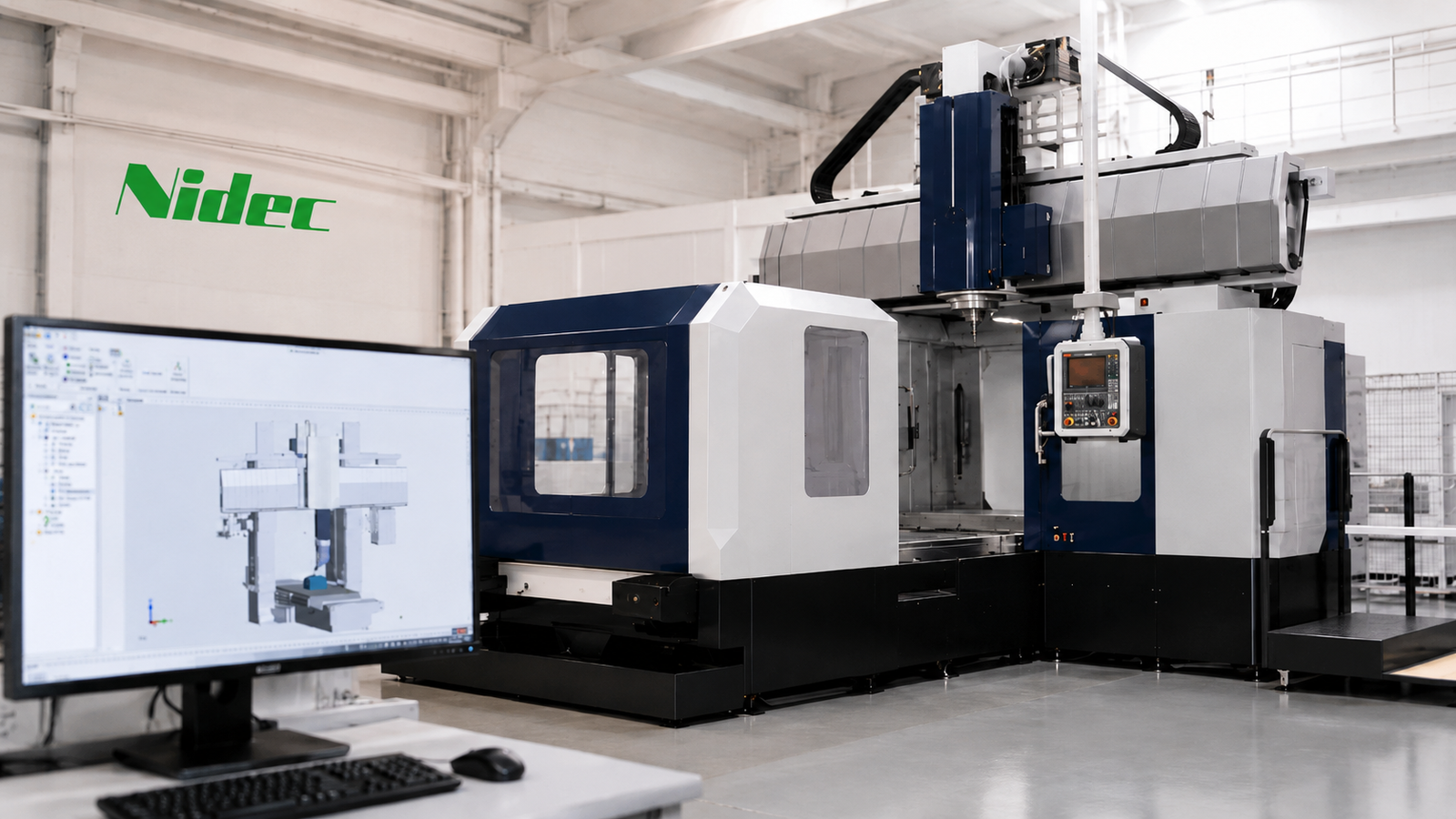
Nidec NC Twin has been launched by Nidec Machine Tool as a new digital twin platform for its MVR Series double-column machining centres, giving manufacturers a way to validate NC programmes, simulate machine motion and predict machining outcomes before production begins.
The launch matters because large CNC machining still has one of the most expensive bottlenecks in metal manufacturing: proving out programmes on the actual machine. When a large double-column machining centre is being used for dry runs, interference checks, trial cuts or programme verification, it is often unavailable for revenue-generating production.
Nidec Machine Tool says its new Nidec NC Twin digital twin platform has been created to move more of that verification work into a PC-based virtual environment. For manufacturers working on large components, high-value parts and complex five-face machining, that could make digital twin technology a more practical part of daily production planning.
For us, this is a strong example of where AI in machine tools is heading. The announcement is framed by Nidec as a digital twin launch, while its relevance sits directly inside the wider movement toward smarter CNC preparation, virtual prove-out, automated simulation and more consistent machining decisions.
Why Nidec NC Twin matters for machine tool users
Nidec NC Twin is designed for the MVR Series, with Nidec listing the applicable models as the MVR-Ax double-column five-face milling machine and the MVR-Hx double-column five-face milling machine.
That makes this a CNC machining story, rather than a sheet metal story. The target user is likely to be a manufacturer running large machining centres for heavy components, complex workpieces, five-face machining, long cycle times and high-value production.
According to Nidec, Nidec NC Twin recreates machine movements and processes in a virtual environment so manufacturers can validate programmes before production starts. The aim is to replace part of the traditional prove-out process with high-precision simulation, allowing operators to complete setup and verification remotely on a PC while keeping the real machine available for production.
That point is important. Many digital manufacturing tools promise better visibility, while the real value comes when they reduce non-cutting time, shorten setup, improve first-time-right production or free up machine capacity. Nidec NC Twin is aimed directly at those pressure points.
For more background on the wider technology, read our guide to digital twin in manufacturing 2026.
The three key functions inside Nidec NC Twin
Nidec lists three core simulation functions inside Nidec NC Twin: machine operation simulation, machining time simulation and surface quality simulation.
The first is machine operation simulation. This allows the same NC programme used on the real machine to be executed in a PC-based virtual environment. Nidec says the platform can reproduce complex machine movements and workpiece conditions, including various attachments, and can visualise potential interference between the spindle, workpiece and machine structure.
The second is machining time simulation. This is highly relevant for shops quoting large machining work, planning production schedules or trying to understand whether a process will meet the expected cost model. Nidec says the system uses the same machine configuration as the actual machine and can keep cycle-time error within 1%, excluding motion errors linked to auxiliary equipment such as automatic tool changers and automatic attachment changers.
The third is surface quality simulation. This is where the launch becomes especially interesting for high-value machining. Nidec says operators can predict machined surface quality by evaluating machining parameters before cutting. The platform can assess surface condition, tool-path deviation, acceleration and surface roughness values such as Sa and Sz.
For machine shops, that links directly to one of the most important questions in AI-driven machining: can manufacturers make better decisions before the first cut? We explored the same issue in our feature on AI in machining and CAM reliability, where the value of AI and automation was tied to more reliable programmes, shorter prove-out and greater confidence at the machine.
A digital twin built around real CNC behaviour
One of the strongest parts of the Nidec NC Twin announcement is its use of a genuine FANUC NC control environment. Nidec says this allows the system to verify complex machine operations, including macros, conditional branching and measurement cycles.
That matters because many CAM simulations can give a useful toolpath preview, while the real machine may still behave differently once controller logic, machine configuration, attachments, probing cycles and macro behaviour enter the process. For large CNC machines, the difference between a clean simulation and a real-world collision risk can be expensive.
By standardising NC programme verification around the actual control environment, Nidec is trying to close that gap. The benefit is especially clear for manufacturers using multiple CAM systems, because the NC Twin platform is designed to verify programmes independently of the source CAM software.
That could make Nidec NC Twin relevant to large manufacturers with several production sites, different programming teams and different levels of operator experience. Nidec points to this challenge directly, saying that machining quality and efficiency can vary when production is spread across multiple facilities.
For a wider look at how CAM automation is developing, read our comparison of AI CAM software in 2026.
Why this launch is relevant to industrial AI
Nidec NC Twin should be treated carefully from an editorial point of view. This is a digital twin platform, and Nidec’s release does not present it as a pure AI launch. Its importance for MachineToolNews.ai is that it sits inside the same industrial intelligence stack that AI-enabled manufacturing depends on.
AI in machine tools needs high-quality process data, realistic simulation, machine-level context and repeatable virtual testing environments. Digital twins provide much of that foundation. A platform that can reproduce machine motion, verify NC programmes, estimate cycle time and predict surface quality gives manufacturers more structured information before cutting starts.
That is why digital twin machining is becoming a major area for AI in CNC. It connects programming, simulation, process planning, quality prediction and production utilisation. These are exactly the areas where AI is already moving from general factory analytics into real machine tool workflows.
Nidec NC Twin also reflects a bigger market shift. Manufacturers are under pressure from labour shortages, rising costs and the need to transfer skilled machining knowledge to the next generation. When a platform captures more of that knowledge inside repeatable simulation workflows, it can help reduce dependence on individual experience while giving skilled machinists better tools.
For more context on that wider trend, see our guide to industrial AI in CNC machining.
MVR-Hx and large-component machining
The Nidec NC Twin launch is closely linked to Nidec’s large machine tool strategy. The company’s MVR-Hx series is a double-column, five-face milling machine designed for large workpieces, with Nidec highlighting high-accuracy machining, heavy cutting and thermal stability features on its official product page.
For manufacturers machining large components, the cost of a mistake can be significant. A collision, a poor surface finish, an inaccurate cycle-time estimate or a failed trial cut can mean lost production time, wasted material and rework. That is why virtual machining becomes more valuable as part size, cycle time and machine value increase.
This is also where Nidec NC Twin has a clear commercial story. The system is not only about digital transformation as a concept. It is about reducing the amount of time a large CNC machine spends being tested, checked or adjusted instead of producing parts.
For companies running aerospace, energy, construction equipment, die and mould, rail, heavy machinery or large industrial components, that could be the part of the launch that matters most.
Nidec NC Twin will be shown at JIMTOF 2026
Nidec says Nidec NC Twin will be exhibited at JIMTOF 2026, the Japan International Machine Tool Fair, at Tokyo Big Sight from 26 October 2026. The official JIMTOF 2026 outline lists the event as running from Monday 26 October to Saturday 31 October 2026.
That timing is significant. JIMTOF is one of the most important global events for machine tools, and digital twin machining is likely to be a key theme as machine builders look for ways to combine CNC hardware, software, simulation and process intelligence.
For Nidec Machine Tool, this gives the company a platform to show how NC Twin can reduce setup time, improve machine utilisation and support more predictable production. For the wider industry, it shows how large machine tool builders are moving beyond hardware specifications and into software-led productivity.
MTN analysis: what manufacturers should watch next
The most important question now is how far Nidec NC Twin can move from simulation into decision support.
The current launch already covers the core problems that matter to machine shops: interference checking, programme verification, cycle-time estimation and surface quality prediction. The next stage for digital twin machining will be the ability to recommend changes, compare machining strategies, support less experienced programmers and connect simulation outcomes to live production feedback.
That is where digital twin technology and AI in machine tools begin to overlap more directly.
For now, Nidec NC Twin is a significant launch because it tackles a real pain point in large CNC machining. It helps manufacturers shift prove-out away from the machine, reduce trial machining, improve planning accuracy and protect valuable production capacity.
In a market where machine utilisation and skilled labour are both under pressure, that makes Nidec NC Twin one of the more important machine tool software launches of the week.
Key Takeaways
Nidec NC Twin is a new digital twin platform for Nidec Machine Tool’s MVR Series double-column machining centres.
The platform is designed for MVR-Ax and MVR-Hx double-column five-face milling machines.
Nidec NC Twin supports machine operation simulation, machining time simulation and surface quality simulation.
The system uses a genuine FANUC NC control environment to verify complex machine operations.
Nidec says the platform can keep cycle-time error within 1%, excluding certain auxiliary equipment motion errors.
The launch is most relevant to large-component CNC machining, not sheet metal.
Nidec NC Twin will be exhibited at JIMTOF 2026 in Tokyo.
FAQs
What is Nidec NC Twin?
Nidec NC Twin is a digital twin platform from Nidec Machine Tool for MVR Series double-column machining centres. It allows manufacturers to simulate machine operation, estimate machining time and predict surface quality before production begins.
Is Nidec NC Twin an AI product?
Nidec describes Nidec NC Twin as a digital twin platform rather than a pure AI product. However, it is highly relevant to AI in machine tools because digital twin machining creates the simulation, process and machine-context layer needed for smarter CNC decision-making.
Which machines does Nidec NC Twin work with?
Nidec says Nidec NC Twin applies to MVR-Ax and MVR-Hx double-column five-face milling machines.
Is Nidec NC Twin for sheet metal?
No. Nidec NC Twin is for CNC machining, specifically large double-column five-face milling machines. It is relevant to machining centres, NC programme verification and large-component milling, rather than cutting, bending or press automation.
Why does Nidec NC Twin matter for CNC machining?
Nidec NC Twin matters because it can move more programme verification, interference checking, cycle-time estimation and surface quality prediction into a virtual environment. That can reduce prove-out time and keep expensive CNC machines available for production.
Where will Nidec NC Twin be shown?
Nidec says Nidec NC Twin will be exhibited at JIMTOF 2026 at Tokyo Big Sight, beginning on 26 October 2026.
Further Reading
Nidec NC Twin official launch release
Nidec MVR-Hx double-column five-face milling machine
Nidec MVR-Ax double-column five-face milling machine
Digital Twin in Manufacturing 2026
Industrial AI in CNC Machining 2026