For manufacturers looking for evidence of where AI machine vision is delivering practical value on the production floor, MVTec MERLIC at Endress+Hauser provides a compelling example.
At the Swiss flow measurement specialist, MERLIC is working alongside production employees to guide complex manual assembly, verify critical process steps and document quality. The application combines conventional machine vision with AI-based semantic segmentation and object detection, while integrating directly into Endress+Hauser’s existing Manufacturing Execution System.
The project has already progressed beyond its initial deployment. Endress+Hauser began using MERLIC in March 2025 and, after establishing the stability and reliability of the system, started rolling the process out to additional global manufacturing sites later that year.
For MVTec, it is another example of its machine vision technology moving directly into real production workflows. It also provides a practical counterpart to the wider AI developments MachineToolNews.ai recently explored in our MVTec VISION 2026 preview, where AI is set to play a central role across the company’s machine vision portfolio.
AI Machine Vision Works Hand in Hand With Production Employees
Machine vision already performs inspection, identification, code reading and robot guidance across modern manufacturing.
The Endress+Hauser application tackles a particularly interesting manufacturing challenge: very high component variation combined with extremely low production volumes.
In these conditions, complete automation can become difficult to justify or implement. Endress+Hauser therefore developed a digital assistance system in which machine vision supports the production employee throughout the assembly process.
Endress+Hauser Flow, headquartered in Reinach, Switzerland, specialises in flow measurement technology and fluid management solutions.
“At Endress+Hauser, our goal is to be technologically leading, to leverage innovations, and to actively drive them forward. This applies not only to our products, but also to our assembly processes,” explains Julius Krause from the Industrial Engineering department at Endress+Hauser.
Krause supports the company’s global production sites with the design, procurement and commissioning of camera-based inspection systems and digital assistance systems.
He was also closely involved in developing the new machine-vision-assisted assembly process.
At its centre is MVTec MERLIC.
MERLIC Integrates Directly Into the Endress+Hauser MES
MERLIC has been integrated into Endress+Hauser’s proprietary web-based Manufacturing Execution System.
Before assembly begins, the MES checks whether a device has reached the correct process stage, whether the workstation is suitable for the operation and whether the employee is authorised to carry it out.
Once approval is granted, the MES presents the relevant assembly instructions using text and images.
MERLIC is then launched in the background with the recipe data and parameters associated with that particular manufacturing step.
The machine vision system verifies whether the process has been performed correctly and provides an additional layer of quality assurance.
Once the operation has been completed, the result is returned to the MES. Process results, production data and image information can then be recorded.
This integration allows machine vision to become part of the wider manufacturing workflow rather than operating as an isolated inspection system.
Moving Quality Inspection Directly Into the Assembly Process
Before the machine vision system was introduced, quality assurance typically involved double checks by two employees together with additional testing.
Endress+Hauser wanted to strengthen this process while providing production workers with more support during assembly.
“The goals of further development were to relieve production staff, provide optimal support, and ensure the highest level of product quality. In addition, in-process inspection allows errors to be corrected easily and prevents failures in subsequent process steps or end-of-line tests,” explains Julius Krause.
This is an important aspect of the application.
Quality inspection takes place while the product is being assembled, giving employees the opportunity to identify and correct a potential problem immediately.
Endress+Hauser initially investigated commercially available assembly assistance systems.
However, the company found that available systems did not fulfil all of its requirements. Cloud-based systems raised data protection and availability considerations, while integrating alternative systems into the existing MES would have required additional development and potentially more third-party hardware.
Integrating standard machine vision software provided a more flexible route.
“Machine vision enables fast, contactless testing in real time. At the same time, our production control system already has numerous interfaces that we could use to integrate image processing software, allowing it to run on hardware managed by us,” Krause explains.
The company selected MVTec MERLIC.
Why Endress+Hauser Selected MVTec MERLIC
MERLIC is MVTec’s no-code machine vision software, designed to allow complete industrial vision applications to be created without conventional programming knowledge.
That flexibility was important to Endress+Hauser because the same software platform can be used across different machine vision tasks.
“We chose MERLIC for a number of reasons. The most important is that, as a standard software, it serves as a tool we can use for various tasks. As a result, we do not have to train our employees on different types of software. Finally, process integration is straightforward. MERLIC’s numerous open interfaces – such as GenICam – give users great flexibility regarding compatible hardware and make software integration simple,” explains Julius Krause.
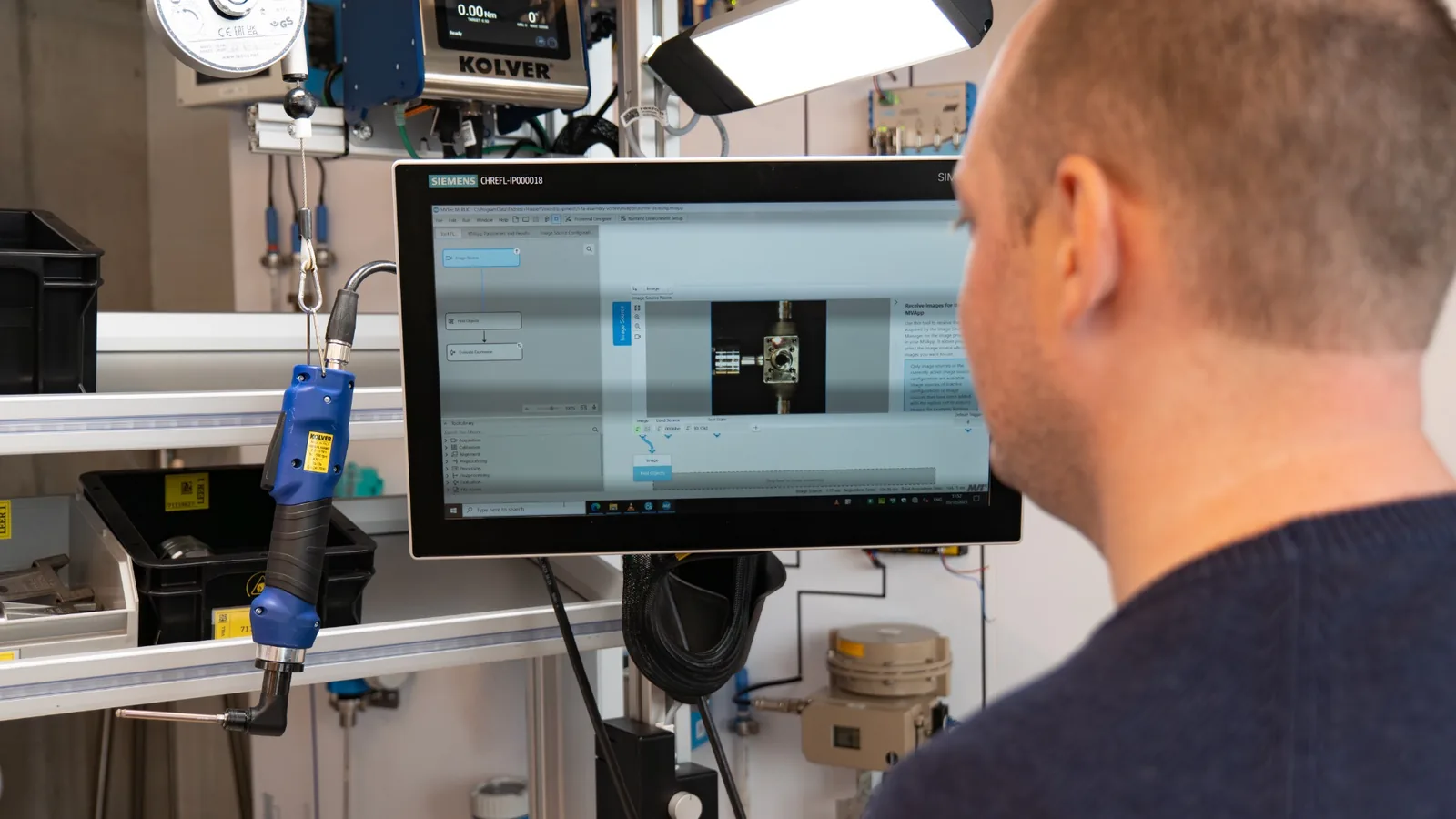
The workstation itself uses a streamlined machine vision configuration consisting of an industrial PC, laser distance sensor and a camera equipped with a liquid lens for variable focus.
A camera positioned above the assembly workstation accompanies the employee as the component moves through each production step.
Batch Size One Manufacturing Makes the Application Particularly Interesting
The components being assembled are typically flowmeters approaching the final stages of production.
A code associated with each component contains information specifying how that particular product must be assembled and what the production worker needs to consider.
This becomes particularly important because products can effectively be produced in a batch size of one.
Once the component has been identified, the workstation screen presents messages and images showing the employee how the assembly step must be completed.
MERLIC then operates in the background to verify that critical operations have been performed correctly.
One example is checking whether required seals have been installed.
Confirmation is returned to the MES before the product is released to the next manufacturing stage.
The result is a production environment in which digital instructions, machine vision and human assembly expertise operate within the same workflow.
MVTec Brings AI Into the Quality Inspection Process
The AI component is particularly relevant for manufacturers watching the development of AI machine vision.
Two AI-based technologies available within MERLIC are being used for recognition and confirmation at Endress+Hauser: semantic segmentation and object detection.
Semantic segmentation provides pixel-precise localisation of defined classes within an image.
Object detection identifies and locates particular object classes using bounding boxes.
Together, these technologies allow the system to recognise what is happening during an assembly operation and automatically confirm correct execution.
The camera and MERLIC can run in the background, enabling the user interface to advance when the required manufacturing step has been successfully completed.
“The application at Endress+Hauser clearly demonstrates how machine vision can easily help customers digitize their production while increasing quality. As a no-code software, MERLIC is ideally suited to work hand in hand with employees – simply because it is easy to use and can therefore be flexibly applied to various machine vision tasks,” explains Ulf Schulmeyer, Product Manager for MERLIC at MVTec.
Endress+Hauser Is Already Expanding the MERLIC Application
The deployment is continuing to develop.
Following the successful introduction of machine-vision-based quality control, Endress+Hauser is moving into another stage of the project in which MERLIC will perform additional tasks.
The objective is for MERLIC to independently read component codes using machine vision technologies including barcode reading and optical character recognition.
Digitally stored information associated with the product can then be retrieved automatically.
Eventually, the production employee should only need to position the workpiece underneath the camera. The system will identify the component, retrieve the relevant information and subsequently inspect the product as it moves through the assembly process.
This would further reduce manual interaction with the digital system while allowing machine vision to become increasingly integrated into the production workflow.
From Reinach to a Global Manufacturing Rollout
Endress+Hauser develops, tests and validates new manufacturing processes at its Reinach headquarters before technologies are considered for deployment elsewhere within its manufacturing network.
The MERLIC-based assembly process has followed that approach.
“We have been using MERLIC since March 2025. The software proved to be stable and reliable. That is why we began rolling out this process to our other global sites in fall 2025,” says Julius Krause.
That wider rollout represents an important validation of the technology.
The project has progressed from a single machine vision application into an approach Endress+Hauser believes can support production at additional sites.
MVTec’s customer support team has also worked directly with Endress+Hauser on further enhancements to the system.
“We had some feature requests to optimize the system. For example, the MVTec team optimized the export of AI models to the target hardware and developed a communicator plugin that sends images directly to our central servers,” Julius Krause concludes.
MTN Analysis
The Endress+Hauser application is an excellent demonstration of where industrial AI and machine vision are creating value in manufacturing today.
The significance comes from the way the technology has been integrated into an existing production environment.
MERLIC sits alongside Endress+Hauser’s MES, existing industrial hardware and production employees. AI-based semantic segmentation and object detection provide additional intelligence while the wider vision system verifies critical manufacturing steps and documents the result.
Batch-size-one production makes the use case particularly relevant.
Manufacturers increasingly need flexibility, yet high product variation can make conventional automation challenging. Digital assistance backed by machine vision offers another route, allowing companies to retain human adaptability while adding automated inspection and process verification.
The no-code element of MERLIC is equally important.
Advanced machine vision becomes considerably easier to scale when manufacturing teams can use a common platform across multiple inspection and identification applications without creating a completely separate software environment for every task.
Endress+Hauser’s decision to begin extending the system across its global production network after its initial deployment provides a particularly strong endorsement.
It demonstrates the progression that industrial AI ultimately needs to make: from a successful application at one workstation to technology capable of becoming part of a wider manufacturing standard.
For MVTec, this customer success story shows MERLIC operating exactly where industrial AI needs to prove itself, inside day-to-day production, supporting quality, assisting employees and becoming increasingly integrated into the manufacturing process.
Frequently Asked Questions
What is MVTec MERLIC?
MVTec MERLIC is no-code machine vision software designed to allow complete industrial vision applications to be created without conventional programming knowledge. It can be used across different inspection, identification and machine vision tasks while integrating with industrial hardware and manufacturing systems.
How is Endress+Hauser using MVTec MERLIC?
Endress+Hauser is using MERLIC as part of a digital assembly assistance system. The software supports production employees, verifies critical manufacturing steps, records inspection results and communicates with the company’s Manufacturing Execution System.
How does MVTec MERLIC use AI at Endress+Hauser?
The Endress+Hauser application uses AI-based semantic segmentation and object detection within MERLIC. Semantic segmentation provides pixel-precise localisation of defined classes, while object detection identifies and locates specific objects within an image.
What does MERLIC inspect during assembly?
MERLIC operates in the background while an employee completes an assembly operation. It can verify whether critical steps have been performed correctly, including checking whether required components such as seals have been installed.
Why did Endress+Hauser choose MERLIC?
Endress+Hauser selected MERLIC because it could be used as a standard platform across different machine vision applications, while its open interfaces made integration with the company’s existing manufacturing infrastructure more straightforward.
Is Endress+Hauser rolling MERLIC out globally?
Yes. Endress+Hauser began using MERLIC in March 2025. After the software proved stable and reliable, the company began rolling the process out to additional global manufacturing sites in fall 2025.
What is the next stage of the Endress+Hauser MERLIC project?
Endress+Hauser plans for MERLIC to take on additional identification tasks, including barcode reading and optical character recognition. The aim is for the system to identify a component automatically, retrieve the appropriate production information and inspect it as it progresses through assembly.
Further Reading
MVTec: MERLIC No-Code Machine Vision Software
MachineToolNews.ai: AI Machine Vision, HALCON and MERLIC