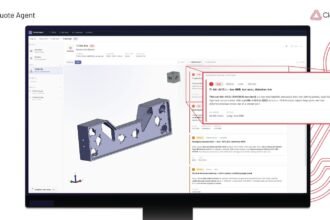
Syspro Torque was shown publicly for the first time at IMTS 2026, introducing an industrial AI platform designed to move beyond the traditional generative AI copilot.
Rather than simply generating answers from ERP data, Syspro Torque connects ERP, MES, SCADA, warehouse and other operational systems to identify issues, recommend actions and, where authorised, execute them.
We spoke with Christopher Lloyd, Chief Product and Technology Officer at Syspro, about how Torque approaches industrial AI, governance, auditability, AI costs, real-world workflows and the company’s longer-term vision for collaborative AI agents.
From AI Copilot to Industrial AI Platform
MTN: Torque was shown publicly for the first time at IMTS. What makes it an industrial AI platform rather than another generative-AI copilot sitting on top of ERP data?
Chris Lloyd: Syspro Torque is designed for industrial operations, rather than simply generating content from ERP data. It connects to ERP, MES, SCADA, warehouse and other systems, whether they run in the cloud, on-premises, or across both. This gives it the context to identify an issue, recommend a response and, where authorised, act within those systems.
Built on nearly five decades of manufacturing knowledge encoded into Syspro’s platform, Torque understands relationships between orders, inventory, production schedules, suppliers and shop-floor activity.
Operations teams can also describe an agent in plain language without writing code, then decide how much authority it should have.
This combination of manufacturing context, cross-system connectivity, governed action and a visible audit trail distinguishes Torque from a generative-AI copilot simply sitting above a single data source.
How Manufacturers Control AI Autonomy
MTN: Torque can detect a problem, recommend a next step and take an approved action. How do manufacturers define the boundary between what an agent may do automatically and what still requires a human decision?
Chris Lloyd: The manufacturer sets the boundaries according to the risk and operational impact of each decision. A sensible starting point is for Torque to recommend an action while an operator reviews and approves it. This lets the team confirm that the agent is applying the right rules before delegating more control.
As confidence grows, trusted, low-risk workflows can run automatically within defined limits, while higher-risk decisions and exceptions continue to require human judgement.
Autonomy is not all or nothing. Manufacturers can require approval for every action, automate selected processes, or apply different levels of oversight to different workflows.
These permissions can be reviewed as the operation changes, while the audit trail keeps autonomous actions visible and accountable.
Making AI Decisions Auditable
MTN: Every decision is described as logged, explained and auditable. What does that audit trail contain, and can a user reconstruct exactly which data and rules caused an agent to take a particular action?
Chris Lloyd: Torque follows Syspro’s Glass House principle, where everything is visible and nothing is hidden.
For each recommendation or action, the audit trail records the business rule applied, the data sources used, the tools called and the reasoning behind the outcome. So yes, this allows an operator or auditor to reconstruct why the agent acted instead of trusting a black-box result.
For example, the record could show that inventory fell below an agreed threshold, identify the order and stock data considered, and capture the rule that triggered an alert or approved workflow.
It also helps teams confirm that the agent stayed within its authorised boundaries. If source data is wrong, the action can be investigated and the underlying information corrected.
Balancing Local Decisions With Business Goals
MTN: Manufacturing decisions cut across purchasing, capacity, scheduling, quality, costing and fulfilment. How does Torque reason across those systems without creating conflicts between one local optimisation and the wider business objective?
Chris Lloyd: Manufacturing decisions rarely affect only one process. A delayed supplier delivery, for example, may change the production schedule, inventory position, customer timeline and cost.
Torque therefore combines context from ERP and connected operational systems, including MES, SCADA and warehouse platforms, rather than optimising against one isolated dataset.
The manufacturer, not the agent, decides what matters most. Business rules set the non-negotiables, such as credit limits, minimum margins, quality holds and stock thresholds.
Each rule is defined as something that blocks an action, raises a warning or is simply logged. Each agent also carries its own instructions and constraints, together with hard limits on which systems it may read, what it may change and which actions need sign-off.
When a recommendation would break a blocking rule or go beyond the agent’s authority, Torque flags the trade-off to the user, with the rule involved and the data behind it, so the right person makes the call.
Syspro’s capability graph extends this by linking each workflow to measurable targets and attributing agents’ actions to business outcomes and ROI. Over time, this gives manufacturers a shared view of whether local actions are moving the wider business in the right direction.
Putting a Cost on AI Workflows
MTN: You have built cost visibility into each AI workflow. Why was controlling AI spend important enough to become part of the product design, and how should manufacturers compare the cost of an agent with the value it creates?
Chris Lloyd: AI costs can accumulate quickly when organisations run workflows without knowing how often they will execute or what value they should produce.
Torque provides an upfront estimate for each workflow, lets the manufacturer set its cadence and tracks what the agent delivers. Pricing follows usage, allowing a business to start with one workflow and expand as it proves its value.
A comparison between an agent and its value should begin with a clear operational objective and baseline.
If the goal is to improve service levels, increase inventory turns or reduce manual processing, the manufacturer should record current performance, measure the change after deployment and compare that benefit with the known cost of running the agent.
The business case should be assessed workflow by workflow, based on measurable improvement against the original objective.
12,700+ Unattended Workflow Runs
MTN: What are the first production use cases from the controlled-availability customers that have shown the strongest measurable result, particularly in fabricated metals and industrial equipment?
Chris Lloyd: One early example comes from a large US industrial equipment manufacturer which has used Torque to build three Salesforce-to-Syspro workflows in weeks rather than months.
Accepted quotes are posted into Syspro as sales orders without rekeying, customer records remain synchronised across both systems, and invoice and order-status information flows back to sales.
Running every five minutes since 1 September 2026, the workflows had completed more than 12,700 unattended runs when the result was recorded.
This provides a clear operational measure: data moves consistently between the systems without repeated manual intervention, while every workflow remains auditable.
It also demonstrates the value of beginning with a focused process, measuring the outcome and expanding once it has proved effective.
Does Manufacturing AI Need Perfect Data?
MTN: How much clean, structured data does a manufacturer need before Torque can deliver value, and what happens when the underlying ERP or operational data is incomplete or inconsistent?
Chris Lloyd: Manufacturers do not need to complete a major data-cleaning or systems-replacement program before Torque can deliver value.
It works with the environment a business has today, connecting ERP, MES, SCADA, warehouse hardware and other sources through standardised MCP connectors.
A manufacturer can therefore start with one defined workflow and the data required for that process, rather than waiting for every system to be fully integrated.
Torque is also designed not to act on data it cannot trust. Rather than relying on a model’s own sense of confidence, the manufacturer defines explicit validation rules.
For example, an order must have a valid customer, price and delivery date. Data that fails a blocking rule stops the workflow before anything is written back.
Other failures can raise a warning or alert the team, and agents ask for missing information instead of guessing.
Approval requirements can be set for any action, or only above a threshold such as an order value, and the item is routed to a named person for review.
The Roadmap Toward Collaborative AI
MTN: What is the longer-term autonomy roadmap? Could Torque eventually coordinate multiple specialist agents across planning, procurement, production and service while still remaining governed by the manufacturer?
Chris Lloyd: Yes, and that is the direction of travel.
Torque already works this way within a single conversation. The roadmap is moving Torque from individual agents towards collaborative AI, with group projects and durable agents allowing people and multiple specialist agents to work together across connected workflows.
Agents will pursue a goal over days or weeks, waking when an order, shipment or sensor reading changes.
Shared project workspaces will let people and multiple specialist agents work on the same initiative, with full visibility of what each has done and what is still in progress.
A planning agent, a procurement agent and a service agent could then coordinate around the same late delivery rather than each reacting in isolation.
Upcoming capabilities such as EDI automation and native IoT integration will also enable Torque to respond to information directly from supply-chain and shop-floor systems.
Greater autonomy will not remove manufacturer oversight, however.
Each agent operates only within the authority it has been given, such as which systems it can see, what it can change and how far it can go before a person must approve.
Human approval gates, guardrails, role-based access and a full audit trail mean that manufacturers always set the rules, approve higher-risk actions and retain visibility over every decision, however many agents are involved.
MTN Analysis: Why Governed Autonomy Matters
The most interesting part of Syspro Torque is not simply that it brings AI into manufacturing software. It is the emphasis on controlled autonomy.
Much of the current industrial AI conversation still centres on copilots: systems that can search data, answer questions and help employees find information faster. Torque takes the next step by putting AI agents inside operational workflows and giving them the ability to take actions.
That creates a very different set of requirements.
A manufacturing agent cannot simply be impressive in a demonstration. It needs to know what information it can trust, which systems it can access, what it is allowed to change and when a human must intervene. For manufacturers, those controls may ultimately be more important than the underlying AI model.
The 12,700-plus unattended workflow runs are therefore particularly significant. They point to a more practical measure of industrial AI adoption: how many real operational processes can run reliably without constant human intervention?
The other notable element is the move toward collaborative agents. If planning, procurement, production and service agents can eventually coordinate around the same business problem, manufacturers could move from isolated AI tools to interconnected digital workers operating across the production environment.
But that also increases the importance of governance. The more systems an agent can access, and the more decisions multiple agents can make together, the more important permissions, validation rules, approval gates and auditability become.
Torque’s approach suggests that the next phase of manufacturing AI may not be about giving AI unlimited autonomy. It may be about giving AI precisely defined autonomy and making every action visible.
That is likely to be a more realistic path for manufacturers operating environments where a seemingly small decision can affect inventory, production capacity, quality, customer delivery and cost.
Further Reading
- IMTS 2026 Post-Show Review: What the Biggest Manufacturing Show in the West Revealed About AI
- IMTS 2026 Industrial AI: How AI Is Moving Into Job Shops, CAM and Quality Control
- AI in Machining: The Real Value Starts Before the First Cut
- AI Adoption in Manufacturing: A Free Practical Toolkit for UK SMEs
-150x150.jpeg)

-330x220.jpeg)