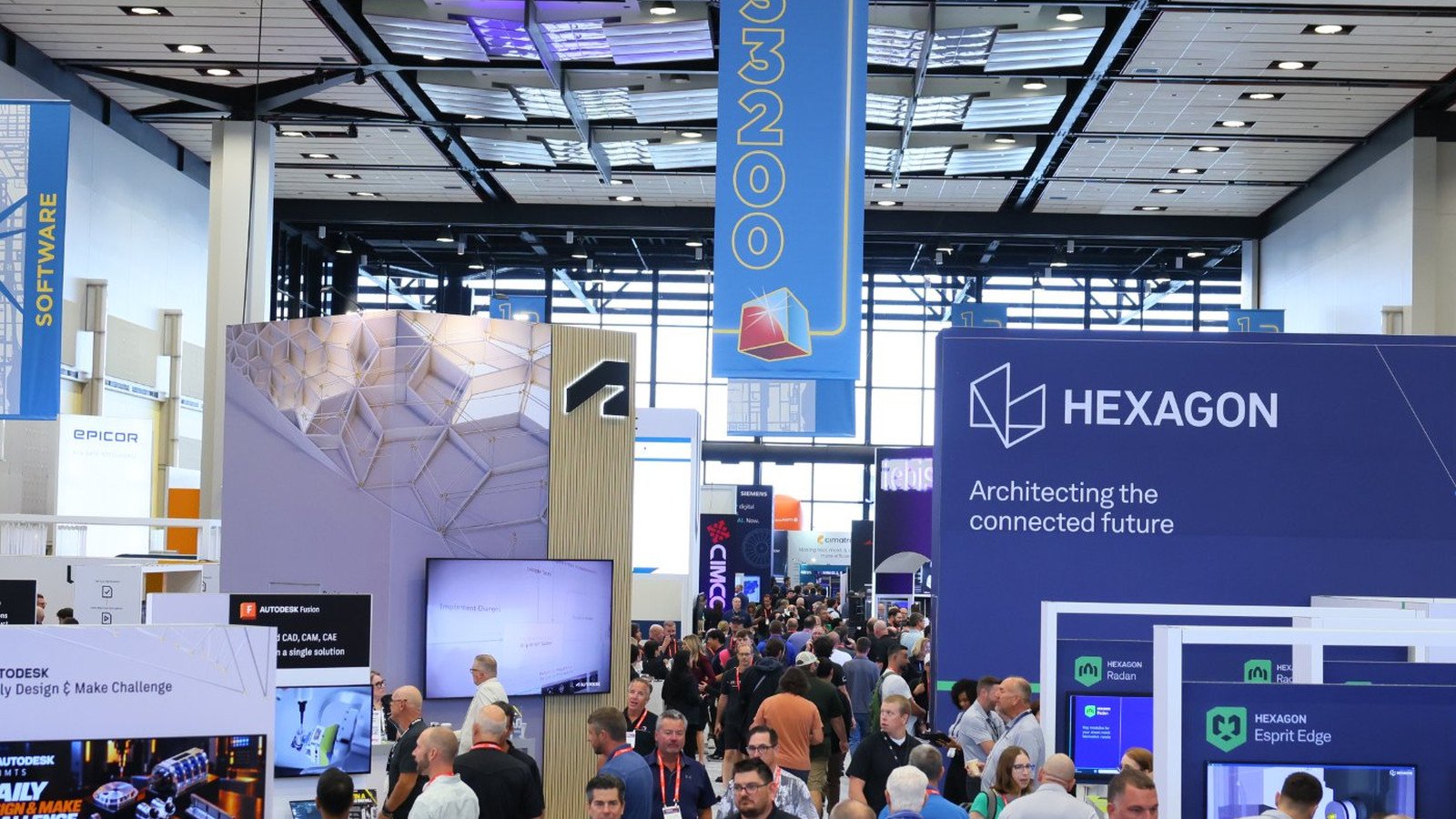
IMTS 2026 was not simply another major manufacturing exhibition. It was a clear snapshot of where industrial technology is heading, and artificial intelligence was impossible to ignore.
Held from September 14 to 19 at McCormick Place in Chicago, IMTS 2026 brought together 1,788 exhibiting companies across 1.17 million square feet of exhibition space. The event recorded 91,295 registrants, including 14,447 students, while 400 new exhibiting companies joined the show.
For us, the most interesting part was not the number of companies using the word AI.
It was where AI was actually being applied.
Across the show floor, artificial intelligence was appearing in CNC programming, robotics, factory software, maintenance, metrology, quality inspection, production planning, automation and manufacturing data.
At the same time, IMTS made something else clear.
AI is no longer developing as a completely separate category of manufacturing technology. It is increasingly being built into the systems manufacturers already use.
IMTS 2026 Post-Show Review: Who Showed What?
The companies we looked at during IMTS represented different parts of that transition.
Some are developing AI-native manufacturing technologies. Others are integrating AI into established software or equipment. Others are building the infrastructure needed for factories to actually use AI at scale.
Here is what stood out.
Atomic Industries
Atomic Industries was one of the companies representing the newer AI-native approach to manufacturing.
The Detroit-based company combines software-driven manufacturing with injection moulding and tooling, taking a vertically integrated approach that connects engineering, tooling and production.
IMTS highlighted Atomic as part of the wider Industrial AI ecosystem at the show.
What makes this interesting is the way AI is being connected directly to manufacturing rather than being treated simply as an analytics layer.
The broader direction is toward manufacturing systems where software intelligence is involved earlier in the process, helping manufacturers make decisions before production begins.
C-Infinity
C-Infinity was part of the wider Industrial AI environment at IMTS 2026.
Its presence reflected one of the larger changes taking place across manufacturing technology.
Industrial AI is expanding beyond individual machine functions and into systems that can work with manufacturing data, workflows and operational decisions.
That was also reflected in the programme for the first Industrial AI Conference at IMTS, which focused on practical subjects including manufacturing productivity, operational intelligence, predictive maintenance, deployment strategies and data readiness.
CloudNC
CloudNC brought AI-assisted CNC programming directly into the IMTS conversation with CAM Assist.
At the show, the company demonstrated how CAM Assist can analyse parts and generate machining strategies and toolpaths, while giving programmers the ability to review and adjust the resulting process.
The technology is designed to work within established CAM environments rather than forcing manufacturers into a completely separate programming workflow. CloudNC supports platforms including Autodesk Fusion, Mastercam, Siemens NX, GibbsCAM and SolidCAM.
CloudNC also demonstrated its Strategy Editor, giving programmers greater visibility into the operations and machining decisions generated by the AI and allowing them to make changes before the final machining strategy is committed.
That human-in-the-loop approach is important.
AI can accelerate programming, but the experienced programmer remains responsible for reviewing the result, making adjustments and deciding whether the strategy is appropriate for the machine, tooling and part.
We have already covered CloudNC’s CAM Assist development, including its work with GibbsCAM and the evolution of CAM Assist 2.0.
The wider story is clear: AI is moving directly into one of the most time-consuming parts of CNC production.
DN Solutions / HELLER
DN Solutions and HELLER arrived at IMTS 2026 with a new corporate relationship behind them.
DN Solutions completed its acquisition of German machine tool manufacturer HELLER on January 28, 2026. The companies retained the HELLER brand identity while bringing together DN Solutions’ global scale and digital capabilities with HELLER’s precision engineering expertise.
IMTS therefore provided an important opportunity to see the two organisations operating together in the US market.
The joint presence covered machining, automation and advanced manufacturing technologies, while DN Solutions also highlighted its Smart AI Technologies.
The important point is not to treat this as a collection of standalone AI products.
Instead, AI is becoming part of a broader technology ecosystem connecting machine tools, automation, production information and digital manufacturing systems.
That direction fits the wider shift visible across IMTS 2026, where manufacturers were increasingly looking at how machines, software and production data can work together rather than as isolated technologies.
ENCY Software
ENCY Software represented the continuing development of intelligent CAM and CNC programming technology.
The company’s presence fitted into a wider movement across the CAM sector in which software is becoming more automated and capable of supporting programmers with increasingly complex manufacturing decisions.
This is important because the AI transition in machining is not happening separately from conventional CAM.
Instead, established CAM environments are becoming one of the places where AI is being introduced into everyday manufacturing workflows.
GibbsCAM
GibbsCAM was another example of the established CAM ecosystem evolving alongside AI.
One of the developments relevant to the show was CloudNC’s CAM Assist integration with GibbsCAM, which brings AI-generated machining strategies and toolpaths directly into the GibbsCAM environment.
The significance is broader than one software integration.
AI-assisted programming is increasingly being delivered inside the CAM systems manufacturers already know, rather than requiring programmers to completely change how they work.
HCLSoftware / CAMWorks
HCLSoftware and CAMWorks represented another part of the connected manufacturing software story.
As manufacturing software becomes more connected, the distinction between programming, simulation, production data and shop-floor information is becoming less rigid.
That matters for AI because intelligent manufacturing systems need access to reliable data.
The more connected the underlying manufacturing workflow becomes, the more opportunities there are for AI to assist with planning, programming, analysis and decision-making.
Hexagon
Hexagon’s presence at IMTS highlighted the connection between manufacturing software, data and AI.
Amy Jarvis, Vice President of Hexagon’s Production Software Division in the Americas, explained:
“I left IMTS encouraged by manufacturers’ determination to keep moving forward. Our recent State of Manufacturing research reflects that ambition: 78% of US respondents are maintaining or accelerating technology investment. Yet only one in three has data from most of their systems available in a unified view. Closing that gap would help the people making production decisions get more from the technology their businesses are investing in.
Our conversations with customers and partners at IMTS brought that opportunity down to the shop floor. How can we get a complex part into production with fewer unknowns? Where can AI genuinely help a programmer? Those are the questions driving our work in production software, helping people apply their expertise and verify the machining process before committing machine time and material. For me, manufacturing confidence means being able to trust the next decision and knowing you have done the work to get it right.”
The point is particularly relevant to the wider AI discussion.
Manufacturers can invest in AI, but if production information remains spread across disconnected systems, there is a limit to what those applications can actually do.
Data connectivity is therefore becoming one of the foundations of industrial AI.
Hurco
Hurco represented the machine tool side of the connected manufacturing story.
The broader trend visible at IMTS was that CNC machines are increasingly becoming part of larger production systems involving automation, data collection, monitoring and software.
That creates an environment where AI can eventually be applied not only to programming but also to machine operation, diagnostics and production optimisation.
The important development is the connection between the machine and everything around it.
Ignizia
Ignizia was among the AI-native companies contributing to the Industrial AI story at IMTS 2026.
The company focuses on industrial AI and AI-native manufacturing applications, representing a newer generation of technology providers approaching manufacturing problems from an AI-first perspective.
IMTS identified Ignizia among the companies contributing to its wider Industrial AI ecosystem.
This is an important development for the industry.
Rather than adding AI to an existing product, AI-native companies are starting with manufacturing problems and designing systems around artificial intelligence from the beginning.
Intrinsic Automation
Intrinsic Automation represented another important part of the AI and robotics story.
IMTS 2026 showed that industrial AI is increasingly moving from software into physical automation.
That means AI needs to interact with machines, robots, vision systems and other production equipment.
Intrinsic was also involved in the AI automation robot cell presented by Okuma at IMTS, demonstrating how AI and robotics are beginning to operate together within CNC production environments.
The significance is clear.
Industrial AI eventually has to do more than analyse information.
It needs a way to influence the physical manufacturing process.
LG CNS
LG CNS brought its smart factory technology into the IMTS conversation.
The company’s Factova platform includes factory simulation, MES and AI-supported equipment control, demonstrating how AI can operate at factory level rather than only at individual machine level.
This is another important direction.
A modern factory contains thousands of signals and decisions spread across machines, production systems and business software.
AI becomes considerably more useful when it can work across those systems.
The future therefore looks increasingly like AI-enabled factories rather than simply AI-enabled machines.
Limitless Labs
Limitless Labs deserves its own place in the IMTS story.
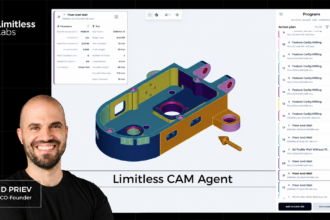
The company is developing an AI CAM Agent designed to work directly inside the CAD/CAM environments used by CNC programmers.
Its technology is built around understanding CAD geometry, machining processes and the physical constraints of CNC production.
At IMTS, Limitless Labs demonstrated workflows involving Siemens NX and Mastercam, with the company also developing support for PTC Creo.
Limitless Labs also developed the Cimatron CAM Agent together with Cimatron, bringing agentic AI directly into CNC programming. The system analyses part geometry and tooling information, identifies machining requirements, recommends strategies and generates 3-axis CNC toolpaths.
The company’s approach is centred around its Physical AI Foundation Model for precision manufacturing.
For machine shops, the important part is that the AI is designed around the actual manufacturing process.
It can work with information such as tooling, machines, fixtures, stock conditions, feeds and speeds and selected manufacturing knowledge, while keeping the programmer involved in reviewing the proposed process.
This is a distinct story within the wider AI in manufacturing landscape and one that MachineToolNews.ai has followed closely through our interview with Limitless Labs CEO David Priev.
Mastercam
Mastercam used IMTS 2026 to highlight connected manufacturing workflows spanning programming, automation, tooling, simulation, inspection and production.
That wider ecosystem is important because CAM is no longer an isolated step between CAD and the machine.
Programming increasingly connects with verification, tooling, inspection and production data.
Mastercam’s Manufacturing Experience included technologies and partners covering these different parts of the workflow.
Mastercam is also developing AI-enabled CAM intelligence, showing how established CAM platforms are incorporating AI into their existing software environments.
This is likely to be one of the defining developments in manufacturing software.
AI does not necessarily need to replace established platforms.
It can become another capability within them.
Nidec Machine Tool
Nidec Machine Tool represented the continuing importance of advanced machine tool technology within the wider digital manufacturing transition.
The IMTS story was never only about AI.
Precision machining, machine performance, automation and reliability remain the foundation of manufacturing.
AI adds value when it improves those underlying processes rather than existing simply as another feature.
That distinction became increasingly clear across the show.
octonomy
octonomy represented another emerging area of industrial AI: AI agents working with complex technical information.
The company develops digital experts designed to work with documentation, technical data and existing systems. Its platform can process complex documents, including diagrams, schematics and tables, while using multiple specialist agents to handle different tasks.
The company was listed at IMTS under Industrial AI, autonomous and generative AI, IIoT, maintenance and automation-related categories.
This matters because manufacturing knowledge is often buried inside technical documents.
Maintenance manuals, drawings, service records and equipment documentation contain enormous amounts of information that traditionally requires an experienced engineer or technician to interpret.
AI agents offer a new way of accessing that knowledge.
Roboris / Eureka Virtual Machining
Roboris and Eureka Virtual Machining represented another important part of the CNC technology ecosystem: simulation and verification.
As AI becomes more involved in generating machining strategies, verification becomes even more important.
Manufacturers need to know that an automatically generated strategy is safe and suitable before it reaches the physical machine.
That makes simulation a natural partner for AI-assisted programming.
The more automated programming becomes, the more important it becomes to verify what the AI has produced.
Shibaura Machine
Shibaura Machine demonstrated the continuing convergence of machine tools, automation and industrial software.
Its IMTS presence included machining technology alongside its machiNetCloud IIoT platform, demonstrating the connection between physical production equipment and digital manufacturing systems.
This is important because AI needs data.
Machine tools capable of generating useful production information create the foundation for future intelligent applications.
Skodi AI
Skodi AI was another company contributing to the growing industrial AI landscape at IMTS 2026.
Its presence reflected the increasing number of companies developing AI specifically around industrial applications.
That focus is important.
Manufacturing AI needs to understand more than language.
It needs to operate around technical information, production constraints, industrial processes and the consequences of incorrect decisions.
This is one of the reasons industrial AI is developing into a distinct technology category rather than simply becoming another application of general-purpose AI.
SYSPRO
SYSPRO brought AI into the operational side of manufacturing software with Torque.
Launched in September 2026, Torque is designed to detect operational problems, recommend the next step and, where approved, take action within existing systems. The actions are designed to remain governed, visible and auditable.
SYSPRO publicly showcased Torque at IMTS 2026.
This represents an important development in industrial AI.
The conversation is moving beyond AI that simply produces an answer.
The next stage is AI that can identify a problem, recommend what should happen next and potentially execute an approved action.
That creates a much more direct connection between AI and manufacturing operations.
United Grinding / United Machining Solutions
United Grinding and United Machining Solutions represented the high-precision machining side of the IMTS technology landscape.
The wider trend around advanced machining is increasingly connected to automation, software, monitoring and digital production systems.
AI does not replace the machine tool.
It creates additional opportunities to make the production system around that machine more intelligent.
Universal Robots
Universal Robots used the opening day of IMTS 2026 to unveil Gen 7, its seventh-generation robotics platform.
The company described Gen 7 as an AI-ready platform designed for AI-powered industrial operations, with changes extending from the controller through to the tool flange.
The announcement was significant because it showed how robotics manufacturers are preparing the physical infrastructure required for AI-enabled automation.
AI can make decisions, but industrial systems still need machines capable of sensing and acting.
Robotics therefore becomes one of the physical foundations of industrial AI.
Yaskawa Motoman
Yaskawa Motoman represented another major part of the industrial robotics ecosystem at IMTS 2026.
The wider robotics story at the show was increasingly connected to machine tools, automation, vision, production software and factory data.
That connection matters because intelligent production requires both digital intelligence and physical execution.
Robots provide one of the key interfaces between those two worlds.
The Bigger Picture: AI Was Everywhere, But It Was Not Everything
One of the easiest conclusions to draw from IMTS 2026 would be that the entire manufacturing industry has suddenly become an AI industry.
That would be too simple.
AI was certainly one of the defining themes of the show.
IMTS created a dedicated Industrial AI Arena and hosted its first Industrial AI Conference, with the programme covering manufacturing productivity, workforce transformation, operational intelligence, predictive maintenance, deployment strategies and data readiness.
But alongside AI were the technologies that make modern manufacturing possible.
Machine tools.
Robotics.
Metrology.
Machine vision.
Automation.
Simulation.
Additive manufacturing.
Digital twins.
Tooling.
Software.
Industrial networking.
What changed at IMTS was the way these technologies are increasingly being connected.
IMTS itself described industrial AI in three broad forms: AI embedded in existing tools, purpose-built AI solutions and infrastructure that enables manufacturers to use factory data more effectively.
That is probably the best way to understand what happened in Chicago.
AI is not replacing the manufacturing technology stack.
It is becoming another layer within it.
Other Companies and Technologies Across IMTS 2026
The companies we saw directly were only part of the wider technology story.
IMTS created a much broader environment for industrial AI, with AI-native companies appearing alongside established machine tool builders, CAM providers, automation companies and major technology platforms.
Amazon Web Services (AWS), Google Cloud and Microsoft were among the major technology companies represented at the show, demonstrating how cloud infrastructure and AI platforms are becoming increasingly relevant to industrial manufacturing.
The exhibition also covered digital twins, connected production, metrology, additive manufacturing, machine monitoring and automation.
That broader picture matters.
A manufacturer does not need to put AI across its entire booth to be part of the AI transition.
A machine generating structured production data is part of the AI ecosystem.
A metrology system generating inspection data is part of the AI ecosystem.
A CAM platform exposing manufacturing knowledge to AI is part of the AI ecosystem.
A robot capable of working within an intelligent production system is part of the AI ecosystem.
The transition is therefore much bigger than the number of AI logos visible at a trade show.
American Manufacturing AI Is Blooming
Another noticeable aspect of IMTS 2026 was the growth of companies building AI specifically for manufacturing.
The show highlighted AI-native companies such as Atomic Industries and Ignizia, while the Industrial AI Arena provided a dedicated space for emerging industrial AI technologies.
That matters because manufacturing has traditionally been a difficult environment for software companies to enter.
Factories are complex.
Machines are expensive.
Production cannot simply stop while a new technology is tested.
Data is often fragmented.
And decisions can have direct consequences for quality, safety and productivity.
The emergence of companies specifically focused on industrial AI suggests that the industry is beginning to address those challenges directly.
The opportunity is not simply to bring generic AI into factories.
The bigger opportunity is to build systems that understand manufacturing processes, engineering constraints, machine behaviour, production data and the economics of industrial production.
That is where industrial AI becomes different from general-purpose AI.
IMTS 2026 Was Successful. The More Interesting Question Is What Happens Next
The numbers from IMTS 2026 were strong.
More than 91,000 registrants.
Almost 1,800 exhibitors.
1.17 million square feet of exhibition space.
More than 14,000 students.
And 400 new exhibiting companies.
But attendance and exhibition space are not the most interesting indicators of where manufacturing is heading.
The more important question is what manufacturers do with the technology they saw.
AI demonstrations are relatively easy.
Deploying AI into production is much harder.
Manufacturers need reliable data.
They need integration.
They need cybersecurity.
They need employee adoption.
They need measurable value.
And they need to understand when AI should make a decision and when a human should remain in control.
That is why the next phase of industrial AI will be less about impressive demonstrations and more about deployment.
MTN Analysis
Our biggest takeaway from IMTS 2026 is that the AI conversation has moved forward.
AI is no longer limited to experimental demonstrations or futuristic presentations.
It is appearing inside CAM software, robotics platforms, production systems, maintenance applications and manufacturing data environments.
But the show also demonstrated that AI is only as useful as the manufacturing infrastructure around it.
A factory with disconnected systems and poor-quality data cannot simply add AI and expect transformation.
The companies making the most interesting moves are therefore not necessarily the companies with the loudest AI message.
The bigger story is the connection between data, software, machines and people.
That is where the real manufacturing AI story is developing.
After IMTS 2026, industrial AI looks less like a future concept and more like the next stage of manufacturing software, automation and machine technology.
FAQs
How successful was IMTS 2026?
IMTS 2026 attracted 91,295 registrants, 1,788 exhibiting companies and 1.17 million square feet of exhibition space. The event also included 400 new exhibitors and 14,447 students.
Was AI a major theme at IMTS 2026?
Yes. IMTS featured a dedicated Industrial AI Arena and its first Industrial AI Conference, while AI applications appeared across CAM, robotics, factory simulation, inspection, production planning, maintenance and automation.
What did CloudNC show at IMTS 2026?
CloudNC demonstrated CAM Assist for AI-assisted CNC programming and its Strategy Editor, which allows programmers to review and modify AI-generated machining strategies.
What did Limitless Labs show at IMTS 2026?
Limitless Labs demonstrated its AI CAM Agent, including workflows involving Siemens NX and Mastercam. The company also worked with Cimatron on Cimatron CAM Agent, an agentic AI system for CNC programming.
What did DN Solutions and HELLER present?
DN Solutions and HELLER presented their combined manufacturing technology presence following DN Solutions’ acquisition of HELLER, while DN Solutions highlighted its Smart AI Technologies.
What is SYSPRO Torque?
Torque is SYSPRO’s industrial AI platform, designed to detect operational problems, recommend actions and execute approved actions within existing systems while maintaining governance and auditability.
What did Universal Robots launch?
Universal Robots launched its Gen 7 robotics platform at IMTS 2026, describing it as an AI-ready platform for industrial automation and AI-powered operations.
Why is data important for industrial AI?
Industrial AI depends on reliable manufacturing data. IMTS 2026 placed significant emphasis on data readiness and connected manufacturing as foundations for successful AI deployment.
Further Reading
For more information about IMTS 2026 and its Industrial AI programme, visit the official IMTS website.
IMTS 2026 Industrial AI Takes Centre Stage
IMTS 2026 Industrial AI: How AI Is Moving Into Job Shops, CAM and Quality Control
CloudNC Launches CAM Assist for GibbsCAM With AI-Generated CNC Strategies
Cimatron CAM Agent Brings Agentic AI Into CNC Programming Ahead of IMTS 2026
Inside the Limitless Labs AI CAM Agent: CEO David Priev on the Next Shift in CNC Programming
IMTS Industrial AI Conference 2026: The Manufacturing AI Wake-Up Call You Cannot Afford to Miss