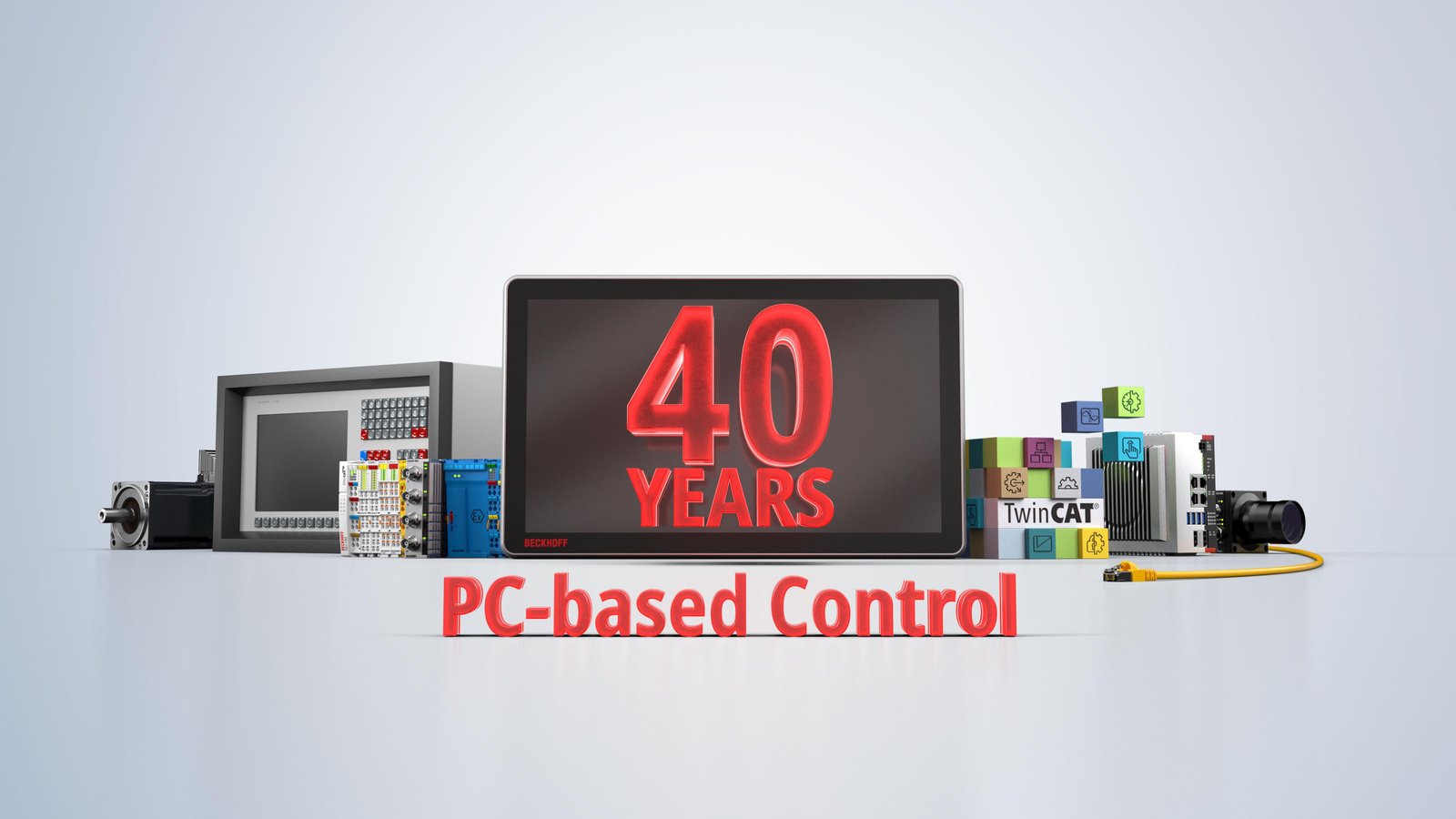
Beckhoff’s journey from PC-based control to industrial AI shows how four decades of developments in computing, software and machine communication have created new opportunities for manufacturing. Today, that foundation supports AI tools that help engineers develop control programs, interpret machine data and investigate production problems.
For those of us working with CNC machines, automated production cells and factory software, the connection is practical. AI needs access to useful data, sufficient computing power and a way to work within the machine’s operating environment. Many of the decisions that make this possible were made long before AI became a familiar manufacturing topic.
We look at the milestones behind that progression and what they mean for your next investment.
Why it matters
A machine’s control architecture influences how easily you can introduce new functions throughout its working life.
Bringing control, motion, measurement and software into a common environment gives engineering teams a foundation on which to add capabilities. As AI develops, that foundation becomes increasingly valuable.
The 40th anniversary of Beckhoff’s PC-based control gives us an opportunity to explain how the industry reached this point, from using a PC to control a saw to integrating machine learning and conversational assistance into automation.
1986: Putting the PC in charge of a machine
In 1986, Beckhoff delivered its first PC-based machine control system for a double mitre saw.
At the time, industrial automation relied heavily on dedicated control hardware. Beckhoff pursued an approach that placed control functions in software running on PC technology.
The significance extended beyond the computer itself. Machine builders could benefit from advances in the wider computing industry, including more powerful processors and a growing software ecosystem.
For manufacturers, this opened a route towards controls whose capabilities could develop alongside computing technology.
1989 and 1995: Connecting computing power to the factory
A capable computer needs reliable access to the machine it controls.
Beckhoff introduced Lightbus in 1989 to improve communication between the controller and the machine’s inputs and outputs. Its approach processed data as it travelled through the network.
The modular Bus Terminal system followed in 1995, giving machine builders a flexible way to connect different signals and devices.
These developments addressed a challenge that remains central to industrial AI: collecting information from the physical process and making it available to software.
A model intended to recognise unusual machine behaviour depends on the quality and relevance of those signals.
1996: TwinCAT brings machine functions into software
The introduction of TwinCAT in 1996 was another important step in Beckhoff’s PC-based control journey.
TwinCAT provided a real-time automation environment on PC hardware. This allowed functions such as PLC logic and motion control to be implemented in software, alongside other machine functions.
Real-time operation matters because machinery depends on predictable timing. Coordinated axes and control sequences must execute within defined deadlines.
For engineering teams, a shared software environment also provided a basis for bringing more functions together. As processors developed, that environment could support increasingly demanding applications.
2003: EtherCAT accelerates machine communication
Beckhoff introduced EtherCAT in 2003, combining Ethernet technology with the processing of data as it passes through network devices.
Fast, coordinated communication helps controllers work with drives, sensors and other equipment across a machine.
Its connection to today’s AI applications is the underlying data infrastructure. Machine learning benefits from access to relevant process signals, while automation still depends on timely, predictable communication.
We can see the progression taking shape: computing power, software control and machine connectivity becoming more closely integrated.
2012 to 2021: Software expands the possibilities of machine design
Beckhoff’s XTS transport system, introduced in 2012, uses individually controlled movers travelling along a track. XPlanar followed in 2018, using magnetically levitated movers travelling over motor tiles.
Both illustrate how software can give machine designers greater freedom to coordinate product movement and adapt production sequences.
In 2021, the MX-System extended this development into the physical arrangement of automation equipment, with modular control technology designed for installation directly on the machine.
For manufacturers, these milestones show how changes in control technology can influence flexibility, layout and engineering decisions across an entire production system.
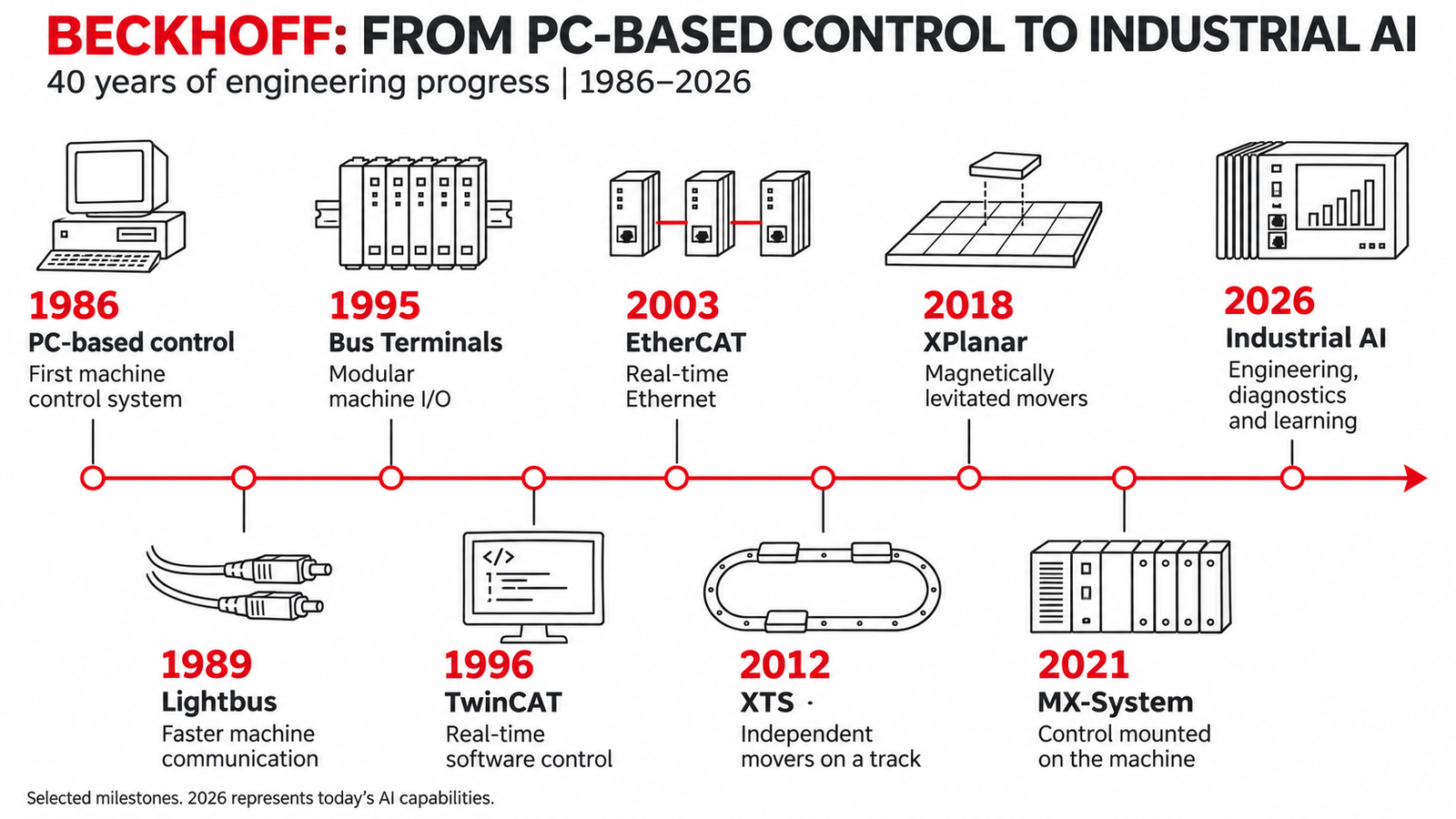
From its first PC-based machine control in 1986 to today’s industrial AI tools, Beckhoff’s milestones show how computing, connectivity and software have evolved together.
How does Beckhoff’s PC-based control support industrial AI today?
The historical progression now connects with several distinct AI applications.
Helping engineers develop automation projects
TwinCAT 3 CoAgent for Engineering supports PLC programming, I/O configuration and HMI development.
Engineers can describe requirements in everyday language and receive suggestions that take account of the project context. The assistant also provides access to Beckhoff’s technical documentation.
For a machine builder, this creates opportunities to reduce repetitive programming and information searches. Engineers still need to review and test the resulting work against the machine’s requirements.
Helping maintenance teams understand machine problems
TwinCAT 3 CoAgent for Operations brings AI assistance into machine operation and diagnostics.
Beckhoff describes capabilities including access to configured operating data, analysis of logs and process values, and recommendations for troubleshooting. Its chat interface can be integrated into TwinCAT HMI.
An illustrative question might be: “What changed before this machine stopped?” The usefulness of the answer depends on the data and documentation made available to the system.
This connects with the wider development of manufacturing copilots, which we have been following across industrial automation.
Running trained AI models close to the process
TwinCAT Machine Learning provides tools for integrating trained models into automation.
Suitable models can run within the real-time control environment. Beckhoff also offers a separate server approach with GPU support for more computationally demanding applications.
This gives engineers different deployment options according to model complexity and timing requirements. It also connects with the principles we explain in our coverage of edge AI in manufacturing.
Making model development more accessible
TwinCAT Machine Learning Creator automates parts of model creation and training. Its extensions cover computer vision and signals or time-series data.
Potential uses include classification, anomaly detection and forecasting. Engineering teams still need representative data and a clear understanding of the production problem they want to solve.
MTN Analysis: What should manufacturers take from this history?
We see a consistent theme across these developments: more of the machine’s capabilities can be defined, connected and extended through software.
That creates an encouraging foundation for AI adoption. Engineers can explore assistance within familiar development tools, maintenance teams can gain new ways to interrogate machine information, and machine builders can integrate trained models into their applications.
For buyers, the practical starting point is a measurable production problem.
If engineering capacity is the constraint, evaluate the time spent programming, documenting and commissioning. If machine availability is the priority, measure fault investigation time and recovery time. For quality applications, track detection accuracy, missed defects and false alarms.
Implementation costs will depend on software licences, computing requirements, integration, data preparation and validation. We would assess those costs against results from a clearly defined application.
When comparing edge and cloud deployment, consider response time, connectivity, data handling and maintenance responsibilities.
The 40-year journey of Beckhoff’s PC-based control helps explain why these decisions are now possible. The industry has progressively brought computing, communication and control closer together. AI adds further ways to use that foundation.
FAQ
When did Beckhoff introduce its first PC-based machine control system?
Beckhoff delivered its first system in 1986 for a double mitre saw.
How does PC-based control help manufacturers adopt AI?
It provides a software and computing environment that can support access to machine data and integration of AI functions. The appropriate hardware, software and deployment method depend on the application.
What is the difference between TwinCAT CoAgent and TwinCAT Machine Learning?
CoAgent provides AI assistance for engineering and machine operation. TwinCAT Machine Learning supports the execution of trained models within automation applications.
Can an existing Beckhoff machine use these AI tools?
Compatibility needs to be assessed against its controller, TwinCAT version, available computing capacity, data access and required licences. A machine’s use of Beckhoff components alone does not establish readiness.
How should we measure the return on investment?
Choose a baseline before implementation, such as engineering hours, troubleshooting time, scrap or inspection performance. Compare the measured improvement with the full cost of deployment and ongoing support.
Further Reading
Beckhoff: TwinCAT Machine Learning
Beckhoff: AI-assisted engineering and operation
Historical source: Beckhoff’s supplied anniversary article, “40 years of PC-based control: A revolution on the shop floor”.